

The surprise is not the price of a casket. It is how often a family reaches the arrangement room having never once asked the person they are burying what they wanted. I spent thirty-five years as a licensed funeral director at a family-owned home in a mid-sized Ohio city, sat with roughly three thousand families, and retired in 2023. The scene I keep is a kitchen table where nobody has put the question to a parent who is plainly slowing down, or a family three weeks past a death realizing no one ever discussed what comes next.
Guilt is the quiet line item in that room. When nobody has asked, a family moves from the cheaper casket to the $2,600 one without quite deciding to, and the bill grows where the certainty should have been.
The work is smaller than it sounds. Wishes spoken out loud. One person named and allowed to sign. A document and account list. Money that can actually be reached. Prices asked for early, and the add-ons questioned line by line. An obituary written by someone awake. A plan for the apartment, the car, the dog. A date at the six-week mark. Nine decisions, made ahead, so the worst week is a set of choices already settled rather than a scramble in a room holding a price list.
By the end you should be able to name the one move that fits where you actually stand, whether your parent is healthy, a death is close, or it has already happened, instead of carrying all nine around as a vague weight.
Quick Tips Before You Start
Ask early
Bring up the funeral wishes before anyone is sick, using the exact words: 'If something happened to you, what would you want us to do?'
Write it down
Put the name of the decision-maker and the funeral wishes on one signed, dated sheet kept with the will and the deed.
Get a written price list
Ask for an itemized list from two funeral homes. Quotes for the same arrangement can differ by more than a thousand dollars.
Order extra death certificates
Request 10 to 12 certified copies at $10 each from the county clerk. Every bank, insurer and title office wants its own.
Circle week six
The hardest month is often the fourth. Set up a recurring grief group or standing call before the funeral, not after.
The Talks to Have While Everyone Is Calm
Every family I met had the same regret, and it was not about a specific purchase. It was that the first real conversation about the funeral happened after the death, in a room with a price list and a clock. The families who had talked early sat down with information. The ones who had not sat down with guilt.
These first two decisions are the ones that remove the most weight from the arrangement room. Neither takes more than an afternoon at the kitchen table.
1. Families Guess, and Guilt Makes Them Guess Big

Your mother is at the sink, and you are holding a coffee cup you have not drunk from, and you say something about a friend's father and the service, and she says, 'Oh, don't.' That is the moment the whole article turns on, and it is not about money. It is about whether anyone in this family has ever said out loud what she wants done with her body, and if not, the children will be deciding it in a room with a price list, under grief, with guilt sitting in the third chair.
The line that worked, the one I picked up from families who had done this well, is a question and not a plan: 'If something happened to you, what would you want us to do?' Ask it at the kitchen table. Ask it on a Sunday, not in a corridor outside a cardiac unit, where the question arrives as a verdict and nobody can hear it.
At my table, two brothers walked in having agreed on the plainer casket. Twenty minutes later they were on the $2,600 one, because the cheaper box had started to feel like a sentence they were passing on their father, and nothing I could say about the fittings changed that arithmetic. That is what the missing conversation costs. 'No fuss' almost always means she does not want to be viewed, not that she wants no service at all, and those are two very different afternoons. When the parent waves the question away, write down what you already know and go have the other talk, about who will be allowed to decide. The conversation has a fallback. It is not a dead end.
💡 Tip: If your parent won't discuss it, write down what you do know, then focus on naming a decision-maker.
| Arrangement | Professional services and facilities | Casket or container | Preparation, transport, staff | Total |
|---|---|---|---|---|
| Burial with viewing | $3,400 | $2,600 casket | $1,800 preparation and viewing; $1,200 hearse and staff | $9,000 |
| Graveside service with rental casket | $2,900 | $800 rental casket and insert | $600 transport; $1,100 graveside staff and setup | $5,400 |
| Direct cremation | $1,700 | $300 cremation container | $600 crematory fee | $2,600 |
2. One Person Has to Be Allowed to Decide

Four adults, three hours, the same unopened price list in front of them. I have seen that meeting play out more times than I can count, and it almost never ends with a signature. It ends with somebody saying "we'll come back" and a funeral home trying to hold a date that no one in the family can commit to.
Once the wishes are down on paper, the next question is who acts when the four of you do not agree. Here is the self-test: in the last twelve months, who has been in the room with your father, or on the phone with the doctor, or helping your mother with the bills? Not the one you would call first. Not the one who is best with paperwork. The one who was actually there. That is the person who decides.
The families who had this sorted out argued less, not because they agreed, but because everyone else had already, weeks earlier, agreed to be outvoted. The rule that holds up: one person decides, and everyone else gets their say before you walk into the room, not during the meeting.
It falls apart when the named person is the sibling who lives two states away, or the one the family has barely spoken to since the last holiday. Choosing the closest in years rather than the closest in miles is the mistake I watched most often, and it shows up here rather than later, so it is worth being honest about now.
Write the name on the same sheet as the funeral wishes. Signed, dated, kept with the documents you will need next. That signature is what turns the arrangement meeting from a disagreement into a decision that was already made, and it is the single thing that keeps that meeting under two hours.
💡 Tip: Name the sibling who has been present for the last year, not the eldest and not the one with the strongest opinions.
The Same Arrangement, Two Ways
The Money and the Paper Trail
The funeral bill comes due in days. The money that would pay it usually sits in an account the family cannot legally reach yet. That gap is what people remember about the first month, and it is the one most preventable.
The next four decisions are about paper and cash: what to gather, what to set aside, what to ask before you need it, and how to read the line items when you are finally handed a price list.
3. The Accounts Take Weeks to Find, Not Days

You should start with one sheet of paper, because the first month after a death is often spent hunting statements, policy numbers and passwords that could have been copied down in an afternoon. Naming who decides settles nothing unless that person can find the accounts afterward, under a deadline, with three banks asking for different things.
The sheet is not complicated, which is what makes the delay so costly: the will, the deed, the vehicle titles, insurance policies, pension and bank account numbers, and the DD-214 discharge paper if he served. That last one is the one families forget, and then spend a week requesting a replacement from the government while a burial benefit sits on hold.
One detail nobody mentions: certified copies of the death certificate come from the county clerk at $10 each, and most families need ten to twelve, because every bank, insurer and title office wants its own original and will not take a photocopy. Two hundred families in my years kept a second copy in the glove box and were quietly grateful. I also watched a family still finding accounts six weeks on, because the paperwork had never lived in one place.
The sheet is not a legal document, and it should never be treated as one. What can be signed, sold or released belongs to the county probate court or an estate lawyer, asked before anyone guesses, not after someone has already handed out the silver at the reception.
4. Money in Their Account Won't Pay for the Funeral

The bill is due in ten days and the money is in an account nobody can touch yet. That gap, not the funeral itself, is what families bring up when they come back a year later to pick up the ashes.
The version I saw most often: one sibling puts the whole $9,000 on a card, telling themselves they'll be reimbursed when the estate opens. Then comes the wait, the minimum payments, and the moment a brother asks whether the cremation really cost that much. That question is where a lot of family resentment starts.
What actually worked was smaller and duller. One child opens a separate savings account, puts a parent's name on it so it transfers cleanly, and writes on the front of the folder that the money is there for the service. A prepaid plan is a different animal: it trades the cash for locked-in choices, and the terms move from state to state, so read the contract and check with the state funeral or insurance regulator before signing anything.
If there's no spare money anywhere, call the funeral home and ask about payment terms now, while everyone is calm. Asking in the arrangement room, two hours after the death, is a harder conversation than it needs to be.
💡 Tip: Ask about payment plans before the death. The answer is often kinder than families assume, and asking early is not shameful.
💡 PRO TIP
The 90-minute appointment that costs nothing
A preplanning meeting at my home ran about 90 minutes, committed you to no purchase, and ended with a written price list you could take home. Most families never booked it because they thought it meant buying. It does not.
5. You Can Ask for Prices Before You Need Them

A price list is the one thing every funeral home must hand you, and the asking costs nothing. Before you set aside a figure or sign a prepaid contract, you can walk in and get the itemized prices in writing.
Book a preplanning appointment: about ninety minutes, no purchase, no obligation at my home. Read the FTC's Funeral Rule page and your state funeral board's guidance first, so you know what the home owes you on paper, then ask what the arrangement you'd actually choose costs and whether that price holds if you wait a year.
Take the sheet home and get a second one from another home across town. I saw quotes for the same service differ by more than a thousand dollars in one city. Walking out with a written list a year early is the cheapest thing a family can do.
Preplanning Appointment: What to Check
6. The Add-Ons Are Where the Bill Grows
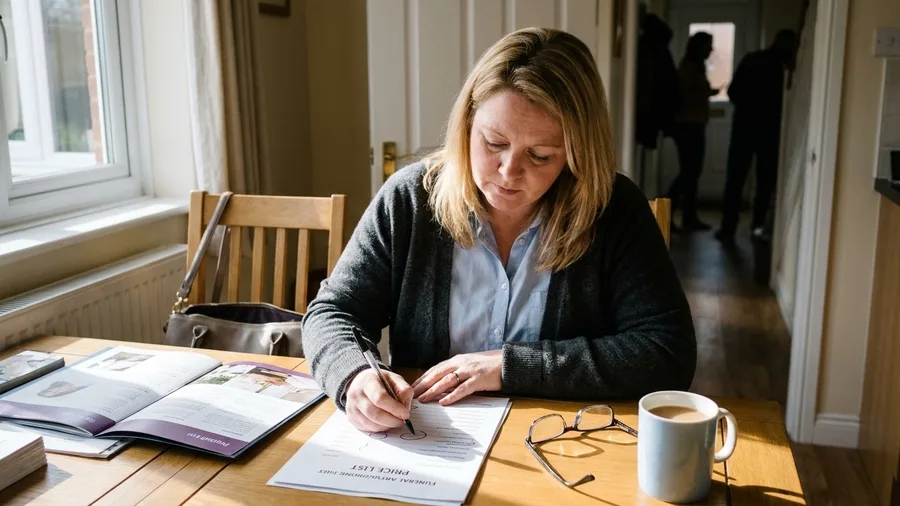
The first arrangement I ever ran alone, I let the family say yes to everything, and I knew better. The casket, the vault, the viewing, the hearse all sat on the page as separate lines above the $3,400 base, and I never asked the one question that would have helped them: what happens if we don't do this?
That question is yours to ask, line by line. Casket, $2,600. Preparation and viewing, $1,800. Hearse and staff, $1,200. Vault, $1,400 on the cemetery side. The honest answer is often 'nothing you'd notice.' I would cut the limousine and the second day of viewing without flinching. I would not cut a viewing for a family who needs to see the person to believe it.
But I have also seen the family who cut it all, the $2,600 direct cremation with no service, standing six months later with nowhere their friends could go. The line to protect is the one where people gather. The rest is a question.
💡 Tip: Ask 'What happens if we don't do this?' for every line item. The answer tells you whether it is required or optional.
What to Cut, What to Keep
Cut without guilt
- The limousine for the family
- The second day of viewing
- The premium casket upgrade
- Printed programs for everyone who might come
Keep if it helps you grieve
- A viewing, if seeing the person helps you believe it
- A service friends can attend
- A graveside moment for the immediate family
- One photograph displayed at the reception
The Week Of and the Months After
The funeral itself is three days. The practical aftermath is a month. The quiet is longer than that. These last three decisions cover the public week, the paperwork nobody thinks about, and the silence that arrives when the cards stop.
None of them belong in the arrangement room. All of them can be planned at the kitchen table.
7. The Obituary Is Written at Midnight by Whoever's Awake

"I'll write it tonight when the house is quiet." That sentence is how most notices begin, and quiet is exactly the problem. The quiet arrives at eleven at night, when whoever is awake is the only person left to do it, with no one to check a spelling.
The task itself is straightforward if the facts are already gathered. The full name and dates, the schools, the jobs, military service, survivors named by relationship, a charity line if the family wants one, and a photograph already scanned and sitting in a folder. What the research on bereavement keeps finding is that grief narrows attention, which is why a family reading the same notice at 1 a.m. misses the name they will later never forgive the paper for.
The paper runs on its own clock, not the family's. In this city the notice cost $180 for the first ten lines and $12 a line after, with a deadline of 4 p.m. two days before it printed. Assign one writer and one proofreader, and call the paper's obituary desk for the current rules rather than trusting a template.
🗓️ The Six-Week Countdown
Before 4 p.m., two days out
Call the newspaper's obituary desk to confirm the deadline and line rate before you write a word.
Day of the funeral
Assign one person to hold the keys and one to handle the pets and the mail.
The first week
Call the landlord, the utility companies, and the post office to put the practical pieces on hold.
Week three
Start the death certificate requests and the account notifications, one call at a time.
Week six
The cards and casseroles stop. This is when the quiet settles and the real grief work begins.
Month four
The hardest month for many families. Have the grief group or the standing call already in place.
8. The Apartment, the Car and the Dog Need a Plan

The usual advice is to focus on the funeral and let the rest sort itself out later. I have watched that advice cost families a week of their lives.
While the notice runs and the service happens, the apartment keeps needing rent. The dog still needs feeding at six. The mail piles up, the fridge holds food nobody will eat, the lease has a signature date and the utilities are in a dead person's name. Families who split that list before the funeral had the dog with a neighbor and the mail on hold by Tuesday. Families who did not were still on the phone about the refrigerator door seven days later.
The list is short enough to fit on one page, under the funeral wishes: who calls the landlord, who handles the utility accounts, who takes the mail, who deals with the car, who takes the animal, who holds the keys. One name against each, written down while everyone is in the room. What can wait is the clothes, the photographs, the letters. What cannot wait is the fridge, the rent, the animal and the post.
For what may be sold, given away or released, call the county probate court or an estate lawyer before anyone starts handing out belongings at the reception. That question asked early costs a phone call. Asked later, it costs a family argument in a driveway.
💡 Tip: Assign one name per practical item before the funeral. The fridge, the rent, the pet, and the mail cannot wait for the estate.
The Practical Week at a Glance
🏠 Landlord
Ask about lease break fee and key return
🐕 Pet
Collar, leash, food, vet records to the feeder
Forward to the executor, not just hold
🔑 Keys
Spare set to the probate lawyer
🚗 Car
Get the title from the safe deposit box first
The rule
Each name gets a phone number and a deadline next to it. A name alone stalls by Thursday.
9. The Hardest Month Is the Fourth One

"Everyone said to call if I needed anything. Nobody called after the first month." A daughter said that to me at the door, four months after her mother's funeral, and I have heard the same sentence in different words many times since.
The pattern is consistent. Three days of decisions and people, then cards and casseroles that stop about six weeks in. That is when I heard from the families who had something already lined up, and by the fourth month the quiet is settled. The practical week can be planned. The silence that follows it can be planned too, and most families do not.
What worked: before the funeral, not after, one recurring appointment and the name of a counselor on paper. A grief group that meets Tuesdays, a standing walk with a neighbor, a monthly call with a cousin. Call the local hospice and ask whether its bereavement group is open to the community. Check what the county offers. Do it while everyone is still in the room.
Not everyone needs a group. Some people do best with one friend who keeps calling in month four, and the family should work out which of them that is before the casseroles stop.
Frequently Asked Questions
How do I bring up my parent's funeral without sounding morbid or greedy?
Use the exact opener: 'If something happened to you, what would you want us to do?' Ask it at the kitchen table, not in a hospital corridor. Frame it as wanting to follow their wishes, not as wanting their money. If they shut it down, write down what you already know and move to the decision-maker conversation.
Who is supposed to be in charge when there are four siblings and none of us agree?
One person decides, and everyone else gets their say before the arrangement meeting, not during it. Pick the sibling who has actually been in the room for the last twelve months, not the eldest or the one with the strongest opinions. Write the name on the same signed and dated sheet as the funeral wishes.
What paperwork should we gather while my dad can still help us find it?
The will, the deed, vehicle titles, insurance policies, pension and bank account numbers, and the DD-214 if he served. Order ten to twelve certified death certificate copies from the county clerk at $10 each. Keep everything in one fireproof box, not scattered across three houses.
How are we supposed to pay for this before the estate is sorted out?
The funeral bill comes due in days, while the estate can take weeks or months. Set up a small separate savings account in one person's name, earmarked in writing, holding roughly the cost of the arrangement. If there is no spare cash, ask the funeral home about payment terms before the death, not in the middle of it.
What goes in an obituary, who writes it, and what does it cost?
The full name and dates, schools, jobs, military service, survivors by relationship, a charity line if wanted, and one scanned photograph. In this example the local paper charged $180 for the first ten lines and $12 a line after, with a 4 p.m. deadline two days before it runs. Assign one writer and one proofreader who is not the writer.
Why did it get worse after everyone went home?
Cards and casseroles stop about six weeks in. By the fourth month the quiet is settled, and that is when the real grief work begins for many people. Set up one recurring appointment, a grief group or a standing call, before the funeral, and ask the local hospice whether its bereavement group is open to the community.
The First Move for Where You Stand Today
The goal was never a perfect funeral. It is a set of decisions already made, so grief does not have to double as procurement in a room with a price list.
If your parent is alive and healthy, your first move is the kitchen-table question. Ask it this week, then book the 90-minute preplanning appointment and leave with a written price list in hand. If a death looks close, your first move is the document and account list and the named decision-maker, written down and signed while everyone can still sign it.
If the death has already happened, call the newspaper's obituary desk before 4 p.m. and circle a date at the six-week mark on the calendar. That sheet from the kitchen table is what your family carries into the room with the price list, instead of a guess.
Pick Your First Move
Find your situation above and do the one thing listed for it this week. One conversation, one signed sheet, or one phone call before 4 p.m.

