

One woman moves her mother's linens into a one-bedroom apartment and steps around the boxes for a year. The other lets them go in the first week, cries once at the counter, and is done. Same packing tape, same rooms. Very different mornings afterward.
I'm 73, a retired schoolteacher in Eugene, Oregon. I lived 31 years in a 2,100-square-foot house and now live in a 640-square-foot one-bedroom apartment. Over 11 weeks, two 3-hour sessions a week, I gave away, sold, or donated about 80 percent of what was in that house. No storage unit.
The first thing I did was stand in the kitchen holding my mother's china service for 12 and cry, and not one box had left the house yet. I assumed the giveaway would be a verdict on my life, and I clicked on articles like this one hoping somebody would tell me whether it would feel like freedom or like erasing myself.
Here is what was true. The guilt came weeks before any lightness, and it attached almost entirely to inherited things, not the sofa or the dining table. The relief came in week 8, in a kitchen drawer holding only 3 mugs.
The order was not the one I'd have scheduled. And what I was doing, it turned out, was trading, not deciding what my life had been worth. Twelve boxes stayed, one bed, one chair, one set of dishes. The person who filled that house is still here, using the 3 mugs.
By the end you can tell which pangs last days from which last because they are the only object left from a dead parent, which stalled decisions can sit in a labeled 30-day maybe box, and which single move makes the rest of the house easier. The sequence is predictable. It is just out of order, and knowing that lets you start this weekend instead of waiting to feel ready.
Quick Tips Before You Start
Book the pickup first
Schedule a donation pickup for a date 8-10 weeks out before you've sorted a single drawer. The truck is your deadline.
Label one 'maybe' box
Tape it shut for 30 days. Anything you don't retrieve by then goes on the next truck.
Photograph before letting go
A phone photo of the mug, the quilt, the kids' art keeps the memory without the shelf space.
Ask family in writing
Send one message before any visit: 'Tell me what you'd use, not what you think I want you to take.'
Cap each session at 3 hours
Two sessions a week is enough. Decisions made after hour four are usually regretted.
Stop when it stops being a trade
If you're no longer weighing what you gain against what you lose, you're punishing yourself. Quit for the day.
The feelings arrive out of order
You would think the hard part is the sofa. It isn't. The hard part is the week before anything leaves the house, when the guilt arrives ahead of the relief and you start to wonder whether you're doing something wrong.
This first stretch covers the sequence I didn't expect: guilt first and loudest, relief late and quiet, and a phone call to your kids that changes what 'handing down' means.
1. The guilt comes before the relief
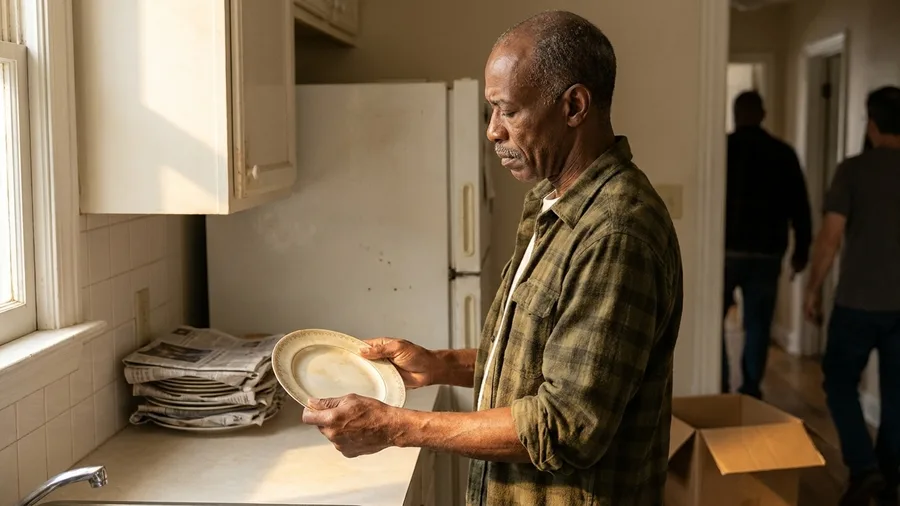
Everyone tells you the hard part is the sorting. It isn't. The hard part is the first Tuesday, standing in your own kitchen holding a china service for twelve, weeping before a single box has gone out the door.
That was week one in the 2,100-square-foot house, and what arrived was not freedom. It was the specific hot shame of a woman who feels she is throwing her mother away. I want to be exact about where it landed, because the geography surprised me. The sofa drew nothing. The dining table, eventually sold for $250, drew nothing. The bookcases I walked past for thirty-one years without a flicker. The grief went straight to the inherited things and the things tied to one person, and the china was both at once, which is why it hit first and hardest.
What I found in that kitchen was a sentence, and I said it out loud to the tile backsplash, feeling ridiculous: "I'm keeping the person, not the plate." It is not a cure. It is a handle. Three of us could say it and mean it; if it sounds like a slogan to you, borrow a different one of your own and say it to the wall anyway.
So I kept two plates from the service for twelve, and the rest went to my niece, who had admired them for years and asked for them plainly. Two plates in a cupboard is not a betrayal. It is a decision that stopped being deferred.
This will not land for everyone, and that is worth saying plainly. Some people feel almost nothing for objects, and if that is you, do not go looking for a pang to perform. The absence of guilt is information, not a character flaw. The guilt is only worth examining when it shows up on its own.
The cost of keeping that china was never shelf space. It was the decision I kept putting off, year after year, and what the letdown bought me was a few days of ache in exchange for a cupboard that finally stopped accusing me every time I opened it.
💡 Tip: If a relative objects to you giving something away, say: 'I'd rather you have it now and use it than inherit it later and store it.' Then hand it over.
⚠️ COMMON MISTAKE
Don't confuse the pang with a warning
The wave of guilt in week one is not a sign you're making a mistake. It's the cost of a decision you've been deferring, arriving all at once. Pay it in days, not months.
2. Relief shows up weeks later
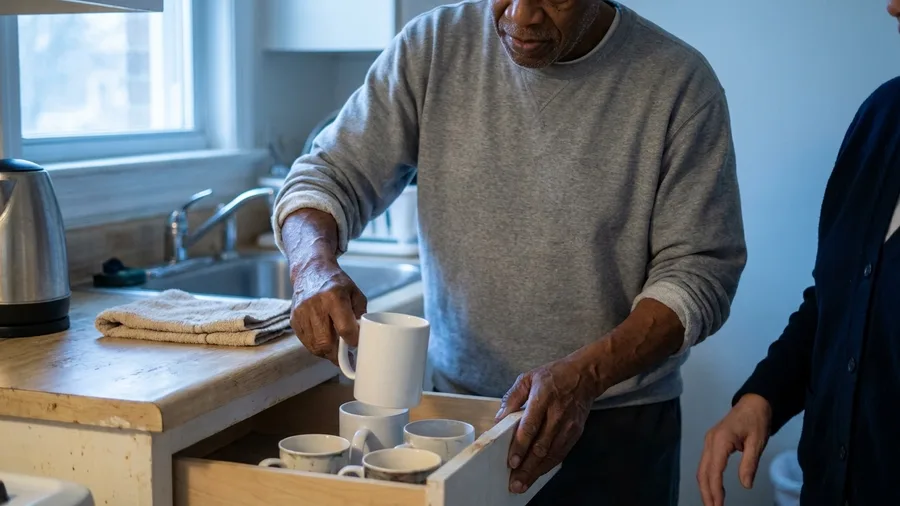
"I'll feel better once it's done." I said that to myself in week one, and week one did not oblige.
The timeline as it actually ran: week one was pure dread. Week three produced the first empty shelf, and I stood looking at the bare wood and felt nothing much either way. Then week eight, a calm morning in the new apartment with no pile to step around, and no ceremony to announce it. That is the answer to the test, by the way. Ask yourself whether the cheerfulness arrives while you are still sorting, or weeks after the box leaves. If it is the first, you are getting the good version early and there is no problem. If it is the second, you are on the ordinary schedule and should stop expecting a finish-line high.
The lift, when it came, was absurdly domestic. I opened a kitchen drawer that held only 3 mugs and felt something I had not felt in months. Not in the sorted garage. Not at the donation center on the day the truck came. That day was mostly anticlimactic, and I went to bed early.
If you are downsizing on a deadline you did not choose, expect to meet the relief as exhaustion first. The body registers the lifting before the mood catches up, and both count.
💡 Tip: The return on letting go is delayed, which is why it feels like a bad trade at the moment of the trade and a good one three weeks later.
| Category | What left | What stayed | Cash or cost |
|---|---|---|---|
| Dining table | Sold | Nothing | $250 |
| Books | Sold to Powell's | A few favorites | $140 |
| China service for 12 | Gave to a niece | 2 plates | $0 |
| Mugs | Donated | 3 mugs | $0 |
| Family photos | Digitized (4,300 images) | 2 paper albums | Time: ~4 weeks |
| Furniture (sofa, bookcases) | Donated | 1 chair | $0 |
| Clothing & linens | 60 boxes/bags donated | Essentials | $0 |
| Total output | ~80% of contents | 12 boxes, 1 bed, 1 chair, 1 set of dishes | No storage unit |
3. Ask before you hand down

Offer the things to your family first, and make it an offer rather than an assumption.
My 4 grandchildren each took 9 items, but only after I asked. One of them said no to the china cabinet outright, and the cabinet went to a niece who had wanted it for years. The message I sent before anyone visited carried the whole thing: "I'm clearing out, tell me what you'd use, not what you think I want you to take." One daughter took 2 small things, not 20. Nobody had to pretend to love a soup tureen, and nobody had to store one in a garage for a decade as a favor to me.
The exception is real, though. Some families do want the heirlooms, and the way to tell is simple. If a child asks for something, give it now and watch them use it rather than promising it later. A thing given as duty costs the receiver storage and a polite lie. A thing given for use is a trade you both win.
The cost of keeping an inherited object was never its shelf space. It was a decision deferred.
— What I kept repeating at my own kitchen table
The china went to a niece in week one and the cupboard stopped being a daily reminder.
What resists the giveaway
The objects that fought me were not the expensive ones. They were the small, dense ones, the paper, and the closets I circled for months. This stretch is about what actually slowed the 11 weeks down.
Every one of these is a trade between space, time and feeling. Once you weigh them that way, the choices get easier to make.
4. Worthless things are the hardest

You pick up the mug on the way past, and before your hand reaches the bag you've set it back on the counter. It cost $2, thirty years ago, on a wet afternoon on the Oregon coast. The sofa went in an afternoon. The dining table took one phone call and sold for $250.
That mug crossed my kitchen table three separate times in three separate weeks, and it is one of the 3 mugs I use now. Price is a useless sorting tool here, and it misled me for two weeks. I could describe that dining table to you without trying; the mug keeps a Tuesday in 1998 intact, with the rain and the person I was with, and nobody else can picture any of it.
What worked: photograph the thing on the table, front and back, then choose one small item to stand for the whole trip and let the rest leave. If it is the last thing you have that belonged to a parent who has died, the rule does not apply.
The mug's cost in shelf space was nothing. Its cost was decision time, three sessions' worth, and that was the real price I paid.
💡 Tip: Photograph the item, write the memory in two sentences on your phone, then donate it. The story is what you're keeping.
The first move this weekend
I would have saved four weeks if I'd started with the kitchen and the pickup date on the same afternoon.
5. Paper takes longer than furniture

Four weeks. Of the eleven, four went to paper while the furniture cleared in a single weekend. Four thousand three hundred photographs went through the scanner, and two paper albums survived.
Week 6 disappeared into the photo boxes. It ran past both three-hour sessions and had to be made up with a Saturday I had not planned to give. The limit that saved the rest of the schedule was a single box per session, never the file cabinet, so I stood up afterward having decided something instead of sitting down with a shoebox.
If you have a scanner and someone to run it, photo sorting moves fast. Without both, pay a service to digitize, or keep two albums and stop. Paper is where keeping costs pennies and deciding costs everything, which is why it eats weeks and not afternoons.
Before the next truck arrives
-
Book the donation pickup date. Week 10 gave me a fixed finish line.
-
Label one 'maybe' box and tape it shut. Set a 30-day reminder on your phone.
-
Ask family what they'd use, in writing. Send the message before anyone visits.
-
Measure the new rooms. The 640-square-foot apartment told me what furniture could come.
-
Choose one first category. Duplicate kitchen tools, linens, or books.
-
Set the sessions: two 3-hour blocks a week. Anything after hour four is usually regretted.
6. A deadline beats a mood

Put a date on it that is not about your mood. I booked the donation pickup for week 10, gave myself eleven weeks total and two three-hour sessions a week, and I had no storage unit to fall back on.
When week 6 slipped, I added a Saturday. I did not move the date. If you have a move date, use it; if you do not, book a pickup anyway – mine took 60 boxes and bags – and let the truck be the deadline.
The one safeguard: a forced date can push you to dump what you will want. Everything I was unsure of went into a labeled 30-day maybe box, and most of it stayed there.
💡 Tip: A deadline doesn't make the decisions hurt less. It makes them finish.
What a deadline does vs what waiting does
With a date
- Decisions get made in sessions, not seasons.
- The 'maybe' box holds the undecided items for 30 days.
- The 11-week plan stays fixed when a week slips.
- The truck arrives and finishes the job.
Without a date
- The same closet gets opened and closed for months.
- Guilt builds with the piles.
- Guests are warned to step around boxes.
- Nothing leaves until the move is forced.
Who you are afterward
The last stretch is the part nobody warns you about. Once the garage is empty and the apartment is full, you have to find out who's still standing in the smaller rooms.
This is where the furniture turns out to matter less than a recipe box, and where an empty counter starts to feel like room instead of a wound.
7. My kids wanted memories, not furniture

The quiet cost of saving things for your children is that you spend years rehearsing a handoff they never agreed to, and the bill comes due in a single sentence. My daughter looked at the dining table that had sat in the same room for 31 years and said, flat and kind, 'We don't have the space, Mom.' It sold for $250 to a stranger who paid in cash. What one child asked for instead was the recipe box from the same room, a thing worth nothing on paper.
When I asked my four grandchildren first, each took nine items, and the haul leaned toward photographs, small tools, a fishing knife. Nothing that needed a van. They live in 640-square-foot apartments of their own and want the objects with a person inside them, not a price tag.
Ask before you assume the rejection. A silent read of 'they don't want it' is the thing that turns a preference into an insult, and the preference is usually just about space.
The apartment at a glance
🏠 Old house
2,100 sq ft, 31 years
🚪 New apartment
640 sq ft, one bedroom
📦 What moved in
12 boxes, 1 bed, 1 chair, 1 set of dishes
🗓️ First night
End of week 11
📉 Contents given away
About 80%
What I didn't expect
The empty space got used every morning, which is more than I can say for the pang.
8. An empty room can feel like room
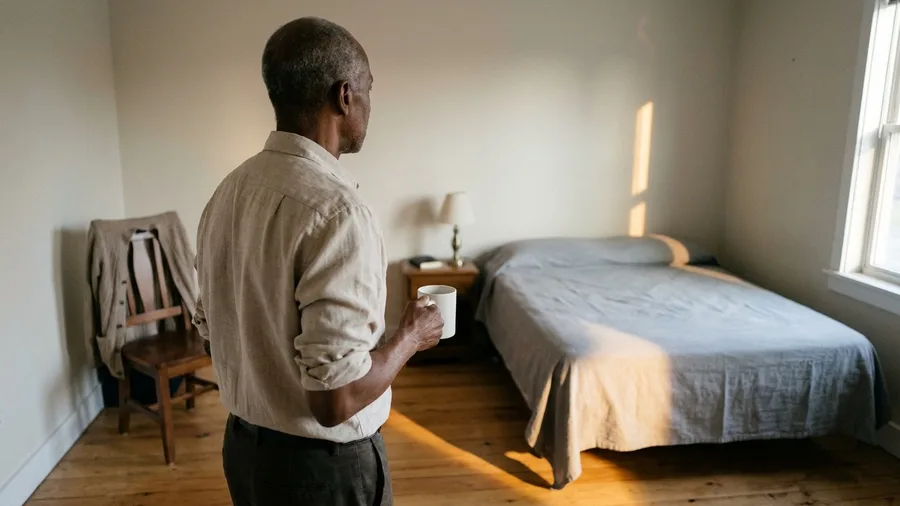
I was braced for the first night to feel like a demotion, and I had rehearsed a version of it in my head for weeks. End of week 11, 640 square feet, one bedroom, after 31 years in 2,100. I unlocked the door expecting the rooms to feel thin.
What was there was 12 boxes, one bed, one chair, one set of dishes, and the rest of the apartment plainly, visibly space.
The moment that undid my worrying came the next morning. Coffee, no piles on the counter, nothing to shift aside to reach the kettle. I stood there with the mug and had nothing to do next, and it turned out nothing to do next was the point.
By week 2 I was sleeping better, which I had not expected and cannot claim I earned through any decision I made. The space was the return on the 80 percent, and it collected every single day, which the pang never did. If you are moving because you have to, or sorting a partner's things, this reads differently, and the first month can be grief with a floor plan. That is not a failure of the method.
💡 Tip: Leave one surface completely empty for the first month — a counter, a shelf. Notice how often you use it.
9. You keep the self you chose

The risk of a smaller place is that you keep what's valuable and let go of what's you, and end up in a tidy apartment that doesn't recognize you. Nine in ten of the objects I let go, I do not miss. What I noticed in the twelve boxes I unpacked is that the survivors were the ones where keeping them and being myself were the same act. I had three mugs, two frying pans, one Dutch oven, two of my mother's china plates – and every one of them was in use inside the first month. None was the most valuable thing I owned.
If I did it again, I'd start in the kitchen and leave the photo albums for later. The kitchen gave me the earliest relief and the surest decisions. I sat at the old table before it left and asked each object one question: 'Will I use this in the next 30 days, or is it here to prove something?' The ones that failed the first test and passed the second were the ones I set on a proof shelf – five objects that still feel like me, kept deliberately and used.
What the field keeps finding, across studies and the people who study possessions, is the same shape in plain language: the objects we cling to as memory tend to comfort us less than we expect, while the ones we use daily tend to comfort us more. The shelf and the drawer do the work.
Everyone else in this house was storage with a story attached. The survivors were the trade where keeping and being yourself matched.
Frequently Asked Questions
How long does it take to downsize a house?
Plan on about 11 weeks for a 2,100-square-foot house if you work two 3-hour sessions a week. Paper is the wildcard — it ate 4 of my 11 weeks. Book the donation pickup for week 10 so the schedule has a fixed end.
What should I keep when moving to a smaller place?
The things you use in the first 30 days, plus a small proof shelf of objects that still feel like you. I kept 3 mugs, 2 frying pans, 1 Dutch oven, 2 china plates, 12 boxes, and 2 photo albums. Everything else went.
Should I ask my children what they want before donating?
Yes, and ask before you offer. Send a message saying 'Tell me what you'd use, not what you think I want you to take.' My grandchildren each took 9 items after being asked first, and one said no to a cabinet that went to a niece.
Why do I feel guilty giving away inherited things?
Because the object carries a person and a relationship, not just a price. The sentence that helped me was 'I'm keeping the person, not the plate.' Keep one small representative item and let the rest go.
What do I do with family photos?
Digitize them if you can afford it, and keep two paper albums. I digitized 4,300 images and kept 2 albums. If scanning isn't possible, pick the albums with people's faces and let landscapes and duplicates go.
How do I start when the whole house feels overwhelming?
Pick one category — duplicate kitchen tools, books, or linens — and give it two hours this weekend. Label a 30-day 'maybe' box for anything undecided, and stop when the decisions stop feeling like trades.
The Two Hours That Start the 11 Weeks
The giveaway was a set of trades, not a verdict. About 80 percent of what filled that house left it, and the person who filled it did not, because she kept the 3 mugs and the 2 china plates and used them. Nothing about the 31 years got smaller.
So pick one category with no guilt on it – duplicate kitchen tools, books, linens – and give it two hours this weekend. Anything that stalls you goes into a labeled 30-day maybe box with the date written on it. Stop for the day when the decisions stop feeling like trades and start feeling like punishment. That line is a signal, not a failure.
The china service for 12 ended up as two plates in a cupboard in a 640-square-foot apartment, used on a Tuesday. My mother was never in the plates. Two hours this weekend, and you will know it too.
Two hours, one category, one box
Pick your least-guilty category and set a timer this weekend. Label a 'maybe' box and mark the date 30 days out. That's the whole first move.

