

Two people hit 40 with the same calendar and the same nothing-hurts-yet feeling. One keeps the midnight email habit and pushes the checkup to next quarter; the other moves the bedtime up half an hour and puts a transfer on payday. Ten years on, the gap between them isn't a dramatic decision. It's a default left running.
This is where time starts to feel faster than the plan. The eight regrets people commonly report about their 40s aren't failures — they're ordinary shortcuts: late nights, skipped checkups, staying for the paycheck, saving later, canceled plans, unspoken needs, obligation-only weeks, an indefinite someday. Each feels efficient now.
The decade's bill arrives through small costs compounding, not one big collapse. So the first move isn't an overhaul. By the end, pick the one regret already charging interest — body, work, relationships, or time — and take one concrete step this week.
Eight regrets, one default to interrupt first.
Quick Tips Before You Start
Pick a Bedtime, Not a Workout
A fixed bedtime is easier to defend than a gym plan and it does more for recovery.
Book the Appointment First
Put one checkup on the calendar before you decide what to ask; the date creates the questions.
Automate One Transfer
A small automatic transfer on payday beats a larger intention that keeps moving to next month.
Send the Direct Invitation
A specific date and place gets a yes; 'we should catch up' gets a reply and nothing else.
Protect One Hour a Week
Treat a low-stakes hobby like a meeting, or it will keep losing to everything else.
Body and Energy
Everything else in this decade runs on capacity: the work, the relationships, the patience for a hard conversation. The first two regrets sit here because the physical defaults are the ones people most often notice too late — not when they change, but when something forces the issue.
The shortcut is always the same: give up the recoverable habit now because the cost is invisible, and let the invisible cost become visible later.
1. Letting Sleep and Movement Slide Until Health Breaks

The regret tends to arrive in a small physical moment, not a diagnosis. You reach the third floor and stop on the landing instead of walking on.
Two habits carry most of the cost when they slide: a bedtime that holds, and a repeatable twenty-minute walk that survives a bad week. The night you push to midnight to clear email and the walk you cancel for a meeting both get filed under productivity. Six months of that and a late night can take the whole weekend to recover from. Energy and recovery budge long before a doctor hands you a result. People already managing a chronic condition or carrying a caregiving load need clinical advice, not a guilt-driven routine.
The lines that keep it in place are short. "I'm off email at 10:30, I'll pick it up in the morning." "Walk at 7:20, back before the call." "That meeting works, but I'm gone by 6."
💡 Tip: Anchor the walk to something you already do at the same time each day — after lunch, before the school pickup — so it borrows the routine instead of competing with it.
2. Skipping Checkups Because Nothing Hurt Yet
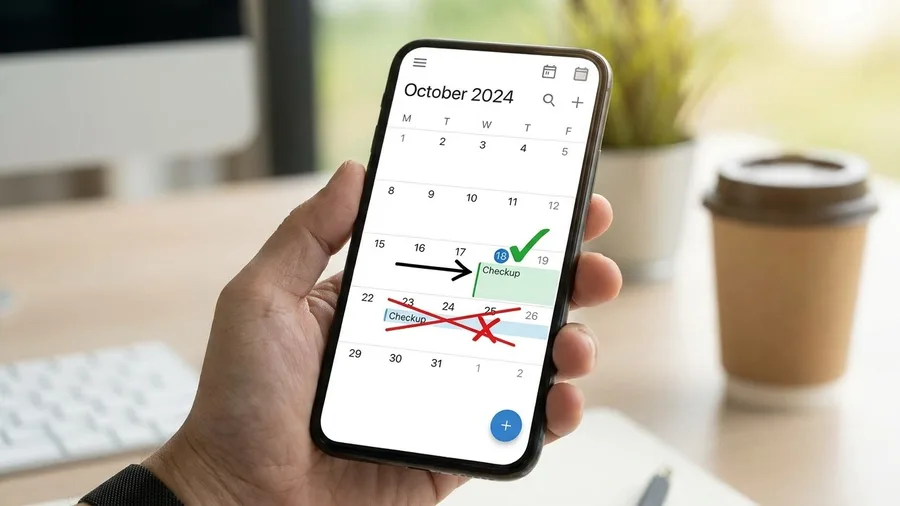
That is the version of the question worth answering, and the honest answer is that you are paying for information while it is still cheap. Screening is not about today's symptoms. It is about the difference between finding something when a clinician has options and finding it when the options have narrowed.
Nobody skips a physical out of laziness. They skip it because the quarter is full and the body is quiet, and a quiet body reads as a green light. A 44-year-old pushes the appointment past a product launch, then past a family visit, and the calendar never offers a natural gap. The appointment stays optional right up until something announces itself, and then it is no longer optional at all.
The efficient-looking trade is one saved afternoon. The cost is the window you gave up, the stretch where a manageable problem could still be handled with a conversation rather than a scramble. That asymmetry is the whole argument: a missed afternoon is refundable, a missed interval is not.
Book one appointment, and when you sit down, ask which screenings fit your history and your family's, because the useful answer is personal and this page is not the place to set medical rules. Official guidance carries the schedules. Your job is only to get in the room and ask.
⚠️ COMMON MISTAKE
Don't Turn Prevention Into a Project
Booking six tests at once is a form of procrastination in a lab coat. One appointment and one honest conversation about family history will tell you more than a stack of unrequested results.
Work and Money
The body regrets are about capacity. The work and money regrets are about the story people tell themselves about time — that the job can change later, that savings can start with the next raise. Both stories assume a decade with fewer competing costs than the one that actually shows up.
The question to hold while reading the next two entries: what does today's reasonable-feeling financial shortcut cost in ten years?
3. Staying in a Hated Job for the Paycheck

The advice I got wrong for years was the tidy version: if the work drains you, leave. It sounds brave and it ignores the mortgage. So a role that pays well and dulls you keeps its grip, and the paycheck is not the problem. The problem is that the paycheck is the only number anyone puts on paper.
People who study career transitions keep landing on the same instruction, and it is unglamorous. Write down three figures before you decide anything: what actually reaches your account, what your fixed costs take, and what sits in a fund you could live on during a move. The resentment is real, and it does not balance a budget.
A 45-year-old did this with a spreadsheet on a Sunday. Eight years in the same seat, benefits solid, take-home $4,800, fixed costs $3,600, transition fund $6,000. The gap was obvious in an hour, and so was the fact that the gap was closing, not open. That is the point of the exercise. You are not deciding to quit. You are finding out how far the door is from where you stand.
The field is consistent about this much: people rarely regret the move they tested, and they describe the decade of staying as the thing that thinned them out. Skills go stale quietly, and a title you have held too long reads as a ceiling to the next hiring manager.
Some readers should not move at all yet, and pretending otherwise would be reckless. If there is no savings buffer, if a visa is tied to the job, if you carry caregiving costs, the first step is an updated resume and one honest conversation, not a resignation letter. Keep the salary. Start pricing the exit.
💡 Tip: Keep a one-page 'exit file' — what you would need to earn, what you would lose in benefits, how many months your fund covers. It turns resentment into a checklist.
4. Assuming Saving Could Start Later

"I'll start saving after the next raise."
That sentence sounds like a plan. It is usually a way of keeping a crowded decade from getting more crowded, and the crowd only thickens. The raise arrives and the rent adjusts to it, school costs step in, a parent needs help, and the start date moves another year down the road. A 41-year-old sets the date for spring, then spring brings a bigger apartment and a tuition bill, and the money that was meant to become savings has already been spent on the life it was supposed to fund.
What changes the arithmetic is size, not resolve. An automatic transfer on payday, small enough that a normal month survives it, runs whether or not the intention holds. One yearly look adjusts the amount. If you already have an emergency fund and a retirement plan, you may be ahead of this; confirm it with a fiduciary adviser instead of copying a number from anyone.
Later feels free because nothing is due yet. The cost is the one thing a raise cannot buy back: the compounding years themselves, which intention can never recover once they pass.
Later vs. Payday
The 'Later' Plan
- Moved by every new bill
- Depends on a good month
- Rests on intention alone
- No fixed date, no amount
The Payday Plan
- Leaves on payday, before spending
- Set below what a tight month allows
- One number, one transfer, no decision
- Raise the amount each January
People and Repair
The first four regrets are about what you do. These two are about who is still around when you look up — and the repairs that get harder every year they are left alone.
The pattern is the same. Nothing collapses. A reply goes unsent, a dinner is canceled, a conversation is postponed, and then one day the silence has become the relationship.
5. Letting Friendships Shrink to Logistics

Close friendships rarely end in a fight. They thin out through the text you meant to answer, the dinner you canceled twice, until the only contact left is a birthday message and a thumbs-up.
The shortcut is small and reasonable each time: not replying tonight, because work ran late. The later bill is a smaller circle to call in a bad week, and a narrower sense of who you are outside your calendar. Money protects options; friendship is what makes the options worth having.
The repair is repeatable. One standing plan, one direct invitation, and a line that names the gap once without over-apologizing: "I've been bad at keeping up; I'd like to see you, coffee on the 12th?" A monthly walk does more than a reunion. If your circle is small and satisfying, this is maintenance, not expansion.
💡 Tip: Put the recurring plan in both calendars before you leave the first one. The second one is the one that tests whether it is real.
6. Putting Off Hard Conversations Until They Were Too Late

You are on the phone with the hospital, and your sibling is asking who is taking the discharge day. You have meant to raise this with them for two years, and now the question is being decided in fifteen minutes on a call.
That is what unspoken things come to. A hard conversation postponed feels like keeping the peace, but it reads differently from the other side: the subject is treated as not worth a calendar slot. Assumptions harden, and the check-in you kept meaning to have becomes a hospital negotiation, the apology you owed becomes a eulogy.
The fix is not courage, it's scheduling. Name the subject plainly and ask for a time: "I want to talk about Dad's care; can we set 30 minutes Sunday?" That names nothing as an ambush. Where abuse or danger is present, no regret outranks safety.
The Hard Conversation — At a Glance
🔄 Where it usually stalls
Both parties wait for the other to raise it first
✋ Who opens
The one who noticed the silence — that is the whole qualification
📅 The two-year tell
If you have rehearsed it in the shower, it is already overdue
🛑 What scheduling will not fix
A conversation the other person has refused three times is a boundary, not a calendar gap
The order that matters
Pick the conversation you have postponed longest. It is the one costing the most in assumptions, and the one that gets easier once the first is done.
Time and Identity
The last two regrets are about the part of life that does not show up in a checkup or a bank statement: the things you do because you enjoy them, and the risks you keep postponing because the calendar is full.
Both feel optional right up until the decade is over.
7. Treating Play as Childish and Optional

The usual advice is to treat the hobby as a reward you earn after the obligations are done. That arrangement has a flaw: the obligations never finish, so the reward never arrives. A life organized entirely around what is owed does not just get narrower, it turns rest into another item with a deadline, and the thing that used to restore attention starts to feel like a task you are failing.
There is a real difference between scrolling and play. At 11 p.m., a 43-year-old is on the phone in bed, thumb moving, not enjoying any of it, and wakes up more tired than the night before. A Sunday hour of drawing with nothing to show for it, no audience, no output target, leaves attention less depleted than it started.
So the experiment is one hour this week, low stakes, chosen for its own sake, and protected like a meeting. For overextended caregivers and workers, the first step is permission to rest, not another performance goal to hit.
Is Play Actually Working?
8. Postponing the Trip or Business Indefinitely

The quiet cost of someday is that the calendar keeps choosing for you, and the bill comes as a decade of dates that were never quite right. A 44-year-old keeps a saved 10-day itinerary open in a browser tab; every year work takes those weeks first. The money stayed in the account. The trip never happened.
It is worth naming what keeps sliding. Money, timing, fear, or other people's expectations, and each one has a way of sounding like a reason when it is really a habit. The regret at the end of this is almost never about trying something and failing. It is about the version that was never attempted.
The smallest test version is the way through: a short trip within driving distance instead of the 10-day one, a side project, one paying customer before a full leap. Guardrails go up before the first dollar or booking, so the leap has an emergency fund, a caregiving plan, and a bailout rule set in advance.
Anyone without those three things is not ready to leap, and the test version comes first anyway, because it is how you find out whether the thing is worth the leap.
💡 Tip: Put the test version on the calendar within 30 days. A short trip takes a weekend; a full one takes a year to plan and a decade to postpone.
🗓️ From Someday to This Week
Pick the one that keeps recurring
If the same thing has surfaced in three separate conversations over the past year, it is the one. Start there, not with the easiest.
Rank the reason from 1 to 4
Score money, timing, fear, and other people's expectations. Whatever scores highest is the real blocker; the others are noise.
Name the bailout rule in writing
Decide now what counts as a stop: a set dollar amount lost, a set number of months, a specific signal. Write it before you start.
Make the test finishable in 90 days
If the test version cannot be completed within a quarter, it is too big. Cut it again until it can.
Book the date before you feel ready
You will not feel ready. Put the date in the calendar within the week, and tell the person who will ask you about it.
Frequently Asked Questions
What is the biggest regret people have about their 40s?
The most common answers cluster around body and energy — letting sleep and movement slide until something forces the issue — because those habits set the capacity for everything else. The second cluster is prevention, followed by work and money. No single regret dominates; the pattern is that each one is an ordinary default that felt reasonable at the time.
How do I know which one to fix first?
Pick the area under the most current pressure. If you are waking up tired, start with the bedtime and the walk. If the job is making you dread Sundays, run the financial stress test. If you cannot remember the last time you saw a close friend, send one direct invitation. The smallest concrete step in the area that is already hurting.
Is it too late to change career at 45?
No, but the order matters. Run the numbers first — take-home pay, fixed costs, and how many months your transition fund would cover. That tells you whether you can move now or need to build a cushion first. The first move is usually a conversation with a manager or an updated resume, not a resignation.
How do I make a savings habit stick?
Automate a small transfer on payday and size it to survive a normal month, not a perfect one. The amount matters less than the fact that it starts this month. Then leave it alone and check it once a year rather than adjusting it after every expense.
What if I have already skipped years of checkups?
Book one appointment and ask a clinician which screenings fit your personal and family history. Do not try to catch up on everything at once — that usually leads to another round of postponement. One appointment, a real conversation, and a schedule you can keep.
Is it really a regret if I am happy with the trade-off?
No. Some of these defaults are genuinely fine — a small, satisfying circle of friends does not need expanding, and a job with strong benefits may be the right choice while a caregiving load is high. The point of the list is to interrupt the choices you did not know you were making, not to replace one set of rules with another.
You Do Not Have To Do All Eight
the eight regrets reduce to one decision, and it's which default you interrupt first. Match it to the pressure you already feel. Body pressure means a fixed bedtime or one 20-minute walk plus one checkup on the calendar. Work pressure means a financial stress test or an automatic transfer on payday. Relationship pressure means one recurring plan or one hard conversation. Time pressure means one protected hour of play or the smallest test version of the trip.
You came in with a full calendar and nothing hurting yet. That quiet pressure is the signal a default is running, not a reason to wait for a crisis. Go back to the two people turning 41 in the same month — the difference was never dramatic. It was one deliberate correction made this week, small and named and already scheduled.
Pick One Default to Interrupt This Week
Choose the area that is already hurting, write down the smallest step, and put it on the calendar with a date. One correction beats eight intentions.

