

You are lonely because the closeness in your marriage has quietly been replaced by coordination, self-editing, or an unspoken hurt – not because something is wrong with you, and not because the marriage is fake. Most people assume loneliness inside a decent partnership means a personal defect or a verdict on the whole thing. Usually neither is true.
A Tuesday: one of you gets home late and asks who is picking up the kids. You say you are. There is a nod, the kitchen gets cleaned, the phones come out. The calendar is current, the house runs, and nobody has asked a personal question in days.
That gap is the mechanism. Practical coordination, a self edited for peace, and assumptions nobody has said aloud can produce real loneliness inside a marriage that otherwise works – a pattern rather than a diagnosis of you or the relationship.
By the end you should be able to rank which patterns are probably yours, test the most common one first, and hold one plain conversation this week – while keeping a clear line between under-attunement and fear, control, or a relationship that is already over.
Which Pattern Are You Living In? — At a Glance
📋 Most common
Logistics over closeness
🕳️ Hardest to spot
Self-editing
🤐 Most mistaken for peace
Peacekeeping
🔮 Most mistaken for proof
The silent mind-reading test
🩹 Most likely to resurface
Old, unnamed resentment
Where to start
Test the logistics swap first. It is the most ordinary pattern here, so it is the cheapest one to rule in or out with a single no-agenda evening.
Shared logistics replace the conversations that create closeness

Running a household together takes the conversation it used to hold. The same talk gets used up on pickups, bills, the grocery list, who has the car Thursday, and by the time the calendar closes there is no unstructured hour left for anything interior. The coordination is real and necessary; it just crowds the other thing out.
Picture a Tuesday. The only exchange of the evening is "Can you get the kids?" and "Yeah, I've got them." Then one of you answers an email and the other folds the laundry, and nobody asks how the day went, what was hard, or what either of you has been thinking about. Competent teamwork, both of you pulling. And neither of you has felt interesting to the other since some point you can't name.
That is the swap. Efficiency goes up and being seen goes down, and it happens in decent marriages all the time. Couples who protect a stretch of time with no agenda tend to run the same logistics and still ask the personal questions, because they kept a slot the calendar does not own.
So test it plainly. Put one no-agenda half hour back this week, no kids, no phones, no list. If the loneliness eases in that slot, the logistics-for-closeness swap is the main pattern. If the slot stays empty, or filling it gets punished, the next thing to look at is a different pattern, or a safety question.
You report tasks instead of sharing your inner life

Information can flow all day and the inner life stay unspoken. A logistics check-in asks for status: "Did you pay the bill?" "Did you sort the school form?" A personal check-in asks for the interior: "What scared you today?" One gets answered in a word, the other would take a minute and some nerve, and most couples default to the first without deciding to.
You can be fully briefed on the schedules, the money, the children and still not be known in your fears, your hopes, or the embarrassment you have not told anyone. Being informed and being close are separate columns, and the first one fills up easily.
Here is the sign to look for this week. You can predict exactly what your partner will say, and you cannot say what the words would be like inside them. You know "work was fine" is coming; you could not say what work was like for them, or what it was like for you. The answers have stopped carrying anything a stranger could not already guess.
Volume is not closeness. Ask one personal question this week, the kind with no task attached, and listen to what comes back. If the partner answers beyond status, the door is open. If every answer slides back to logistics, you have found which column the marriage has been keeping.
💡 PRO TIP
Swap the question, not the volume
You do not need more conversation, you need a different kind. Replace one logistics question a day with a personal one — 'what was the hardest part of today' — and let the answer run for two minutes before you solve anything.
Usefulness at home doesn't make you feel known

Being relied on and being known are different needs, and the first is easy to mistake for the second. Being relied on means you handle the school forms, the insurance call, the schedule nobody else will track. Being known means your partner could tell someone what you fear, what you still want, what you have quietly resented for two years.
The reliable one becomes the household's operator, not its confidant. Praise comes for output: "You're so on top of the insurance thing, I'd have lost my mind." And it is genuine. But nobody asked why the call left you shaken for an hour, or why you needed the rest of the afternoon quiet afterward. You covered it, and being covered gets noticed; being shaken does not.
That is how usefulness can make you lonelier. Reliability grows and confiding shrinks, because the job is done well and a well-done job does not ask anything of the person who did it.
Couples who also ask about each other's inner life, not just what got handled, run the same efficient house and stay close in it. So test the question directly: when did your partner last ask about something interior, something not tied to a task? If you cannot remember, the need that goes unmet here is not more usefulness. It is being asked.
A marriage can keep the house meticulous and still run on three of these five.
You edit yourself to prevent conflict and disappear

The mask itself is built gradually, one swallowed sentence at a time. Self-editing is the habit of running every opinion through a filter before you say it: softening a disagreement from "I don't think that's right" to "maybe, I'm not sure," keeping a money worry to yourself, not mentioning the lump you noticed, not admitting you felt lonely in your own living room, not asking for an hour alone or a hand across the table.
The cost is easier to feel than to name. Your partner relates to a tidied version, so the praise lands on someone who is not quite you. "You're so easygoing," they say, and you smile, because you are not easygoing, you swallowed the objection twenty minutes ago, and the compliment drifts past the real self without touching it.
There is a reasonable version of this. In a relationship where a disagreement brings punishment, threats, contempt, or control, keeping the peace is a sensible protection, and the first task there is safety, not better phrasing.
The test is small and honest. Say a real preference, something like "I'd rather not do dinner with your family this Sunday," and watch what comes back. If it can be discussed without withering or a three-day chill, the pattern is fixable. If it is punished, what you have is not a communication problem.
You stop asking for comfort after enough misses

The reaching stops before any deliberate decision to stop, which is what makes it so hard to notice from the inside.
You say you had a hard day and your partner offers a distracted "mm" while scrolling. You mention your worry about your mother's test results and the conversation turns to dinner. You ask to sit together and get "in a minute" that never comes. Two, three of those, and the asking begins to thin, not because you decided closeness was impossible but because it stopped paying out.
Then comes the strange arithmetic. The absence of asking starts to read as the absence of love. Nobody has packed a bag, nobody has left, and yet the silence in the kitchen feels like rejection, because a need you stopped voicing has no way to be answered.
So the quiet is protection, not a verdict. Learning to spot the signs someone is truly lonely can help you tell protective silence from deeper isolation. Make one low-stakes request this week and state it plainly: ten minutes to tell your partner about your day, no fixing, no advice, just listening. The way that request lands tells you whether closeness can reopen. If it is mocked or punished, the next concern is safety, and that is a different conversation.
Peacekeeping vs. Conflict With Repair
Peacekeeping
- The sting is swallowed and replayed alone at midnight
- The evening stays smooth and nobody learns anything
- Hurt accumulates with no outlet and no repair
- Ordinary distance starts to feel like rejection
Conflict with repair
- The sting is named within a day, briefly
- The evening gets bumpy and then settles
- Disagreement ends with a repair, not a punishment
- Distance stays situational instead of loaded
Peacekeeping trades honesty for a quiet, lonely house
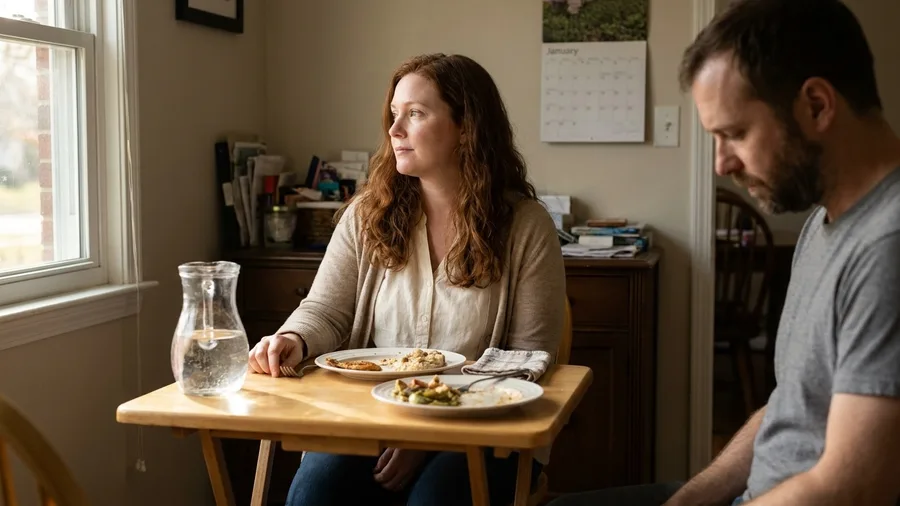
Keeping the peace buys a calm house and keeps the hurt, and the bill comes later. You trade the short argument you never had for the long distance you now live in: no open conflict, but also no repair, and repair is the only thing that restores closeness.
A comment stings, about your job, your body, the way you parent. You say nothing, because saying something would tip the evening into a three-hour silence and neither of you has the energy. So the table gets cleared, the show goes on, and you replay the comment alone at one in the morning.
That is the trade, and it is expensive: the house stays calm, you stay alone, and the hurt piles up until ordinary quiet starts to feel like judgment. For couples who can disagree and then repair without punishing each other, this pattern does not apply, because they have conflict plus repair, not peacekeeping.
So test it. If a disagreement with your partner can end without punishment, peacekeeping is the costly pattern and the fix is small. If disagreement is punished, the calm is a safety strategy, and outside help is the first step.
⚠️ COMMON MISTAKE
Do not lead with the whole decade
Opening with 'we never talk anymore' asks your partner to defend ten years at once, and they will defend instead of listen. Start with one evening, one request, one honest sentence, and let the pattern reveal itself over a few weeks.
Assuming they already know keeps you from saying it

The calm holds because a request never quite becomes sayable: you expect that someone who loves you would have noticed the sigh, not needed it explained.
So the test stays silent. You wait at the counter a beat longer than usual, let the sigh out where it can be heard, drop a hint about the weekend and leave it hanging. Each one is a question you have not asked, and each one gives your partner a chance to answer something they were never told.
When they do not, the failure lands as a verdict. Not "I have not said it yet" but "if this mattered, they would have felt it." That is the leap, and it is made alone, in a kitchen that looks the same from both sides.
Some people do read a room well. A sharp partner catches more sighs than a distracted one. But attunement is not mind-reading, and holding a partner to a standard of perfect reception is a test no one passes for long. Two people with the best intentions still miss what is not placed in front of them.
The plain request is what separates not knowing from not caring, and the two look identical until you say the sentence out loud. Ask, and you find out which one you have. That answer prevents a verdict on the marriage that the silence was writing on its own.
🧭 Naming a Change Before It Becomes Distance
Notice the shift
Name to yourself what has actually changed — a job, a habit, night school, sobriety, a new ambition.
Say it out loud
Tell your partner plainly that something is shifting, before the shift has a chance to look like leaving.
Separate growth from departure
Say the sentence that keeps them from guessing: 'This is not me going. It is me changing, and I want you to know.'
Invite without demanding
Offer a way in — a question, an invitation to join, or simply an offer to hear how it looks from their side.
Decide together what it is
After a real conversation, name whether the difference is shared, tolerated, or a reason to get outside help.
Unnamed different growth rates make partners feel alone

That asking gets harder still when one of you is changing and neither has found words for it. One partner starts night school, or gets sober, or takes the promotion that reshapes the week, and the household absorbs the change without ever discussing it. There you are at the kitchen table with a textbook at ten at night, and your husband registers the closed door but not what is happening behind it. Or you are the one watching your wife come home lit up about a job you do not recognise, and you feel the gap widen without a name to put to it.
The changing person feels unseen, because the new version is not known yet. The partner at home feels left behind, because the shared ground is moving and no one said so.
Distance then reads as abandonment or rejection, when it is really growth that never got spoken. The fix is not to ask for permission or to demand that your partner join you at the same pace. It is to name the shift out loud: this is changing, it is not a leaving, and we need to talk about it. That sentence gives the other person something to hold instead of a closed door.
The test is whether the difference can be named and lived with, or shared, or tolerated, or whether it points toward outside help. Unnamed growth protects a temporary calm and quietly builds drift. Naming it lets the couple decide what the change actually means for them, before the silence decides for them.
A Plain Request, Built in Layers
What to put in the sentence before you say it out loud
The request is the test. The answer tells you which conversation comes next.
Old resentment reframes ordinary distance as rejection
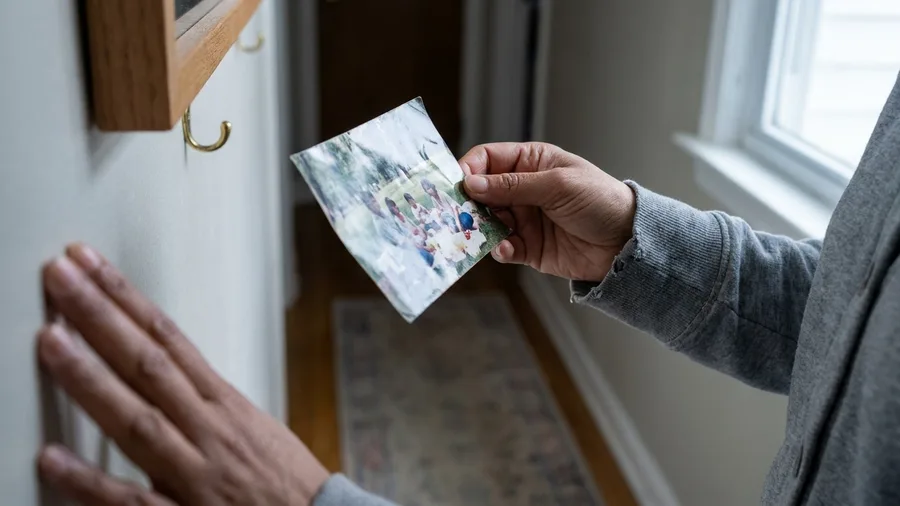
Unnamed change is easier to hear through old hurt, and when an earlier rupture was never resolved, a neutral late night at the office starts arriving as abandonment and a short reply over breakfast reads as contempt. Nothing about the evening changed. What changed is the lens: present distance gets filed as further proof of a verdict reached years ago.
So the two of you argue about tonight's dishes while carrying an older injury that has nothing to do with the dishes. One of you wants the plates dealt with; the other is still responding to the thing that happened before either of you stopped keeping score. The complaint you make at the sink is usually about a wound the schedule cannot touch.
This is not a universal. Couples with no history of rupture feel distance as situational, and it passes with the week. The loaded version only applies where something broke and was never repaired.
The test is to ask whether your reaction matches today's event or an older injury. If it is older, the conversation has to name the history, not just reorganise the calendar. And if current fear or control is woven into that history, safety comes before any conversation about the past, because some injuries are not a misunderstanding to be talked through but a reason to get help outside the house.
🌱 GROWING TIP
Match the conversation to the age of the hurt
A complaint about tonight gets answered with tonight's facts. A reaction that is bigger than the event belongs to an older injury, and it will keep resurfacing until the two of you name the year it started.
Frequently Asked Questions
Is it normal to feel lonely in a good marriage?
Yes. Loneliness in a functioning marriage is common and usually describes a pattern rather than a failing relationship — coordination replacing curious talk, self-editing, or a hurt nobody has named. The question worth asking is which pattern is yours, because each one has a different fix.
How do I tell my husband or wife I feel lonely without starting a fight?
Lead with one specific request instead of a diagnosis of the marriage. 'I want ten minutes tonight to tell you about my day, and I don't want it fixed' is doable. 'We never talk anymore' asks them to defend a decade and usually gets a defense rather than a conversation.
Can a marriage be lonely even when you talk every day?
Absolutely. Volume and closeness run on different channels. Two people can exchange constant information — schedules, money, the children — and never once say what something felt like inside. Being fully informed about someone is not the same as knowing them.
Why did I stop asking my partner for comfort?
Usually because a few early bids went unanswered. A bad day that got no response, a worry that got the subject changed, a request to sit together that got postponed — enough misses and the asking stops on its own. What replaces it is handling things alone, which then reads as distance.
When is loneliness in a marriage a sign of something serious?
When disagreement brings punishment rather than repair — threats, contempt that lasts for days, control over money or movement, or fear about saying the small true things. That is not under-attunement, it is a safety issue, and the first step is outside help rather than better wording.
What is the first conversation I should have?
Put one no-agenda forty-minute slot back in the week and see whether the loneliness eases. If it does, the logistics-for-closeness swap was doing most of the work. If the slot stays empty, moves, or gets filled with a task, the next conversation is about what the empty slot is protecting.
Start With The Logistics Swap Tonight
Rank them the way ordinary married life produces them. Most common is the logistics-for-closeness swap, then self-editing and peacekeeping, then missed bids for comfort, assumed mind-reading, unnamed growth, old resentment. Start at the top, because the swap is both the most frequent and the most reversible.
This week, twenty minutes, phones away, nothing to solve. One question: what has felt hard this week that has not been said? Listen without fixing. Then one plain request for what would help.
Come back to that Tuesday. Same calendar, same kid pickup, and this time one personal question. If the house stays silent, you also know something, and it is not about communication.
Loneliness means the marriage is unsafe or over, not merely under-attuned, when fear, control, contempt, threats, punishment for disagreement, isolation, or a refusal to repair are in the room. Then the next step is safety planning, outside help, or leaving, not better wording. For everyone else: the closeness did not vanish, it was replaced, and the first replacement is yours to undo.
Put the Forty Minutes in the Calendar Tonight
Before you close this page, pick the evening and the slot for one no-agenda conversation this week. If the slot survives, you have your answer; if it does not, you have your next question.