

What do you do when one of you wants nothing from retirement but a slow morning, and the other wants a calendar with things on it? That gap is what this settles. One of you pictures a Tuesday with no alarm and coffee that goes cold on the table. The other is already reaching for errands, a plan, a reason to be out of the house by nine. Both of you call it the same word: retirement together.
The argument underneath is rarely about love or laziness. Paid work anchored different things in each of you, and unpaid care usually anchored more in one. Different social networks came with that, different habits with unstructured time, different histories with money. Those are gendered anchors and an unpaid-labor problem. They can be named, scheduled, and tested. They are not a verdict on whether the two of you work.
By the end you should be able to point to the fault line that runs through your own house, whether it is work and home, caregiving, or money, and walk into the first conversation with a reversible trial in hand rather than a permanent plan.
Quick Tips Before You Start
Name the lost anchor
Before you argue about the schedule, ask which daily anchor each of you is missing: the commute, the title, the caregiving role, the work friendships.
Separate calendars first
Block one recurring morning or afternoon per week that belongs to each partner alone, and treat it as non-negotiable.
Use 'I notice' not 'you always'
Open with what you see and how it lands, not with a character judgment. 'I notice I'm the one planning the week' works better than 'you never plan anything.'
Trial before permanent
Rent before moving, test a budget before cutting work, try a schedule for two weeks before calling it your new life.
Separate fun money
Agree on a shared essentials budget and a monthly no-questions allowance for each of you. It removes the need to justify every pleasure.
Identity and Daily Structure
Retirement does not just change what you do from nine to five. It removes the scaffolding that told each of you who you were and what the day was for. That scaffolding was built differently depending on which of you carried the paid-work identity and which carried the caregiving and household one.
1. Retirement Removes Different Anchors

Because paid work was holding up a different set of things for each of them. For many men it supplies the title, the start time, the reason to be out of the house by 6:40; for many women it is caregiving and running the family calendar that carry identity, and those roles do not clock out at retirement.
So watch what happens on the Monday after. His shift, his workmates, and the small authority of his job title are simply gone, and what surfaces is the loss of identity retirement brings that looks like a mood rather than a loss. Meanwhile the partner who has managed the rota and the birthdays looks around and sees retirement adding another adult to the house, not subtracting one. What reads as rejection may just be grief in a costume.
The pattern is a tendency, not a law; couples who shared both work and care roles, or whose job was never the main source of who they were, tend to feel the shift differently. Before judging the reaction, ask which anchor is being pulled up by the root.
That answer points to a negotiation, not a verdict.
💡 Tip: Ask: 'Which part of your old day do you miss most?' The answer points to the practical negotiation, not to a verdict on the relationship.
2. Work Friendships and Home Friendships Differ

The version I got wrong was assuming the anxious partner was simply clingy and the distant one simply cold. What was actually happening was two social worlds closing at different speeds. Because work and caregiving anchor people differently, the friendships built around those roles differ too, and retirement pulls the plug on one partner's main supply of daily company while leaving the other's largely intact.
Picture it. His coffee-break network ended on the last day; her book club and the neighbor who calls on Sundays carry on as before. He proposes that every errand be run together, and she asks, a little too sharply, for Tuesday alone. Neither is a flaw. Loneliness in him looks like clinginess; crowding in her looks like withdrawal. Both are describing a network, not a personality.
who remembers the birthdays, who arranges the visit, who keeps the calendar. If that load sits with one partner, separate social calendars and a weekly check-in will do more than forcing a joint hobby neither of you wanted.
| Pressure point | One common priority | The other common priority | What helps |
|---|---|---|---|
| Identity anchor | Status and schedule from paid work | Caregiving and home management as identity | Name the lost anchor before judging the reaction |
| Social network | Coworkers as main social contact | Friendships maintained outside work | Separate social calendars and a weekly check-in |
| Time style | Craves open, unstructured days | Needs routine to feel purposeful | A trial week with blocks for shared and separate time |
| Housework | Waits to be asked | Notices and plans the mental load | Written task list with an owner for each task |
| Togetherness | Companionship and shared days | Autonomy and separate mornings | Schedule apart time before resentment does |
| Caregiving | Assumes family will handle it | Already carrying kin-keeping and care | Name unpaid labor, set limits, price outside help |
| Travel planning | Adventure and bucket-list trips | Family connection and everyday stability | One shared trip and one separate trip in year one |
| Money | Savings as security | Retirement as earned freedom | Separate fun money plus a shared essentials budget |
| Risk | Stay put and protect the nest egg | Sell and move closer to family | Rent before moving; test a budget before cutting work |
| Purpose | Permission to rest | Usefulness on an ordinary Wednesday | One shared anchor, one separate pursuit, one review |
3. Unstructured Time Is a Gift or a Threat

The obvious advice for a couple who cannot agree on a Tuesday is to compromise: split the day, meet in the middle. That advice is wrong here, because the two of you are not bargaining over hours.
Once social contact no longer arrives with a workplace, the hours have to be filled by choice, and that is what exposes the real difference. One partner, after decades of schedules, craves an open calendar and slow coffee at 7 a.m.; the other needs a routine to feel purposeful and reaches for a list. The fight lands on breakfast and errands and the TV, but the data underneath it is time style. It is not laziness in one or control in the other; it is how each of you regulates meaning and energy.
So do not argue the hypothetical. Run a trial week instead, with blocks marked for shared time and blocks marked for separate time, and watch what actually happens to each of you when a Tuesday is spent that way. That week tells you more than any conversation about how you imagine you will feel.
💡 Tip: Pick one week and mark three blocks: shared, separate, and open. Compare notes on Friday. The open block tells you which of you can tolerate a blank day.
Two time styles, one Tuesday
How open vs structured days split the same week
4. The House Becomes a Shared Workplace

The standard advice is to divide the chores fairly now that both of you are home. Fair division misses the point, because the argument was never only about who runs the vacuum. Once the rooms are occupied all day, the kitchen counters, the lunch dishes, the unmade bed turn into a running record of who notices and who waits, and the partner who ran that record for years tends to look at retirement and see more unpaid work arriving, not less.
Different standards for cleaning, cooking, and hosting were always there; retirement just stops hiding them behind a commute. You come down at nine and the breakfast things are still out, and the question "are you going to leave that?" lands harder now that neither of you has a train to catch. Say instead: "Let's write down who owns what, starting this week, and I mean owning the noticing, not helping when asked." A task with an owner has no helper waiting to be told. Dishes stack faster now because two people are home; the fight is about the load nobody has named, and naming it out loud is the first line.
⚠️ COMMON MISTAKE
Don't turn the task list into a scoreboard
A written list carries planning and noticing, not just doing. Each task needs an owner, not a helper. If one of you finishes a task and then announces it, the list becomes a tally of who did more. Assign the whole task, including the part where you remember to do it.
Togetherness, Care, and Family
The second cluster of flashpoints is about other people. How much time you spend together, who you care for, and how you show love to family. These are not preferences you can negotiate once and file away. They are daily claims on time and attention.
5. Togetherness Means Different Things

It's Saturday, and you're putting your shoes on for the farmer's market when he says it: "I'll come with you." He means it kindly. He has been waiting all week to be with you. You hear a morning that was going to be yours, a slow hour with no conversation required, and something in your chest tightens before you can stop it, and you say "sure" and mean something else.
That tightening is not a lack of love, which is what worries you at 2 a.m. One of you hears "retirement together" as companionship and open days. The other hears a full calendar of supervision, someone noticing every errand, every phone call, every hour that used to belong to nobody. Both readings are reasonable, and the fight is about the ratio between them, not the feeling underneath.
What each of you is protecting is different, and neither is wrong. He may be protecting connection after a work life that supplied it automatically; she may be protecting a patch of autonomy she has held onto through years of other people's schedules. Loneliness can look like clinginess from the outside; crowding can look like withdrawal. The person who suggests the market may be reaching for the day; the person who hesitates may be reaching for the hour.
So schedule the apart time before resentment does it for you. Two or three usable lines: "I want Tuesdays to be mine until noon, and I want Saturday mornings with you. Can we try that for two weeks and see how it feels?" If you are the one who wants more togetherness, the honest version is: "I miss you during the day. What if we plan one thing a week that's ours, and I find something of my own for the rest?"
Then there is the couple who already live largely separate lives, parallel calendars, different rooms, different friends. The same advice would leave them more separate than they meant to be. Their version is the reverse: one deliberate shared anchor, a standing walk, a Thursday dinner, something on the calendar that neither partner has to be talked into. The ratio matters more than the direction.
The question worth asking each other is not "do you love me" but "what mix of shared and separate time would let you feel close rather than watched?" Every couple has an answer. Finding yours, and writing it down where you can both see it, is the whole negotiation.
💡 Tip: Agree on one shared anchor per week (a walk, a meal, a class) and one separate morning per week. Put both on the same calendar.
6. Caregiving Expectations Follow Them Home
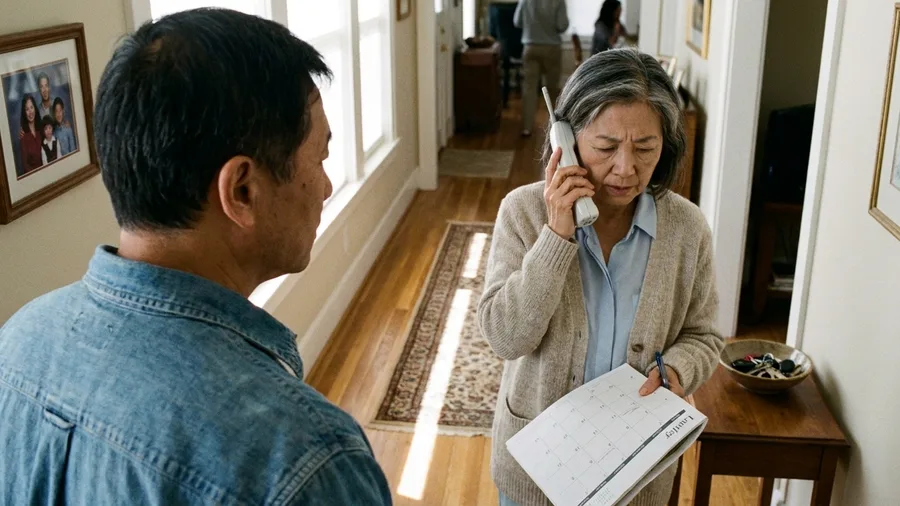
The cost arrives quietly, long before anyone needs a wheelchair: one calendar with a parent's cardiology appointment, a grandchild's school pickup, and a note about who will drive to the pharmacy, all of it sitting on the same person's time. What happens next is not a fight about the calendar. It is a fight about whose hours are assumed to be available, and the assumption usually runs along the same lines it always has: women more often carry the kin-keeping and caregiving expectations, and men more often assume the care will be there without asking who is providing it.
who is already holding the appointments, the birthdays, the pickup times? If the answer is one name, that person is not being dramatic about retirement; they are watching more of the same labor arrive while the other partner imagines the load lifting. If the answer is genuinely both names, you are already the model, and the work is to keep it that way when a crisis comes.
The pattern does not fit every couple, especially those without family care obligations or those who long ago divided the care work evenly. But where one name keeps coming up, the check to run is simple: name the unpaid labor on that calendar, set limits before the crisis sets them for you, and price outside help before you need it. The question to ask each other is plain. Whose time is being assumed?
Two ways to handle the care load
Name and divide it
- Write the owner's name beside each task, not a helper's.
- Cap your hours weekly and say the number out loud.
- Get a quote for home care before the first fall.
- Recheck the split when a parent's needs change.
Assume it will work out
- Wait for a hospital discharge to start the conversation.
- Let 'we'll figure it out' stand in for a name.
- Treat a sibling's promise as a schedule.
- Say yes now and resent it later.
7. One Plans Trips; the Other Plans Family

Two calendars, two browsers, and one word – retirement. One screen stays open on an itinerary with flights and a rental car; the other stays open on the school calendar, pickup times, and the week the grandchildren are out. Both are planning. Only one of them is being counted as planning.
The research on later-life leisure keeps turning up the same split: men more often imagine retirement as a change of scene, women more often imagine it as a continuation of family connection and steady routine. Neither script is the mature one. What differs is what each partner is protecting – novelty and freedom on one side, closeness and usefulness on the other – and both are protecting something real.
The hidden cost is the labor underneath both scripts. Someone compares fares, someone else remembers the recital. When only the itinerary gets called a plan, the family calendar disappears into the background as though it maintained itself. Name the work out loud, because it is the same work that ran the household for years and it did not retire.
In the first year, try one shared trip and one separate trip. The shared one tests whether your ideas of a good day can coexist; the separate one tests whether either of you can leave without guilt and return without accounting for the time. Couples who already plan their trips apart, or who have no interest in travel at all, will find this less useful – for them the same question shows up in a different currency.
Money, Risk, and Purpose
The final cluster is the hardest to talk about because it touches fear. Money fights are rarely about money. They are about security, permission, and what a good life is supposed to look like now that the earned years are over.
8. Security and Fun Money Split

"We finally have money. Why are we fighting about it?" Because the two of you are answering different questions with the same account. One is asking whether we are safe; the other is asking whether we are allowed to enjoy what we saved.
The security fear is often rational, not anxious. A partner who took caregiving breaks, or earned less across thirty years, has watched the balance grow more slowly and knows what a bad year costs. Treat that worry as information, not as a mood to be managed.
Separate fun-money allowances, with a shared essentials budget underneath, take the justification out of every small pleasure. Neither of you has to argue for a purchase the allowance already covers. Tax, claiming, and investment rules belong to the Social Security Administration, a fiduciary adviser, or the plan documents – not to a kitchen-table guess.
💡 Tip: Agree on one number for essentials and one number for each of you to spend without explanation. Revisit it every six months.
9. Risk Tolerance Is Not Just Personality

Two people, one house, and two different pictures of the next ten years: in one, the for-sale sign goes up in spring; in the other, the nest egg stays exactly where it is. Neither is reckless and neither is frozen. They are guarding against opposite failures – running out of money, or running out of good years.
Loss aversion and worries about longevity are shaped by history. Whoever earned more, whoever stepped back to care, whoever handled the accounts – each carries a different sense of how fast the balance can vanish. The same number looks like cushion to one partner and cliff edge to the other.
What separates a workable plan from a standoff is reversibility. Renting near the grandchildren for a month before listing the house costs far less than a sale you both regret. Testing a leaner budget for a season before cutting work tells you more than a spreadsheet argument ever will. Irreversible commitments can wait until a trial has run.
This frame fits least when both partners came to retirement with equal financial history and share every decision – there the disagreement is usually about the numbers themselves, not about what the numbers mean.
🧭 How to negotiate the purpose fight in four moves
Name the ordinary Wednesday
Each partner says aloud what would make them feel useful on a plain midweek day, not on a holiday.
Pick one shared anchor
Choose a single recurring activity you both protect, whether that is a walk, a meal, or a class.
Pick one separate pursuit
Each partner names one thing they do without the other, and the calendar makes room for it.
Schedule the review
Put a 30-minute check-in on the calendar every three months to adjust what is not working.
10. Purpose Is the Real Negotiation

Strip the trips, the chores, the money, and the fights underneath them are about purpose, status, and who is allowed to rest. The dishwasher argument is rarely about the dishwasher. It is a debate about whether one day matters and whether being idle is permitted. When one partner loads the plates and the other waits to be asked, the silence holds a question neither has said out loud: is my time worth something if nobody is paying for it?
What gets quietly spent here is the first year. A couple can negotiate every calendar and allowance, sign the budget, agree the tasks, and still find that Wednesday morning arrives and neither can say what it was for. The cost shows up in months, not moments, and it bills the person who cannot name a use for the day and the person who feels watched while they try to find one.
Each partner needs to say what would make an ordinary Wednesday feel useful. Not the whole retirement, not the trip they hope to take; one day, one subject, one honest answer. For one, it is being needed. For the other, it is being left alone. Both can be true in the same house and neither invalidates the other. What stays hidden is the permission. One partner waits for the other to grant it, and the other has no idea the question was asked.
The fix that fits purpose is different from the fix for money or tasks, because there is nothing to divide. Try one shared anchor, one separate pursuit, and one recurring review. The shared anchor could be a walk each morning, a joint project, a weekly meal that matters. The separate pursuit belongs to one person and the other does not supervise it. The review is short: every month, two questions, what worked and what did not, then change one thing.
The point is not to build the permanent plan now. The first conversation does the work. Each names one anchor being lost, one thing that would make Wednesday useful, and one reversible trial to run for one week. No permanent move, no budget cut, no care commitment before the review. The purpose does not have to be settled before the trial. It only has to be named.
Frequently Asked Questions
Why does retirement feel like a loss to one of us and a release to the other?
Because paid work and unpaid care anchor different things. For many men, work supplies status, schedule, and a social network; for many women, caregiving and home management supply identity. Retirement removes those anchors in different ways, so the same last day can feel like freedom to one partner and grief to the other. The reaction is not a verdict on the relationship; it is a signal about which anchor is being lost.
How do we handle the housework now that we are both home?
Write down every recurring task and assign an owner to each one, not a helper. Include the planning and noticing part, not just the doing. If one partner has been carrying the mental load for years, the goal is to redistribute the whole task, not to add another layer of supervision. A written list discussed in a weekly check-in works better than hints.
What if one of us wants to travel and the other wants to stay near family?
Treat it as two legitimate planning styles, not a compatibility crisis. Pick one shared trip and one separate trip for the first year, and let the experiences give you data. Count the planning labor for both scripts. If the travel partner is doing all the research and the family partner is doing all the kin-keeping, the real conversation is about redistribution, not destinations.
How do we talk about money without it turning into a fight?
Separate the shared essentials budget from each partner's fun money, and give each person a monthly allowance they do not have to justify. Keep tax, claiming, and investment questions with official sources like the Social Security Administration or a fiduciary adviser. The kitchen-table conversation should be about values and fears, not about rules you are not qualified to settle.
What is a reversible trial, and why does it matter?
A reversible trial is a small test of a big decision: renting in a new town before listing the house, trying a schedule for two weeks before making it permanent, or testing a budget before cutting work. Trials shrink the argument to something you can actually evaluate. They also protect both partners from committing to an irreversible change before they have real information.
Which Fault Line Is Yours, and What to Do First
If one of you is anchored to work and the other to home, run a trial schedule before any permanent decision: two weeks with a shared morning, a separate afternoon, and one deliberate evening together. If caregiving is your fault line, write the tasks down, assign owners, set limits, and price outside help before a crisis prices it for you. If money is the flashpoint, separate the fun money and check the claiming rules with the Social Security Administration or a fiduciary adviser instead of guessing at the kitchen table.
Now go back to that Tuesday. The slow morning and the calendar are not evidence that you want incompatible lives. They are one of you signalling an anchor to protect and the other signalling a time style that keeps the day useful. Same facts, and now they point at a negotiation.
This week, sit down for twenty minutes. Each of you names one anchor you are afraid of losing, one thing that would make an ordinary Wednesday feel worth getting up for, and one reversible trial to run for a week. No permanent move, no budget cut, no care commitment before you sit down again and review it. The Tuesday you were both picturing is not the problem. It is the first thing to put on the table.
Name Your Anchor Before You Plan the Trip
Look back at item 1 and answer the one question it asks. Then put a twenty-minute conversation on the calendar for this week. That is the only first step that makes the other nine possible.