

The pill cup goes down on the tray at 7:40 on a Tuesday night with one aide covering twenty rooms, and that is the building. Not the chafing dishes at two in the afternoon. I moved in at 82, three days after a fall left my daughter a hospital discharge date and nowhere to put me, and she picked the place that answered the phone on a holiday weekend. Two years later I know better.
The tour is not the building. The rent you are quoted is not the bill. At seven in the evening, with two aides on the floor, you see what you are actually buying. Nine things follow, and only four of them change which building gets signed. The other five decide how the first month, the guilt, the room and the visits get lived once you are inside.
So this is what I would tell a family sitting where mine sat: tour at six on a weekday, ask for the a la carte sheet, the year-two increase and the aide tenure, and then put two buildings side by side on total cost rather than rent.
Quick Tips Before You Start
Tour Twice, Unannounced
Book the 2 p.m. tour, then come back at 6 p.m. on a weekday without calling ahead.
Ask for A La Carte
Demand the add-on price sheet and the year-two increase in writing before you compare two buildings.
Time a Call Light
Find a lit call light in the hallway and clock how long until someone answers it.
Ask Aide Tenure
Ask how long the aides on that specific hall have worked there — not the whole building.
Start a Year Early
Tour three buildings while nothing is wrong, so the fall never picks for you.
Before You Sign

Two of the nine happen before a single box is packed, and they are the two that decide which building you sign for. Everything after them is about how the life inside gets lived.
Get these two wrong and no amount of Wednesday visits fixes it.
1. The Tour Shows the Building at Its Best

Two o'clock on a Tuesday, and the dining room smells like lemon polish. The activities calendar on the wall has a full month of squares and not one of them crossed out, which tells you the calendar is a wish, not a record. Aides stand a little straighter when the marketing woman walks through with you and your mother.
So you come back. Six o'clock on an ordinary weekday, no call ahead, and you sit in the lobby like a visitor who forgot something. Then again after seven, when the building goes quiet and you can hear how thin the coverage really is. Where I live, the night floor drops to two aides for the whole place once the sun is down, and that is not a scandal, that is just the shift.
Then do the hallway test. Find a lit call light, start the timer on your phone, and see how long it burns before a person walks in. Do it twice, in two different halls. Whatever the tour said about staffing, the stopwatch is the answer, and the answer is the thing you are actually signing.
💡 Tip: Bring a stopwatch, literal or on your phone. "How fast do call lights get answered?" gets a brochure answer. A stopwatch gets a number.
| Line item | Cost | What it buys |
|---|---|---|
| Base rent, one-bedroom, 12-month lease | $4,850 / month | Room, three meals daily, weekly housekeeping, laundry twice a week, Tuesday and Thursday bus |
| Medication management | $300 / month | Pills set up and handed out on schedule |
| Doctor's appointment escort | $22 each | Someone rides with you and waits |
| Guest meal | $12 each | My daughter's dinner when she visits Wednesday |
| Pet fee, one time | $250 | The right to keep a cat here |
| Year-two renewal | +4% | The same room, the same schedule, more money |
2. The Rent You're Quoted Is Only the Floor

Everybody tells you to find the lowest rent. That advice will cost you money. The number on the brochure is not a price, it is the bottom of a price, and the add-ons stack on top of it in ways nobody reads aloud on the tour.
My one-bedroom quotes at $4,850 on a year's lease, and that covers the room, three meals, housekeeping once a week, laundry twice, and the Tuesday and Thursday bus. Medication management is billed separately at $300 a month. A driver to a doctor's visit runs $22 a trip, a guest at your table $12 a plate, a cat $250 once. A normal month here lands about $400 past the quote, and my renewal came in 4% higher in year two.
So compare two buildings on rent plus a typical month of extras, never on rent alone. The cheaper quote can lose to the add-on sheet before you finish the arithmetic.
What It's Really Like Inside

The next three things are not signing criteria. They are what the first year feels like, and they matter because a building that is right on paper can still be lonely, understaffed at the hands-on level, and heavy with guilt nobody has said out loud.
Read these to know what to do in the first month, not to decide which building wins.
3. The First Month Is Lonelier Than Anyone Warns

You are sitting at a table in the dining room, tray in front of you, and everyone around you already knows where to sit. That is your mother in week one, and nothing is wrong. The first six weeks are the hard stretch. New residents eat alone at first even when the food is good and the staff are kind, because eating alone is what being new looks like.
The residents who settle all do the same thing: within that first month they claim one recurring spot – the same table, the same chair by the window at 10 a.m., the same card game on Thursday. Your job is not to fill her calendar. Make one introduction, to one resident or one aide, and leave the room. The connection has to be hers, not yours.
So at about week six, ask her the only question worth asking: which hour of the day is empty? Solve that hour and leave the rest alone. The cost sheet tells you what the building charges. This is the part the bill cannot buy – company, a routine, a claimed chair – and it is work you do after the choice is made, not a reason to pick a different building.
🌱 GROWING TIP
The One Recurring Thing
Ask the activities director which standing events run at the same time every week — a card game, a coffee hour, a walking group. Pick one and put it on the wall calendar before move-in week. One recurring thing beats a full schedule.
4. Aides Who Stay Two Years Beat Any Chandelier

"The chandelier in the lobby is gorgeous," my daughter said on the drive home from the first tour, and I told her I had not noticed it once in two years. What I noticed, from the first week, was whether the woman who helped me to the bathroom at night was the same woman who had helped me the week before.
Loneliness thins out when a face repeats. Ask the activities director on the tour, plainly, how long the aides assigned to the hall you are looking at have actually worked in this building, and watch whether the answer comes quickly. At my end of the hall the longest-serving aide has been here three years, and she is regarded as ancient. The two women in that slot before her lasted seven months and five months.
Every departure costs something a brochure cannot show: the new aide learns my gait, my hearing, which side I get up on, and for a few weeks the signals get missed. A hall that keeps people long enough to learn those things is a different hall from one where the names on the schedule change every season.
Ask, too, whether aides are fixed to one hall or rotate through the building. A fixed assignment is how someone learns that I always take the left side of the bed, and that I will not ask for help until I have tried twice on my own. That knowledge does not hang from a light fixture. It walks into the room.
The bistro and the chandelier never answered a call light. The person who knows my name did, and she had to be here long enough to learn it.
💡 Tip: Ask the question twice, once at the front desk and once to an aide in the hall. Compare the two answers.
5. The Guilt Belongs to You, Not to Her

I got this wrong in the way most parents do. I spent the first weeks after the move telling my daughter I was fine, which was true and also useless, because it answered a question she was not asking. What she was carrying had nothing to do with whether I was fine.
The night the decision was made, I felt relief. Real relief, the kind that let me sleep without listening for the phone. That relief belonged to me. The guilt arrived for my daughter and, two years on, has not entirely left her.
Name the relief out loud, because it is honest and it steadies everyone: company at every meal, someone counting the pills, no stairs, nobody alone on the floor after a fall. Then say the other half, the part that is harder. If a parent is still driving and cooking Sunday dinner and keeping a garden, that parent is trading a life for a schedule and will say so, often and at volume.
The question that helped us was not whether she was doing the right thing. It was smaller and answerable. Which parts of my week did I want help with, and which parts did I want to keep doing badly on my own? I still make my own coffee. I still choose my own clothes and get them wrong. Those small stubbornnesses are mine, and naming them gave her something to protect rather than something to fix.
The guilt is not a signal that the building was wrong. It is the emotional work that follows a decision, and separating the two is what let her visit me as a daughter instead of auditing the place like an inspector.
What a parent needs from an adult child in those months is not reassurance that the choice was correct. It is permission to stop grading it.
Where the Guilt Actually Comes From
What the relief and the guilt are each made of
Moving Day and the Visits After
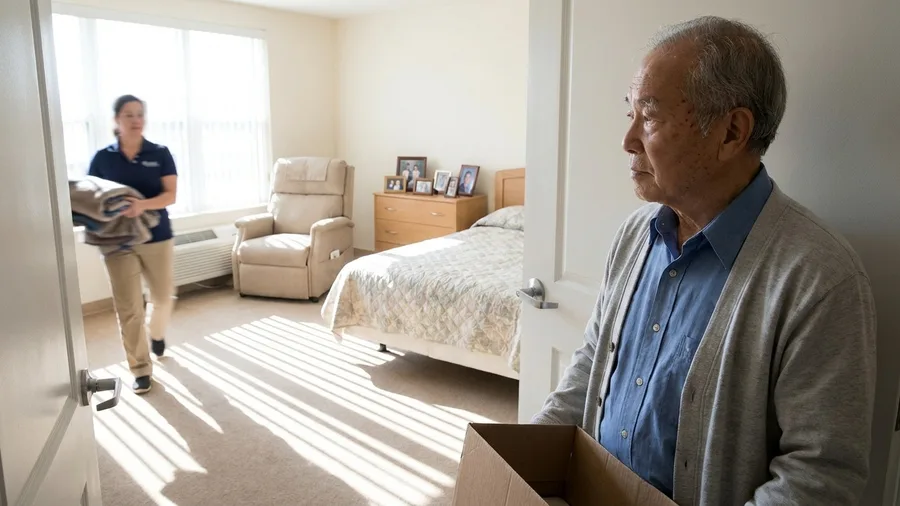
What you bring, how often you come, and how you treat the people who work here — this is the part that happens after the lease is signed, and it decides how the two years feel.
None of it changes which building wins. All of it changes the life inside it.
6. The Storage Unit Costs More Than the Recliner

Start with what the storage unit costs, because that number is the one nobody puts on the comparison sheet. Mine ran eighty-five dollars a month for the fourteen months it took me to empty it, which comes to $1,190, and every box I carried out had been packed by a version of me who thought he would come back for it.
What actually made the room mine was smaller than the house: my own queen bed, the lift recliner I sit in, six framed photos on the wall where I can see them from that chair, and a small bookcase. Everything else was me downsizing, not decorating.
There is a pattern here that anyone who has moved a parent will recognize. The things people keep in storage are almost never the things they later miss, and the boxes tend to sit because opening them means making the decision a second time. Storage is not a plan. It is a bill for postponing one.
So bring the bed you actually sleep in and the chair you actually sit in, whatever the room measurements say. Buy the rest to fit the room rather than the house it came from. And notice that none of this changes which building you sign. It is the work of the weeks after, and it decides whether the place you chose feels like a room or like yours.
💡 Tip: Set a storage deadline before move-in: 90 days, written on the calendar. Anything still in the unit on day 91 gets donated.
7. Short, Boring Visits Beat Sunday Marathons

Visits work better small. Twenty minutes on a Wednesday does more than three hours on a Sunday, and the shorter one is the harder habit to build.
My daughter lives 40 minutes away and comes most Wednesday evenings. She arrives around six, eats whatever the dining room is serving, and is back in her car by seven fifteen. That is the whole visit. Sunday at two, by contrast, is the worst slot in the building: the fewest aides on the floor and the most family in the lobby, everyone worn out from the drive up, nobody's needs getting met because there are too many people needing things at once.
The visits I remember are the ones with a job attached. Walk me down to the mailroom. Sit while housekeeping changes the sheets and hand me the pictures off the bookcase so I can dust them. Fifteen minutes of errand beats an hour of sitting across from me asking how I've been, because I will say fine, and then we will both watch the clock.
What matters is that I know when you're coming next before you walk out the door. The paper calendar on my wall is not decoration; I count days off it. A daughter who says "Wednesday, same time" on her way out gives me something to plan a week around. The length of the stay barely registers.
None of this decides which building gets signed. It decides whether the room feels like a place someone comes to, and that is a habit you build from the first month forward, not a question you ask on a tour.
The Wednesday Visit vs. the Sunday Marathon
Wednesday at 6
- Aides know her name and her meds by day three
- You see the same two faces week to week, so change gets caught
- One job per visit, decided before you arrive
- 45 minutes is the ceiling, not the goal
Sunday at 2
- The floor is covered by whoever drew the short shift
- A problem raised Sunday waits until Monday to move
- Three hours is the trap: long enough to get tired, short enough to skip the errand
- Skipping one Sunday costs nothing, so it becomes two
8. Aides Who Know Your Name Check In More

You make the floor know her by name, and you make yourself someone the aides are glad to see. Predictable short visits get you in the door. The relationship you build while you're there is what buys the extra check after supper. Learn three aides' names and use them in front of your mother: 'Good morning, Denise. This is my mom, Ruth.' She becomes somebody's person, not room 114.
Ask for the small things first. 'Could she get on the list for a hair appointment Thursday?' 'Is there room for her at the quieter table by the window?' Save the formal complaint for the director, in writing, and keep it short. A complaint to the front office buys compliance. A relationship at the desk buys the aide who looks in on her way past, because she knows you'll notice.
One thing gets thanked out loud each visit. 'Denise, thank you for getting her to the dining room on time.' It costs nothing and it's remembered at shift change. None of it changes which building gets signed. It changes what happens inside the one you signed.
My Room, Two Years In
🛏️ Brought from home
Queen bed, lift recliner
🖼️ On the dresser
Six framed photos
📚 Furniture
One small bookcase
📦 Storage unit
14 months at $85/mo
🐾 Pet fee
$250, one time
Don't Wait for the Emergency

The last thing is about timing, and it is the only item on this list that can override every other one.
A building chosen in a crisis is not a building chosen. It is a building that answered the phone.
9. The Fall Picks the Building for You
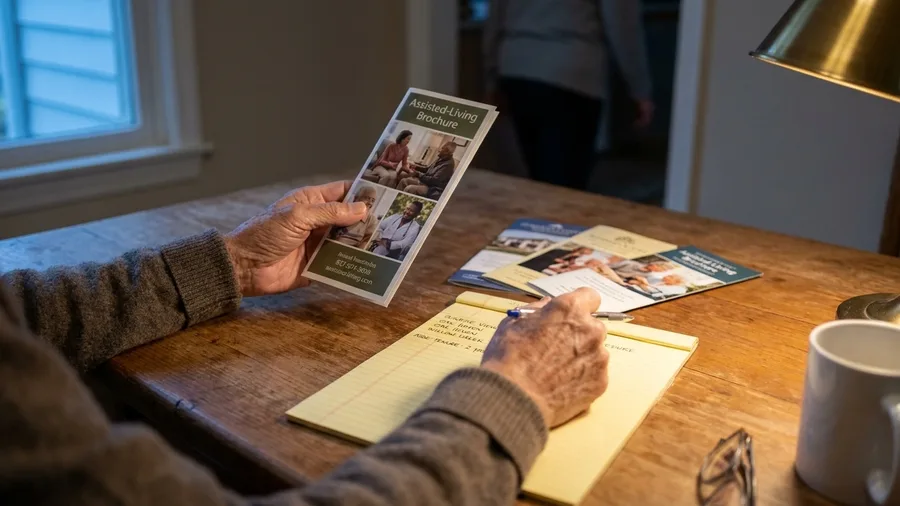
I got this one wrong in the most expensive way available. When I fell at 82, my daughter had 72 hours between the hospital telling her I was discharged and the building needing my first month's check, and she chose the place whose phone a human answered on a holiday weekend. Not the best building. The one that picked up.
Start looking a year before anything is wrong. Walk through three buildings on ordinary days when nobody is in crisis, and keep the price sheets and the aide-tenure notes you gather in one folder so the comparison is on paper and not in your head.
Understand who the hospital discharge planner answers to. She works for the hospital, and her job is to get the bed cleared, so the place that will take your mother by Friday is not necessarily the place that suits her. Sometime in the next month, on a plain Tuesday afternoon, make the shortlist while you are calm enough to read it. The fall decides for you only if you have left the deciding until the fall.
💡 Tip: Put the folder somewhere you will find it at 11 p.m. — a kitchen drawer, not a filing cabinet.
🗓️ What to Measure, and When
First visit
Ask for the a la carte sheet, not the base rent. Mine added $300 a month for medication management alone.
Second visit, 6 p.m.
Count aides on the floor. After 7 p.m. two cover the whole hall here; ask how many cover it at that hour.
Third visit, Sunday
Fewest staff, most visitors. Watch whether call buttons get answered while families are in the room.
When you ask about staff
Ask one aide how long she has worked this hall. Three years here; the two before her lasted five and seven months.
Before you sign
Get the year-two increase in writing. Mine came in at 4 percent, on a 12-month lease I had already signed.
Frequently Asked Questions
How do I see the real building instead of the sales version?
Go back unannounced at 6 p.m. on a weekday and again after 7. Walk the hall, find a lit call light, and time how long it takes to be answered. Count the staff you pass. Then ask which rooms and which hallway the scheduled tour skipped.
What does assisted living actually cost beyond the quoted rent?
At my building the one-bedroom is $4,850 a month and that covers meals, housekeeping, laundry twice a week, and the Tuesday and Thursday bus. Medication management is $300 a month on top, escorts to appointments are $22 each, guest meals are $12, and a normal month lands about $400 above the quoted rent.
Is it normal for a new resident to be lonely at first?
Yes, and it usually runs weeks one through six. The residents who settle claim one recurring thing inside the first month — the same table, the same chair, the same card game. Make one introduction and then leave the room so the conversation can happen.
What should we bring from the house?
The bed she sleeps in and the chair she sits in. Buy the rest to fit the room. Keep the framed photos where she can see them from that chair — that is the difference between a room and her room.
When should we start looking?
A year before you think you need to. My fall gave my daughter three days to choose, and she picked the building that answered the phone on a holiday weekend. Tour while nothing is wrong and keep the price sheets in one folder.
Four of These Nine Decide the Building
Strip it down and four of the nine decide which building gets signed: the real floor after seven, the full monthly bill with its add-ons and year-two increase, how long the aides on that hall have stayed, and starting before the fall does the choosing. The other five decide how the life inside gets carried. They matter, but they cannot rescue a building chosen badly.
The place that answered the phone on a holiday weekend was not the place that knew my name at 7:30 in the evening. Make one move this week: book a weekday six o'clock tour, then ask for the a la carte price sheet, the year-two increase and the aide tenure. Compare two buildings on total cost, not on rent alone. The decision gets made in daylight, on an ordinary Tuesday, before the fall picks the building for you.
Book the 6 p.m. Tour This Week
Then ask for the a la carte price sheet, the year-two increase and the aide tenure before you compare two buildings on rent alone.

