
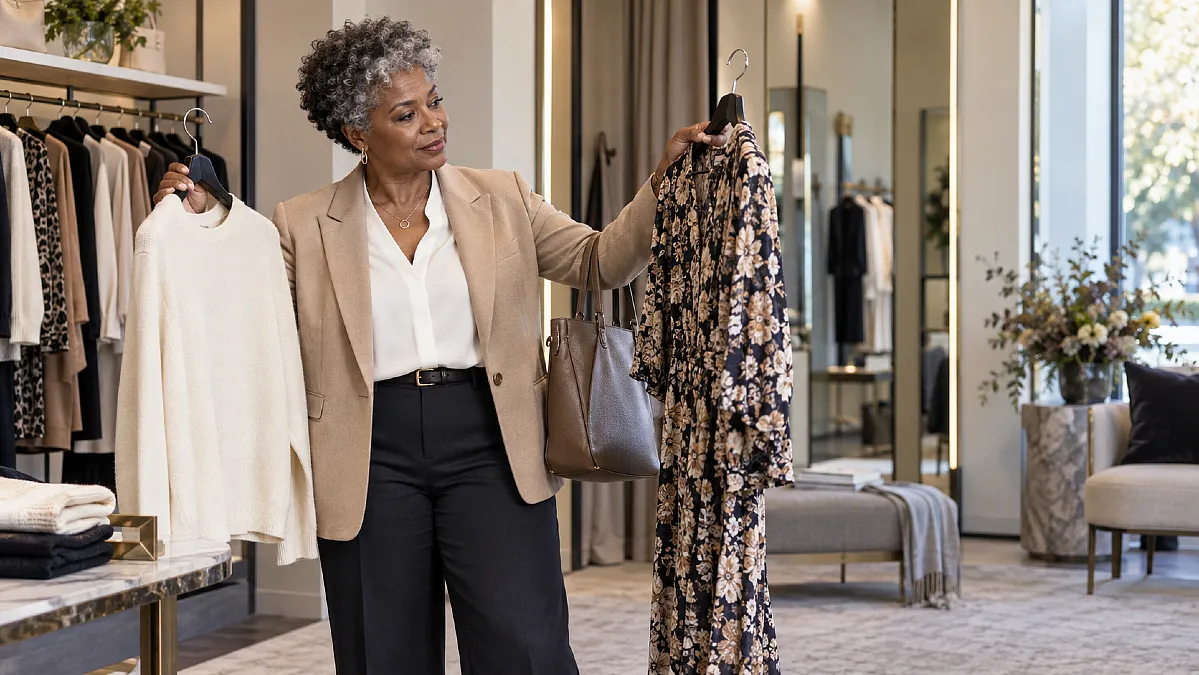
Shopping gets frustrating when clothes look promising on the hanger but somehow feel wrong once you get them home. The waist pulls, the neckline sits strangely, the fabric clings, or the beautiful jacket works with absolutely nothing you already own.
For women over 50, the problem is rarely that you have suddenly forgotten how to dress. Clothes, trends, proportions, and your own preferences may simply have changed while your old shopping habits stayed the same.
Good dressing over 50 starts before you reach the checkout. You need a clearer way to judge fit, fabric, usefulness, and comfort while you still have the garment in front of you.
The goal is not a bigger wardrobe. It is coming home with fewer pieces that actually get worn.
Stop Shopping for an Imaginary Version of Your Life
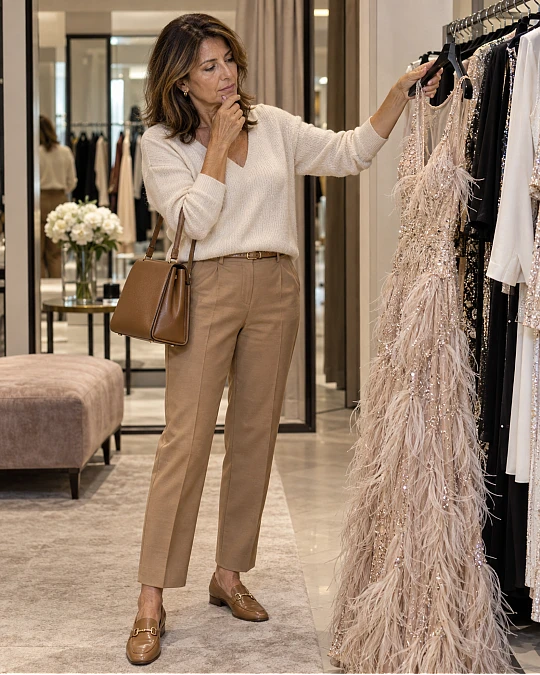
One of the quickest ways to waste money is to shop for situations that barely exist in your week.
A dramatic blouse may be gorgeous, but if most days involve errands, working from home, casual lunches, travel, or family time, another polished knit may earn far more wear.
Before buying anything, give the garment a job.
Instead of thinking, “I need some new clothes,” make the need specific: “I need a washable top that works with my dark jeans and trousers for lunches and casual meetings.”
That small change makes shopping far easier because you are solving a wardrobe problem instead of responding to whatever catches your eye.
Think about your real week. You might need clothes for:
- casual daytime plans
- work or volunteering
- dinners and social events
- travel
- walking and errands
- occasions that need slightly smarter clothes
You do not need equal amounts for every category.
If 70 percent of your life is casual, most of your wardrobe should probably support casual dressing too. That is how everyday outfits for women over 50 become easier instead of feeling like something you have to invent each morning.
Try this: Before shopping, write down one sentence beginning with “I need something that…” If you cannot finish the sentence clearly, you may not actually need to shop yet.
Fit the Woman You Are Dressing Today, Not the Size on the Tag
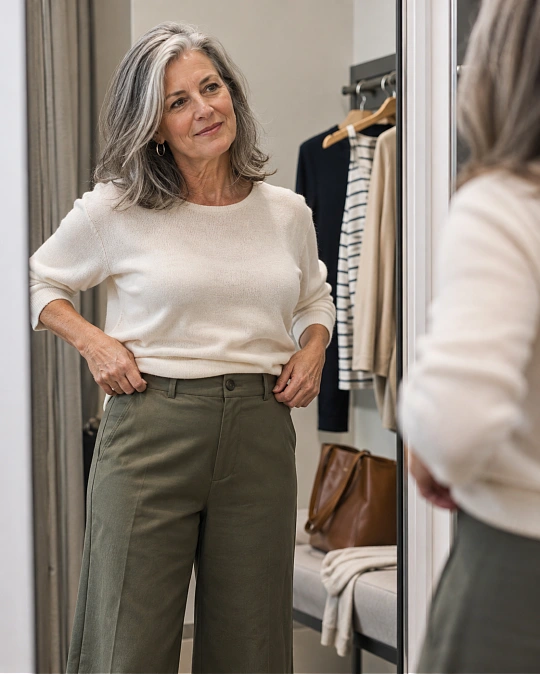
A size label is useful only as a starting point.
Two garments marked with the same size can sit very differently because of the cut, fabric, shoulder shape, rise, sleeve width, or amount of stretch.
That is why trying to force yourself into one fixed size can create unnecessary frustration.
Take two sizes into the fitting room when you can. Judge the garment by how it hangs, moves, and feels rather than by which number you hoped would fit.
Pay particular attention to the places that are expensive or difficult to alter. Shoulders on jackets, the rise of trousers, armholes, and the placement of dress waists deserve more attention than a hem that can easily be shortened.
A good fit should allow the garment to skim or follow your shape without constant pulling and adjusting.
Here is a useful fitting-room check.
| Area to Check | What You Want to See | Warning Sign |
|---|---|---|
| Shoulders | Seams sitting close to your natural shoulder | Fabric collapsing or pulling across the back |
| Bust | Fabric falling smoothly | Buttons pulling or fabric tenting outward |
| Waist | Comfortable definition without gripping | Waistband rolling, digging, or sliding |
| Hips | Fabric dropping cleanly when standing and sitting | Horizontal pulling lines |
| Sleeves | Enough room to bend and reach | Armholes cutting in or sleeves twisting |
Do not assess a garment while standing perfectly still with your stomach held in.
Sit down. Walk. Reach forward. Cross your arms. Bend to pick something up.
Real clothes have to survive real movement.
Fabric Can Make a Good Cut Look Expensive or Completely Wrong
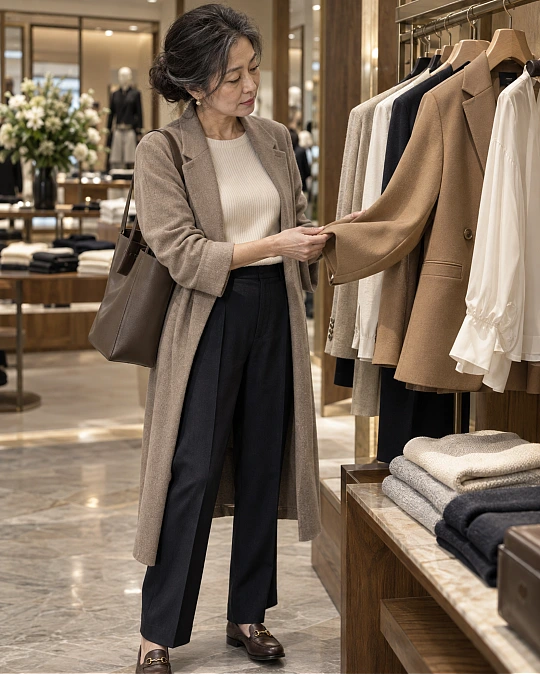
A flattering shape can still disappoint if the fabric works against it.
Fabric determines how a garment hangs, how much structure it keeps, how it behaves after sitting, and how comfortable it feels several hours into the day.
For trousers, look for enough substance to create a clean line without becoming stiff.
For tops and dresses, notice where the fabric falls and where it catches. A little movement and drape often creates a softer line than fabric that is extremely thin or clingy.
Knits deserve special attention.
Very fine knits can reveal every seam underneath, while very bulky knits may add more volume than you want. Midweight knits often sit more smoothly and layer more easily.
The same logic applies to stretch.
Stretch is useful when it improves movement and recovery. It is less useful when the garment relies on extreme stretch simply to fit.
Fabric note: Scrunch part of the garment gently in your hand. If it immediately stays badly creased, ask yourself if you are genuinely willing to steam or iron it every time you wear it.
A few fabric choices tend to behave differently in everyday wardrobes.
| Fabric or Construction | What to Look For | Why It Helps |
|---|---|---|
| Midweight knit | Soft drape with good recovery | Sits smoothly without feeling flimsy |
| Structured cotton | Enough body to hold shape | Keeps shirts and jackets looking polished |
| Fluid viscose blends | Movement without extreme thinness | Works well in relaxed blouses and dresses |
| Stretch woven fabric | Moderate stretch with structure | Gives trousers comfort without losing shape |
| Linen blends | Linen mixed with another fiber | Keeps the relaxed look with slightly easier care |
There is no single “best” fabric for women over 50.
The better question is whether the fabric behaves the way you need it to in your actual life.
Check the Proportions Before You Blame Your Body
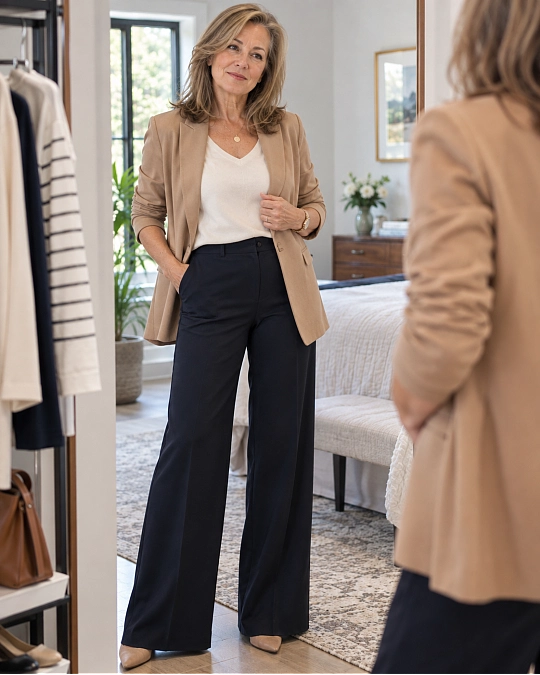
Sometimes the problem is not that a garment looks bad on you. It is that the proportions of the whole outfit are competing.
A long loose blouse worn with very wide trousers, for example, can create one continuous block of fabric.
That does not mean either piece has to go.
You could half-tuck the blouse, choose a slightly shorter top, open the neckline, add a structured jacket, or switch to a straighter trouser.
The same thing happens when shopping.
A sweater can seem wrong in the fitting room because it is being tested with leggings when you actually intend to wear it with straight-leg jeans.
Whenever possible, wear or bring something similar to the clothes you plan to pair with the new piece.
Shoes matter too.
Wide-leg trousers may look awkward barefoot yet fall beautifully over a low block heel, sleek trainer, loafer, or ankle boot.
A midi skirt can change completely depending on where the shoe visually ends.
This is why strong style confidence over 50 comes less from memorizing fashion rules and more from learning how proportions interact.
You are not asking, “Am I allowed to wear this?”
You are asking, “What does this piece need around it to look balanced?”
That is a much more useful question.
Watch for the Shopping Habits That Create Closet Regret
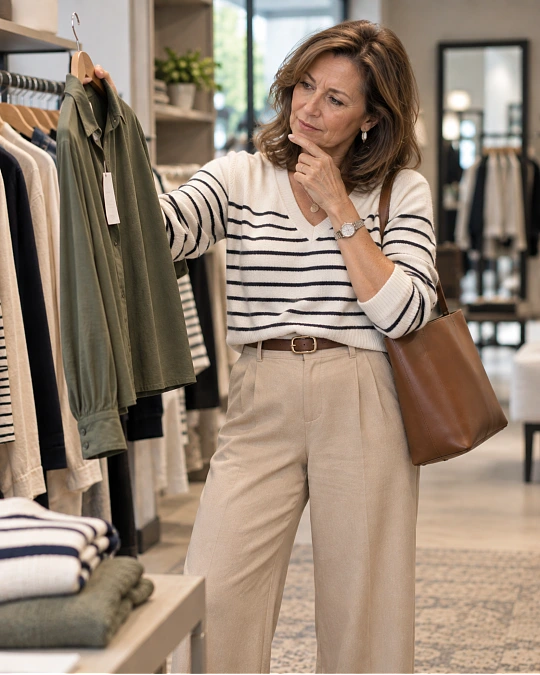
Most wardrobe mistakes are not wild fashion disasters.
They are reasonable-looking purchases made too quickly.
A blouse was almost right. The shoes were uncomfortable but beautiful. The trousers required a different bra, different underwear, different shoes, and possibly a different life.
Those “almost” pieces quietly create a closet full of clothes with nothing to wear.
If any of these situations sound familiar, try the gentler replacement on the right.
| Instead of This | Try This |
|---|---|
| Buying because it is heavily reduced | Ask if you would still want it closer to full price |
| Keeping something that needs constant adjusting | Look for a cut you can forget about once dressed |
| Buying for a future body change | Buy for the body you are dressing now |
| Choosing a trend that needs five new pieces | Look for a version that works with what you own |
| Assuming discomfort will improve | Walk, sit, and move before deciding |
| Buying without knowing what shoes work | Name at least one pair you already own |
Another common mistake is bringing home duplicates that do not solve a new problem.
There is nothing wrong with owning several white shirts or black trousers if you wear them constantly. The question is whether each version has a useful difference.
Perhaps one white shirt is crisp enough for tailoring, another is soft for weekends, and another works open over a tank.
That is thoughtful repetition.
Five nearly identical tops that all lose to the same favorite one every morning are simply taking up space.
Budget-friendly rule: When you already own something similar, the new version should improve at least one thing: fit, fabric, comfort, versatility, or condition.
Use the Three-Outfit Test Before You Buy Anything
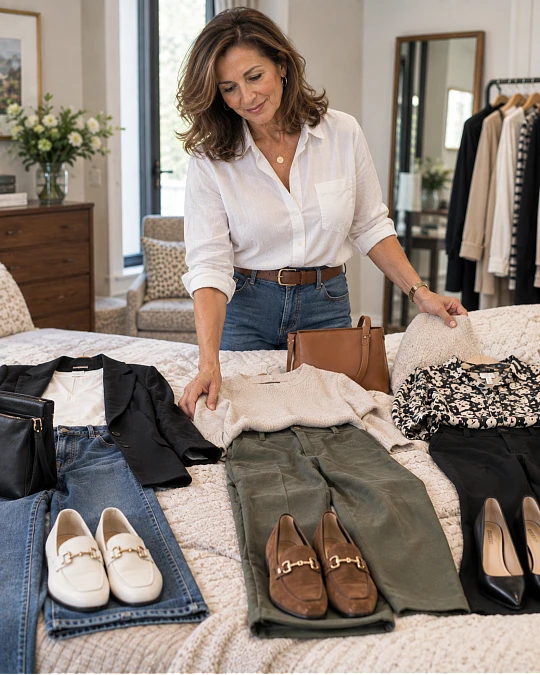
The simplest way to build a useful wardrobe is to stop judging new pieces in isolation.
Before buying, try to create three outfits using clothes and shoes you already own.
Not imaginary future purchases. Not “I could find a skirt for this someday.”
Your current closet.
A camel cardigan, for example, might work with dark jeans and loafers, black trousers and flats, then a printed midi skirt and boots.
That is already three reasons to wear it.
A beautiful jacket that requires new trousers, new shoes, a different bag, and a special camisole may be much more expensive than its price tag suggests.
This three-outfit test is especially useful if you are building a capsule wardrobe over 50, because every new piece should strengthen several existing outfits rather than create another wardrobe branch of its own.
Here are a few examples.
| Occasion | Simple Formula | Why It Works |
|---|---|---|
| Everyday errands | Straight jeans + knit top + light jacket | Comfortable base with enough structure to look pulled together |
| Lunch with friends | Relaxed trousers + fluid blouse + loafers | Soft movement balanced by a neat shoe |
| Smart casual event | Midi dress + cropped jacket + low heel | Defined proportions without complicated layering |
| Travel day | Pull-on trousers + fine knit + long cardigan + trainers | Easy movement with removable layers |
A useful buying formula is:
Formula: Fits now + works with three existing pieces + suits your real life.
If a garment passes all three parts, it has a much stronger chance of becoming one of your regulars.
If it passes only the “it looks beautiful” test, leave it for a moment and keep looking.
That pause can save both money and wardrobe space.
Build a Shopping List From the Outfits That Keep Failing
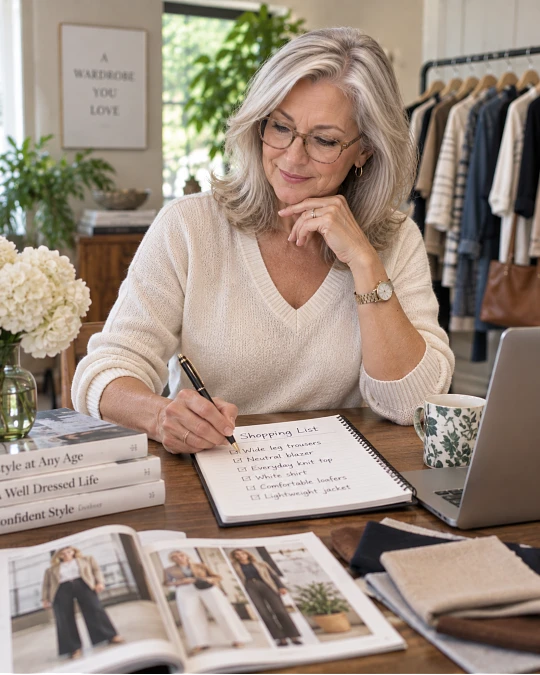
You do not need to rebuild your wardrobe to make dressing over 50 feel easier.
Start by noticing where getting dressed keeps breaking down.
Maybe every outfit would improve with a comfortable dark trouser. Perhaps you own plenty of tops but no lightweight third layer. Maybe your dresses are fine but none of your shoes work with them anymore.
Those repeated problems are your shopping list.
Keep the list short and specific.
“Black trousers” is still too broad.
“Black straight-leg trousers with a comfortable mid-rise, flat front, and enough structure for dinners and appointments” gives you something you can actually evaluate in a store.
The same approach works for color.
If your wardrobe is mostly navy, cream, denim, camel, and burgundy, buying a neon green jacket may create more work than excitement.
That does not mean you cannot experiment.
It simply means experimentation is easier when the shape or color can connect back to clothes you already enjoy wearing.
Color note: When trying a new color, hold it beside two or three pieces you wear often. You will quickly see whether it expands your wardrobe or creates an isolated outfit.
This kind of shopping may feel slower at first.
In practice, it often becomes faster because you stop considering dozens of clothes that were never right for the job.
Frequently Asked Questions
How do I stop buying clothes I never wear?
Give every purchase a clear purpose before buying it. Make sure you can name at least three existing pieces it works with and one real situation where you would wear it.
If you cannot do either, the item may be attractive without being useful.
Should women over 50 follow fashion trends?
You can enjoy trends without rebuilding your wardrobe around them.
Choose the parts that suit your taste, comfort, and existing clothes. A current trouser shape, shoe, color, or jacket can refresh familiar pieces without making you feel dressed as someone else.
How can I tell if clothes fit properly in the fitting room?
Check the garment while moving, not just standing in front of the mirror.
Sit down, raise your arms, walk, and turn sideways. Look for pulling, twisting, gaping, sliding waistbands, or anything you immediately feel the need to adjust.
Is it better to buy fewer expensive clothes after 50?
Price alone does not tell you how useful a garment will be.
A moderately priced jacket worn twice a week can offer better cost-per-wear than an expensive dress worn once. Focus first on fit, fabric, usefulness, care requirements, and how often the piece realistically fits your life.
How do I know what clothes to get rid of before shopping?
Start with pieces you repeatedly avoid because the fit, fabric, color, or comfort no longer works for you.
You do not have to clear the whole closet at once. Removing a few consistently unsuccessful pieces can make your actual wardrobe needs much easier to see.