
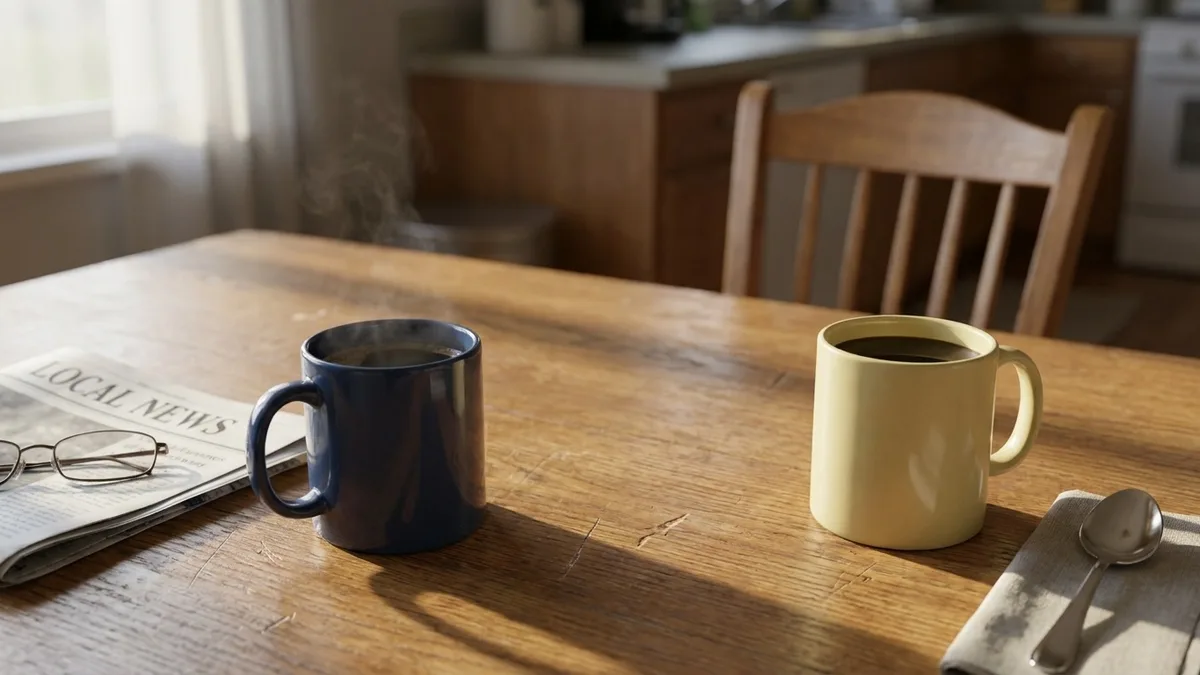
Two women lose their husbands in the exact same month, both in their early seventies. One keeps the house exactly as he left it, shrinking her life down to a single chair in the living room. The other repaints the bedroom, changes the locks, and starts a completely different morning routine by Tuesday.
The difference isn't how much they loved them.
It comes down to how they manage the sudden, echoing silence of a house built for two. Here is what actually helps when you are suddenly widowed at seventy-one.
Does Time Actually Heal Anything After Seventy?

The popular advice insists that time heals all wounds, provided you sit patiently in your sadness. That completely misunderstands what happens when you lose a spouse of forty years.
The passive approach is dangerous here.
You did not just lose a person; you lost the entire architecture of your daily schedule. Over the coming months, simply waiting deepens the rut of the old routine and makes the silence infinitely louder. The women who recover their footing intentionally build a new environment, actively changing how they interact with their house, their friends, and their mornings.
0. Changing the Physical Space Immediately
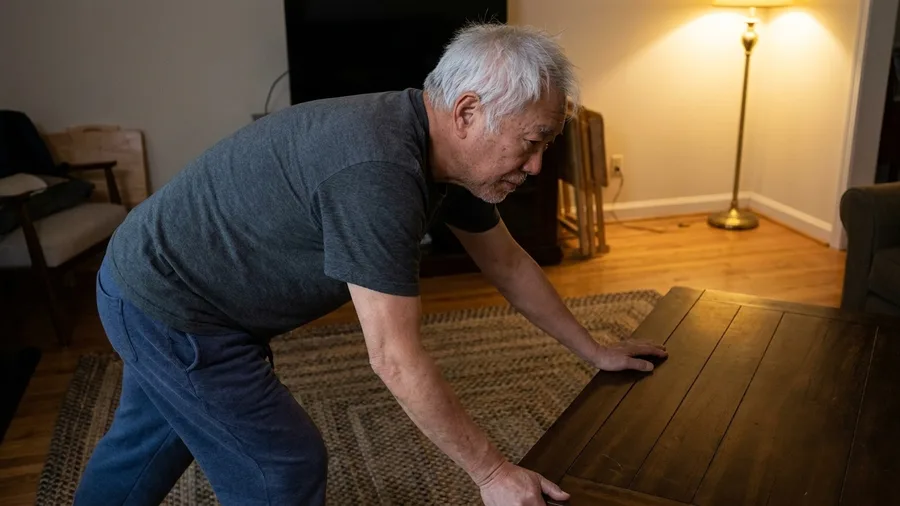
Is it a mistake to move his armchair out of the corner before the first month is over? The standard grief manual insists you must avoid all major changes for a full year. That rule exists to prevent panicked real estate decisions, not to trap you in a museum.
Dragging the heavy sofa to the opposite wall on week two felt like a profound betrayal. Yet leaving the layout exactly as it was spends energy you simply do not have right now.
If the physical space stays identical, your nervous system spends every afternoon unconsciously bracing for him to walk through the door. This is the one mandatory exception to the waiting period. You have to break that ingrained visual expectation immediately so your brain can begin processing the sheer silence.
Pick the room where you sit the most and change the entire layout this weekend. You cannot heal while living inside a ghost town.
⚠️ COMMON MISTAKE
Waiting on Everything
It is wise to delay selling the house or managing investments for a year. It is a mistake to wait a year to move his armchair out of your direct line of sight.
0. Does Retreating Always Mean You Are Sinking?

You will eventually cancel a standing Tuesday lunch date just so you can sit completely alone in your own silent living room. The standard bereavement literature warns constantly against this, assuming that any solitary hours will drop you straight into an inescapable, clinical despair.
That popular advice completely misses the physical reality of losing your partner. Sometimes, the sheer exhaustion of managing everyone else's lingering discomfort with your situation is much heavier than the grief itself.
Sitting across a crowded cafe table while a well-meaning neighbor struggles to say the correct thing takes a specific emotional energy you simply do not possess right now. Retreating from that awkward dynamic is not a sign that you are giving up. It is often a sheer survival tactic.
The difference between a necessary, healthy solitude and a dangerous isolation comes down to one honest internal check. You must look around your house and ask yourself whether you are resting, or actively hiding.
If you are resting, you must decline the incoming invitations without carrying any guilt or offering elaborate apologies. When the message arrives, reply, 'I am taking a quiet day today, but I would love to connect next week.' If they press the issue, hold the boundary and say, 'Thank you for checking on me, but I am resting today.'
You do not owe your extended community a continuous performance of polite resilience. You are allowed to let them worry slightly while you finally secure the absolute quiet your body requires.
Solitude vs. Isolation
Healthy Solitude
- Turning down a crowded dinner to read a book.
- Feeling physically relieved when the house is empty.
- Answering texts but refusing phone calls.
- Using the quiet hours to rebuild your energy.
Dangerous Isolation
- Ignoring the phone for days at a time.
- Staying in bed because getting dressed feels pointless.
- Avoiding the grocery store to prevent running into neighbors.
- Feeling trapped by the silence rather than rested.
0. Handing People the Exact Words to Use

"I know you do not know what to say, and that is okay. Just tell me about your garden instead."
The accepted advice is to let your friends carry you, but you quickly learn the counterintuitive truth: you have to manage their comfort first. People are terrified of saying the wrong thing. They freeze when you walk into a room or offer empty platitudes, so you have to hand them a safe script.
You do not owe anyone the heavy truth. Saying, "I am managing today, but I would love to hear what your kids are up to," gives them permission to treat you normally.
0. Why Should You Throw Away the Condolence Cards?
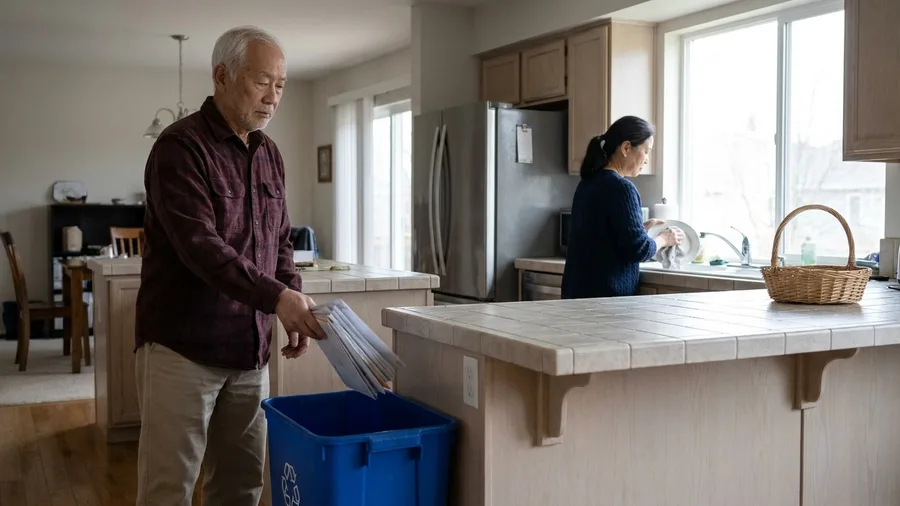
Four dozen sympathy cards sitting in a woven basket on your kitchen counter is not a comforting collection of memories. It is a heavy, physical monument to the worst week of your life, sitting right where you try to make your morning coffee. The standard advice is to save them all in a box because you will want them later.
You will almost certainly never want to revisit that specific week.
Throwing away these formal condolences feels incredibly callous right now. It feels as if you are casually discarding the friends, neighbors, and relatives who actually took the time to mail them to your home.
But staring at that basket every afternoon quietly drains your spirit and anchors your environment to a moment of pure grief. The reframe is what allows you to let them go. A card is just a delivery vehicle for support. Read it once, recognize the real love that sent it, and drop the paper straight into the recycling bin.
0. Scheduling the Silent Hours

You open your eyes at six in the morning, and the house is so completely still that the quiet actually rings in your ears. There is no one pulling coffee mugs from the cupboard, no morning news murmuring down the hallway, and a terrifying fourteen hours stretching ahead of you before you can reasonably go back to sleep.
Well-meaning people tell you to take it easy and let the long day unfold naturally without any pressure. They do not understand that an unstructured afternoon is not relaxing when you are living entirely alone.
An empty, silent house will very quickly swallow you whole.
We are conditioned to think of a strict routine as a tedious chore we have to maintain, but early in grief, a rigid schedule is the only handrail you have in the dark. It gives the sprawling, unmanageable day a tangible shape that you can actually navigate without breaking down.
You must write down exactly what you are doing every single day, hour by hour. If the schedule dictates that you eat lunch at noon and read a book at two, you sit and read.
You do not negotiate with the emptiness of the living room, and you never wait until you feel ready. The heavy silence stops being a terrifying ambush and becomes just another block of time you have deliberately planned for. The external structure carries you when your own internal momentum completely fails.
🕰️ A Saturday Structure
8:00 AM
Wake up and immediately leave the bedroom to make coffee.
10:00 AM
Complete one household chore that forces physical movement.
1:00 PM
Leave the house for an errand, even if it is just buying milk.
4:00 PM
Call a friend or family member to break the late-afternoon silence.
7:00 PM
Eat dinner away from the dining table to avoid the empty chair.
0. How Do You Grocery Shop for One?

Throwing away food every week is a quiet, recurring tax on your grief. It happens when you keep pushing a large grocery cart through the aisles exactly the way you did for forty years, loading up on his favorite brands out of sheer muscle memory.
Ask yourself right there in the produce section: are you grabbing a bag of six apples because you want them, or just out of habit? If the answer is habit, put them back.
Watching those extra portions spoil only reinforces the loss, which means you have to fundamentally change how you feed yourself. Grab a hand basket instead, buy ingredients for the next two days only, and rely heavily on pre-chopped vegetables or ready-made meals if it gets you to actually eat dinner.
💡 Tip: Buy pre-marinated proteins to remove the mental friction of cooking entirely.
Best Swaps for Solo Shopping
0. Checking for the Quiet Resentment

I told my friends I was overwhelmed by the paperwork, but I was actually dodging an uglier truth. Researchers who study grief consistently note that we rarely recognize anger at the dead right away. Instead, the mind masks that fury as intense irritation at the lawnmower breaking or the bank repeatedly demanding a death certificate.
Bitterness builds up long before you realize you are actually furious at them for dying.
You have to locate the actual source. Ask yourself if you are crying because the task is hard, or because he is not here to do it. If it is the latter, you are angry. Admit the anger out loud to the room.
0. Are You Moving Your Body Enough to Clear the Stress?
I honestly thought the crushing physical exhaustion of early grief was nothing more than a dramatic metaphor for how sad I felt inside.
When you are suddenly alone at seventy-one, it is dangerously easy to misread that bone-deep fatigue as a clear signal to stay in your chair. We treat mourning as an emotional weight requiring total stillness. But researchers studying bereavement consistently find that intense grief actually triggers a massive, systemic inflammatory response across your entire body.
You are not just sad; your physical systems are under severe distress. Moving your body actively metabolizes the heavy stress hormones flooding your bloodstream.
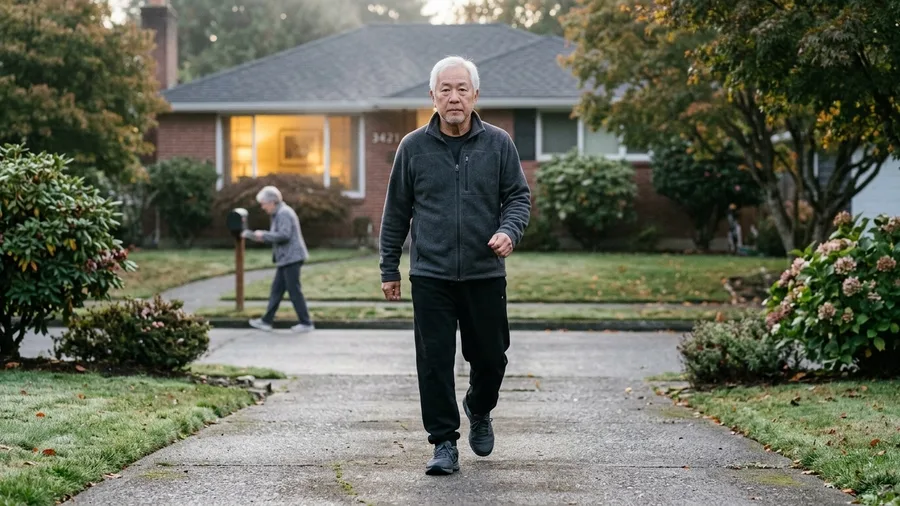
If you stay completely still, that chemical tension has absolutely nowhere to go and feeds on itself. You must walk outside for twenty minutes every single day, even if you just pace the length of your driveway. That deliberate physical movement breaks the chemical loop of anxiety that paralyzes you indoors.
💡 PRO TIP
The 4 PM Crash
The hardest part of the day is often late afternoon, when the house settles into twilight. Schedule your daily walk for exactly this time to physically escape the shifting shadows.
0. Deciding When to Take the Ring Off
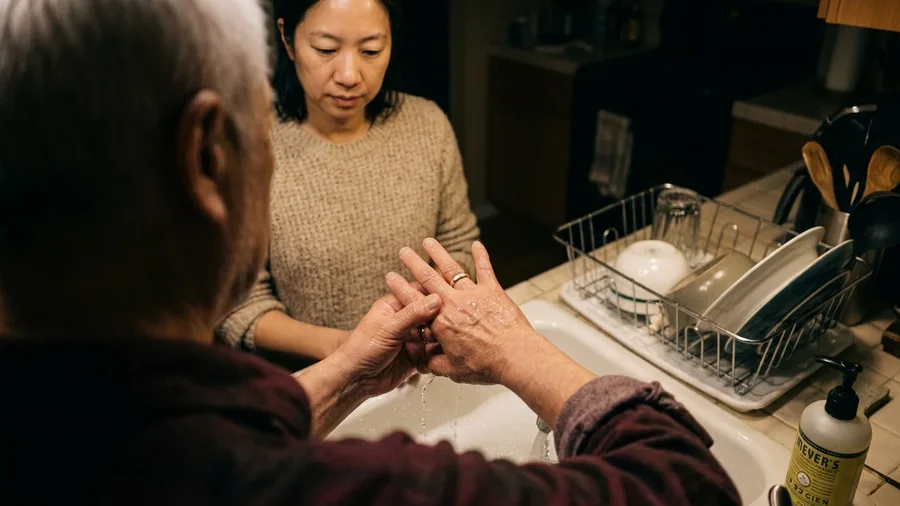
You are at the kitchen sink, soapy water running over your hands, and you feel the familiar slide of gold against your knuckle. For forty years, adjusting it back into its groove was a reflex you never had to think about. Now, staring at the band under the harsh evening light, it suddenly feels impossibly heavy.
People assume removing the band means you are moving on.
The actual signal it sends to your brain is entirely different. Moving the ring to your right hand, or putting it on a chain, is not an erasure of the marriage.
It is a physical acknowledgment that the nature of the relationship has permanently shifted, and the gap is entirely in the timing. There is no acceptable public timeline to follow. You do it when looking at the ring causes more pain than comfort, because doing it early never means you loved him any less.
0. What Actually Helps on the First Major Holiday?
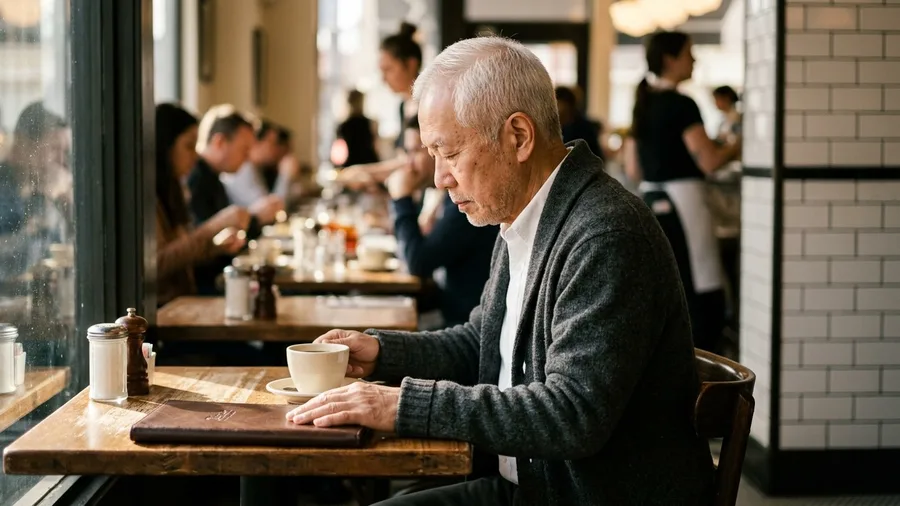
The exhaustion that flattens you on that first holiday comes from a specific cost. You spend weeks dreading the empty chair, trying to force a suffocating table for four to feel like fourteen.
The anticipation is always worse than the day itself.
The day usually becomes a flat, exhausting blur, so deliberately break the ritual to give your family permission to breathe. Change the menu, shift the time, or go to a restaurant to remove the glaring comparison to last year. The only exception is keeping a tradition that offers you genuine comfort rather than a sense of obligation.
0. Letting Go of the Widow Identity

"I am a widow now." Handing that phrase to every new acquaintance buys you immediate grace, quickly explaining your sudden tears or the mornings you cancel plans at the last possible minute.
That identity is highly protective early on, functioning as a necessary shield against the outside world. But as the months passed, I noticed the label was quietly building a cage around me. It dictated how I was expected to act, what I was allowed to enjoy, and the fragile way people treated me.
The grief shield eventually becomes a script you are trapped inside.
It is genuinely fine to stop bringing it up to new people. When you join a walking group or meet a stranger at the market, you are allowed to just be yourself. You can let them meet the woman you are today, without feeling obligated to lead with the devastating loss that brought you here.
How Do You Decide What Stays and What Goes?
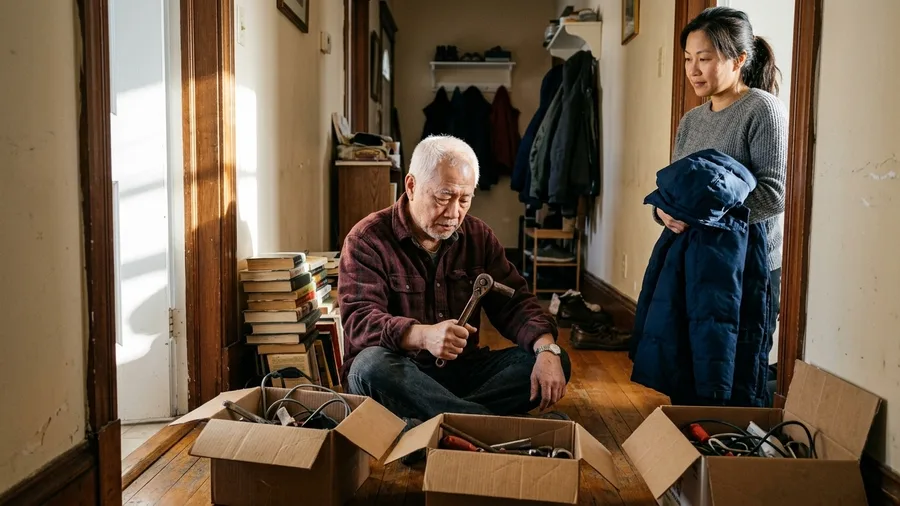
Fifty years of a shared marriage leaves you staring down thousands of individual objects, each demanding a final ruling. The common advice tells you to touch every item and ask if it holds a precious memory. That is a flawless recipe for paralyzing yourself on the hallway floor while holding a rusty socket wrench.
Stop measuring the emotional weight of every winter coat.
Instead, ask if a possession serves the life you are building right now. If a lawnmower requires maintenance you cannot perform, or if looking at a specific armchair ruins your afternoon, it leaves the house.
Are You Ready to Change the Furniture?

I spent the first six months believing that keeping his armchair in its exact spot was a necessary monument to our marriage. Moving it felt like I was erasing him from the room. That is the most common misread of grief in a shared home, where loyalty becomes confused with maintaining a museum.
We think preserving the furniture honors the person we lost, but it actually freezes us in a waiting room. Every time you walk past an empty chair, your body expects someone to fill it.
The room is built for a life that is no longer happening. Healing after seventy does not mean returning to who you were before the funeral. It means constructing a life that functions well for one person. Start by changing the physical layout of your main living space this weekend. Shift the sofa to the opposite wall.
It is a tiny, reversible action that forces your brain to register a new reality. You are no longer waiting; you are living.
Frequently Asked Questions
Is it normal to feel intensely angry at my spouse for passing away?
Yes. It is a completely standard psychological response to sudden abandonment. Stating the anger out loud helps metabolize the feeling faster than hiding it behind generalized sadness.
How long should I keep their clothes hanging in the closet?
There is no mandated timeline, but staring at them daily drains your energy. When looking at the coats causes more pain than comfort, it is time to donate them.
What do I do when friends stop calling after the first month?
Reach out with a specific script. Tell them directly that you just want to hear about their day, which removes their fear of saying the wrong thing about your grief.
Should I move to a smaller house immediately?
Delay major financial and real estate changes if possible. Focus first on rearranging the interior of your current house to make it function well for a single person.
Why am I so physically exhausted all the time?
Intense grief triggers a massive inflammatory response in the body. You are physically processing heavy stress hormones, which is why a daily twenty-minute walk is so critical for recovery.
The Life You Carry Forward
The belief you arrived with—that you simply have to endure the passage of time—is what keeps so many people trapped in a silent house.
You cannot wait for the grief to run its course. You have to actively build a new routine, rewrite your daily schedule, and give your friends the words to support you. The goal is not to forget them, but to make sure you survive their absence.
Check Your Daily Routine
Review the 'Scheduling the Silent Hours' step above and write down tomorrow's 10 AM, 2 PM, and 4 PM tasks right now.