

Most people assume calm is a temperament — something you are born with or handed by an easier life. Then you watch someone take the same rude email, the same bad news, and answer it like they have all the time in the world. They don't. They have about six seconds, and they've practiced what to do with them.
You know the version of this that isn't calm: 9pm, a message that lands like a slap, and your reply typed and sent before you've finished reading it. Whatever comes next, that first sentence can't be unsent.
The calm colleague has built small gaps — six seconds, one notch lower, a fifteen-minute slot at the kitchen table — and every gap costs something. Each one also fails somewhere specific.
So pick by where your damage gets done: the six-second pause if it's the first sentence, the hard stop at 8:30 if it's never stopping, the one-year question if it's saying yes too fast. Calm isn't a personality. It's nine small interruptions, and the other eight can wait until the first one is boring.
Quick Tips Before You Start
Pick one habit
Don't try all nine at once. Choose the one that matches the moment you most often regret.
Say the sentence out loud
The exit line or the clarifying question only works if it comes out of your mouth, not just your head.
Use paper
Worry windows and worst-case pages work better handwritten — it forces a slower pace than typing.
Move the phone
A phone in another room is not a metaphor. It is the only thing that stops the 9pm check.
1. A six-second pause before answering anything sharp

The version worth admitting to is the pause that did its job. You held the reply back, kept your voice even, said nothing sharp, and then said nothing at all for the rest of the evening. That is not the habit. That is withdrawal wearing its coat.
The habit is one slow exhale, roughly six seconds, before any word leaves you, and inside the gap two small moves: name the temperature to yourself, hot or stung or embarrassed, then pick what you want from the next minute. The reply that comes out is a delayed one, not a gentler one.
The tell is what happens after. If the other person is left guessing and you feel quietly superior, it has curdled. Six seconds should end in a sentence, not in a silence that lasts three days.
💡 Tip: Set a timer on your phone for six seconds and practice with low-stakes texts first. The habit needs reps before the real thing.
⏳ How to Practice the Six-Second Pause
Run it on texts too
Same six seconds applies to a message before you type. The gap is the habit, not the medium.
Count the exhale, not the silence
One long out-breath is the whole timer. If you are counting in your head, you are already past it.
Skip it when nothing is at stake
Small logistics, quick yes or no, no sting in your chest: answer straight. Pausing everything turns the habit into a mannerism.
The six seconds fail if
You use them to rehearse a comeback rather than to pick a temperature. That is the delay curdling early.
Close the loop out loud
End the pause with a real sentence in the next minute, even if it is only 'give me a second on that.' Silence past a minute reads as the withdrawal you are trying to avoid.
2. Answering a raised voice with a lower one

Not by staying silent and taking it, and not by going louder. There is a physical move for this, and it is smaller than it sounds. Once you have stopped the first sentence from leaving your mouth, the next problem is the room's volume, and the room's volume is not something you match.
One notch lower, and noticeably slower. Not a whisper, not a theatre drop that tells everyone you are being patient with a difficult person. The voice stays ordinary and audible, just beneath the shout. The other person has to stop talking to hear you, and the exchange changes pace without anyone having issued a challenge.
A colleague stands up and tells the whole desk the deadline was missed and it was your fault. The instinct is to match the volume, which turns two people into a spectacle. One notch lower gets you the room's attention while the shout gets the staring, and everyone can see which of you is which.
It is not foolproof. Someone who reads quiet as being handled will hear condescension, and the lower voice lands as a second insult, worse than the first. The move assumes the other person wants to be understood, which is not always true.
So you need the line for when the volume does not drop. 'Let's pick this up at 10 tomorrow.' Said it plainly, then walk. Not matching the shout, not walking out without a word. You have named a time to resume, which ends the scene without ending the conversation. The cost is that you look like the one who stepped back, and the morning conversation still happens.
💡 Tip: Practice the lower voice in a mirror. If it sounds like a teacher scolding a child, it's too low.
The Six-Second Pause, By the Numbers
What the gap actually costs and buys
3. One clarifying question before defending yourself

A lower voice can lower the volume of a room, but it cannot tell you what the noise is actually about. That takes a question, and the question has to come before the defence, not after it. So you ask: "What do you need from me here?"
The move is not a stalling tactic. When someone accuses you of sending the report in late, your instinct is to explain the timeline, name the review that held it up, produce the receipts. The question cuts past all of that. It surfaces what the person in front of you is actually afraid of – that the missed deadline makes them look bad in front of the boss – and it surfaces it before you have spent twenty minutes building a case for something they were never arguing about.
It also buys you time. While they answer, you are not composing a rebuttal; you are listening, which is a different and slower job. It costs something real: the moment you ask it, you give up the first blow, and if the person across from you came for a fight, the question lands as deflection. The answer comes back as another attack.
💡 Tip: If you get a second attack instead of an answer, say: "I hear that you're upset. I still need to know what you need from me."
💡 PRO TIP
The question that buys thinking time
Asking "What do you need from me here?" is not a deflection if you actually listen to the answer. The trick is to ask it before your defence is built — while you still have an open mind.
4. A 15-minute worry window that closes on time

Noon, a message from your sibling lands, and by one o'clock you have run the same argument four times while the kettle boils. Some of what a sharp exchange leaves behind cannot be settled in the room at all; the residue needs somewhere to go, and the habit that handles it is a scheduled slot rather than a chase.
Pick a time and keep it. Fifteen minutes, same hour every day, at the kitchen table with paper in front of you and the phone charging in another room. That last part is not decoration. A worry window with a phone beside it is a scrolling session with a serious name.
The closing time does the work, not the opening one. A window allowed to run becomes an all-day hum that happens to have a start time. When the fifteen minutes are up, stand, take the page with you, and let the rest wait for tomorrow's slot.
Outside the window the rule is one line. Something your sibling said gets written on the corner of the page and told plainly: that belongs to six o'clock. The line is a note to the version of you who will sit down then, not a task to solve on the way to the car.
5. Writing the worst case down once, by hand

"I've already run this through my head a hundred times. Why would writing it down help?"
Because a hundred run-throughs circle the fear and never finish it. Fifteen minutes of that is rehearsal; fifteen minutes of the same thought past midnight is a groove you can't climb out of. The page gives the thinking an edge to stop at.
Take one sheet, ten minutes, by hand. Write the exact scene – the meeting, the faces, the sentence you get wrong – then the first three things you would actually do. Not the catastrophe. The morning after.
That's the ten-second test: picture your worst case now. Does it end in a plan, or does it just end? If you can see your first move, ten minutes on paper will do. If the answering pain is the writing itself, do it aloud instead – one person, or a voice memo, same ten minutes and same three actions.
It's a limit, not a ritual. Ten minutes, one page, then close the notebook – past that the writing turns into a tidier version of the same worry.
💡 Tip: Set a timer for ten minutes. When it goes off, close the notebook even if you're mid-sentence.
6. Naming the feeling out loud before it decides anything

Four words, before the reply goes out: "I'm furious, and I don't know why."
Most people read that sentence as a confession of losing control. It's the opposite. The feeling hasn't picked a move yet, and saying it out loud is what keeps it from picking one – the slammed door, the resigning email, the text sent at 11pm.
The scene from an ordinary Tuesday: a curt email from someone senior, two lines, no greeting. It's not a catastrophe to write down – a catastrophe is a page-sized thing. This is a feeling already leaning on the reply button. The sentence goes to a friend, not to the sender and not to a feed. "I'm furious and I don't know why yet, but I'm not going to answer that email tonight."
Once it's out in plain words, the feeling stops needing to prove itself through a slammed door or a resignation letter. The urgency drains because the thing is already witnessed.
The audience is the whole trick. One or two people you trust. Naming it to the person it's about, or posting it publicly, turns the feeling into a position you now have to defend. And if there's nobody to tell that hour, say it aloud in the kitchen or write it in a notebook – the step can't be skipped, only moved.
What you're after isn't calm. It's the gap between feeling something hot and doing something final.
7. Leaving at the first tightness, not the tenth

The repair takes an hour. The five-minute exit at the first sign costs one awkward sentence, and most people spend the hour instead, because they wait until the tenth tightness to move.
"I need five minutes, then I'll come back to this." Say it and go: a glass of water, a walk round the block, at work or at home, short and ordinary. The body flags it early, jaw or shoulders tightening, breath sitting high in the chest, and the first signal is the cheap one.
What turns the five minutes into a vanished afternoon is leaving without the sentence. A silent exit reads as storming off, or worse, as someone who simply did not come back, and the exit stops being a choice and becomes avoidance. Naming a feeling early only works if the body gets consulted first; this is where that consultation happens, at the jaw, before the argument has assembled itself.
⚠️ COMMON MISTAKE
The exit that becomes an escape
Leaving without saying you'll return feels like a storm-off, even if you mean it as a pause. Always name the return time. "Five minutes" is a promise; silence is a disappearance.
8. The one-year question before agreeing to anything new
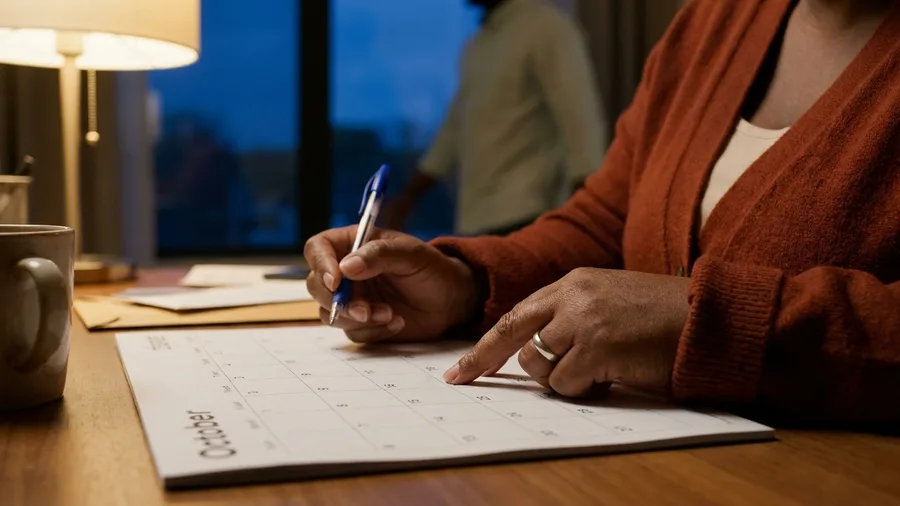
"Just trust your gut and say yes to what feels right" is the advice that keeps people overcommitted into their sixties. The gut is a terrible judge of a calendar twelve months out.
So borrow a slower test. Ask yourself whether the thing will still matter next year, and whether you will still want it once the novelty of being asked has worn off. Then wait a full day before you answer. On an ordinary Tuesday this looks like a colleague asking you to chair the weekend fundraiser: the honest reply is 'Let me check and come back to you tomorrow', which buys the day without a single lie. The waiting is the whole method, not a stalling tactic you deploy after you have already decided yes in your chest.
The default is no. That is the part people resist, and it is the reason the question works at all, because a default of yes makes the pause decorative. This is for new commitments, not for the fire alarm, so a real deadline still gets a real answer today. And the quiet failure is worth naming: someone who hides behind the default no for every request eventually gets a reputation for never being around, until the pause is just avoidance wearing a considered face.
💡 Tip: When you're about to say yes out of obligation, ask yourself: "If I had to do this tomorrow, would I still agree?"
9. A hard stop at 8:30, list unfinished

"I'll stop once the list is clear" is the sentence that guarantees you never stop. The list does not clear. It refills overnight.
So put a clock on it instead of a finishing line. Pick 8:30pm on weeknights, close the email, and leave the phone charging in another room. The first week will be restless, and you will feel the pull to go check; choose your substitute for those twenty minutes before the hour arrives, not after, whether that is a shower, a walk, or a chapter of a book.
Make the stop visible. Tell the people who might interrupt it, plainly: 'I'm off email at 8:30 on weeknights.' A stop that only you know about is a stop others will walk straight through, and the phone in the other room still gets fetched.
The quiet failure is the version kept secret and never enforced. Willpower alone at 8:31 is not a boundary. It is a preference.
Calm Habit vs. Common Reaction
Calm habit
- Pause six seconds before replying.
- Lower your voice when theirs rises.
- Ask what they need before defending.
- Leave at the first tightness, not the tenth.
Common reaction
- Fire back the first sentence that comes.
- Match their volume or go silent.
- Explain why you're right.
- Wait until you're furious, then storm out.
Frequently Asked Questions
How long does it take for these habits to feel natural?
Most people notice a difference in about three weeks of daily practice, but the first week feels forced. The pause and the lower voice are the quickest to become automatic because they are physical. The worry window and the hard stop take longer because they involve scheduling.
What if I try the six-second pause and the other person gets angrier?
That can happen, especially with someone who expects an immediate reaction. The pause can look like guilt or agreement. If they push, say: "I'm thinking about what you said." That names the silence without making it a weapon.
Can I use the worry window for real problems that need action?
No. The worry window is for worries that loop, not for problems that need a phone call today. If the house is on fire, put out the fire. Use the window for the low-grade hum of what-ifs.
What if my partner or family ignores my hard stop?
Tell them the stop is visible and repeat it once. If they still interrupt, move the phone to another room and close the laptop. The stop is enforced by your actions, not their cooperation.
Which habit should I start with?
Match it to where your damage is done. If you regret the first sentence, start with the six-second pause. If you never stop working, start with the hard stop. If you say yes too often, start with the one-year question.
Where Your Calm Actually Starts
Calm is not a temperament you were issued at birth. It is a set of quiet habits that build peace practiced until they run before the feeling does. You copy the interruption that matches the damage, not the one that sounds nicest.
If your damage is the first sentence, take the six-second pause and end it in a sentence. If it is never stopping, set the 8:30 stop tonight and tell one person. If it is agreeing, the one-year question and a default no, held a day.
The 9pm reply and the person who answered slowly are separated by one gap, and the gap is a single habit made boring. The other eight can wait. Choose by the damage it prevents, not by how calm they looked.
Pick One Habit for This Week
Choose the habit that fits your biggest regret. Practice it for seven days, then come back and see which one to add next.

