

The cake arrives with a sparkler where a candle should be, and the person at the head of the table is already reaching for the phone to show the grandchildren the booking confirmation. The table for twelve has been held since six weeks out, at about $65 a head, and the guest list was settled before the deposit went down.
If you are approaching or past 60, the birthday can feel less like that and more like a verdict: another number, another candle, another year subtracted from a total you would rather not watch. The people who look forward to the day are not pretending the number is smaller. They simply prepare. The hearing test is booked for 65. The Sunday call is fixed at four o'clock. The dinner is reserved before anyone can drift.
That is the whole difference, and it is learnable. Eight practices turn the birthday from a measure of years already spent into a dated occasion you build toward, one action at a time.
You do not need all eight by the weekend. Pick the one that fits your next birthday and attach a date to it before the week is out.
Quick Tips Before You Start
Use paper, not memory
A wall calendar you write on beats a phone reminder you swipe away without reading.
Name one person
A general wish to be useful fades; a named person expecting you at a set time does not.
Book six weeks out
Any table, any size, reserved early enough that you cannot quietly cancel it.
Schedule the boring test
Hearing, eyes, blood pressure: put the appointment in the same month as the birthday.
Close one loop
Pick one letter, apology or thank-you you have carried for years and mail it.
How They Count the Years
Everything in this first group comes down to arithmetic, and there are two ways to do it.
One way totals what is behind you and produces a verdict. The other counts what is still on the calendar and produces a list of dates to prepare for. The people who enjoy birthdays have quietly switched to the second method, and the next three entries show what that switch looks like in practice.
It is not optimism. It is bookkeeping with a different column at the top.
1. They Budget Birthdays Left to Spend

It's the week before the seventieth, and the tally runs backward: seventy years behind, and the candle on the cake reads like a subtraction. The people who look forward run a different sum. On a paper calendar they mark the next ten birthdays as occasions, 70th, 71st, 72nd and on down the line, each with a grandchild's name written beside it. The seventieth becomes the first entry in a count of celebrations still to spend, not a running total of years gone.
Two lines do the work, depending on which way you're counting. When the number starts to feel like a verdict, the line is: 'Ten more birthdays, and I want to be at all of them.' When a decade feels too long to promise, it narrows: 'This one, and the next, and I'll take them as they come.'
Neither denies that the body is changing. What changes is the frame: each remaining date is an appointment to prepare for rather than a judgment on the years already spent. The honest limit is worth saying. Counting what's left doesn't make aging easy, and for some people the arithmetic turns morbid the moment they try it. If it does, leave the calendar blank and count something else.
💡 Tip: Write the names in pencil. People move, and a calendar you have to rewrite is one you stop looking at.
🌱 GROWING TIP
Close the Paper Loop Too
The thank-you letter is one loop. The passwords are another. Keep them in a notebook in a desk drawer, tell one person where the drawer is, and the practical loose end stops sitting in the back of your mind where it colors every birthday.
2. They Measure Against Their Own Last Year

The people who don't flinch at the number keep a private baseline, and the only person measured against it is last year's version of themselves. Their log is short and unsentimental: how they slept in March, how many times they climbed the stairs before stopping, whether the two-mile walk still happened on Saturday, whether the Thursday call was still made. Four lines, maybe five, and none of them visible to anyone else.
A birthday with no private baseline becomes an auction. A friend posts the Algarve trip, another has a fourth grandchild on the way, and the kitchen renovation finishes on time, and every one of those lands as a column of numbers you did not post that year.
Against their own last year, the same birthday returns a different sort of report. The stair count shows more flights finished without that pause at the landing, the Saturday walk is still on the calendar, and the friend on the other end of the Thursday call is still picking up.
It is not a way of asking less. The comparison still asks for one thing more than last year: one additional flight, the walk kept in the diary, or the call made when it would be easier to send a text.
⚠️ COMMON MISTAKE
Don't Compare Upward on the Day
A birthday spent scrolling through other people's travel photos turns the day into an audit. Do the self-check in the morning, before the phone gets a say, and close the comparison file by noon.
3. Expecting the Small Declines Early

"I'm fine, I just turn the TV up a bit," someone says at 64, and everyone at the table nods and moves on.
Most people read the small declines as proof of the verdict: hearing going, night driving going, and soon the stairs, which means the body has started handing back what it gave. What the timetable actually allows is a series of rooms to walk into with your eyes open. The hearing test booked for 65, before a dinner where you have to lean in and guess at the punchline. The car keys handed to a friend for the drive home at 70, settled in advance, so it is never a standoff in a dark car park. The bedroom moved to the ground floor at 72, moved before a fall decides it. None of those is a celebration of decline; each is a change you named and scheduled, which means the birthday arrives as adaptation already underway rather than as a shock with candles on it.
That is the difference between dread and preparation, and it depends on temperament. For someone who prefers to solve a thing on the day, a list of anticipated losses can be a weight rather than a relief, and grief about the body's changes is real and does not schedule neatly. The practice is for people who find it easier to look at a thing early.
The Decline Timetable — At a Glance
👀 Who starts early
Those who find looking ahead easier than reacting
🚫 Skip this if
You solve best on the day; anticipatory lists weigh you down
💧 Grief
Does not follow a schedule — allow it its own pace
📍 Threshold
Name each change at its natural milestone, not in a cluster
⚖️ Failure mode
A timetable becomes a weight if every line is a loss you dread
The real test
Does looking at it early give you steadiness, or dread? If dread, set the list aside and address each change as it arrives.
How They Engineer the Day
A birthday does not organize itself. Left alone, the day drifts to four in the afternoon with no reservation, no settled shape and a room full of people waiting to be told what happens next.
The people who look forward to the date are not more sentimental. They are better at logistics, and they treat the birthday as a deadline rather than a performance.
Three moves do most of the work: attach a stalled decision to the date, reserve the celebration weeks ahead, and accept the fuss when it arrives.
4. A Birthday Makes a Deadline Out of Someday
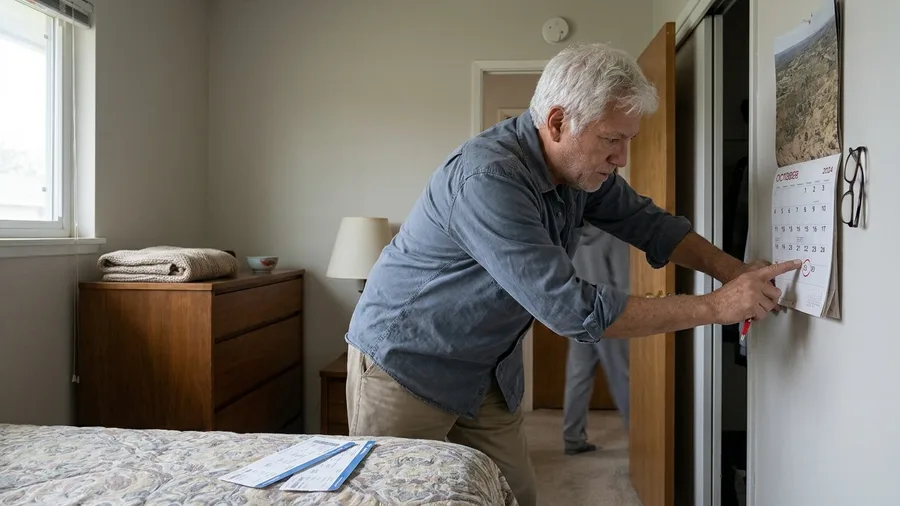
The cost of not setting a date is that the trip stays a good idea until it quietly expires. A woman means to visit her daughter for years, and the visit never happens, because no date was ever fixed and no deposit was ever paid. Then a birthday appears on the calendar and gives the intention somewhere to land: a ten-day trip for two, about $1,400, booked 90 days out so the deposit is in and the dates are locked before the candles are lit.
Scheduling the body's changes ahead and scheduling a long-postponed trip run on the same skill, which is naming the day before the day names you. The hearing test at 65, the night driving handed over at 70, the bedroom moved downstairs at 72 – each one is a decision taken early instead of forced late, and the trip belongs in that same column.
What makes the fixed date work is other people knowing it. The daughter has the dates in her phone, the calendar holds the booking, and the intention can no longer float. Someday has no witness; a paid deposit and a texted itinerary do.
One warning, because this lever does not suit everyone. Some people turn a deadline into one more stage to fail on – another performance, another chance to come up short – and for them the birthday pressure only adds dread. If that is how deadlines land, this is the one to leave alone.
💡 Tip: Put the booking confirmation on the fridge, not in an inbox. A date you see every morning does the work for you.
💡 PRO TIP
Nine Days Before Is the Sweet Spot
Dinner guests who get the invitation nine or ten days out almost always come. Four days out and half of them already have plans. Book the table six weeks ahead, but send the messages at day nine.
5. They Book the Table Six Weeks Ahead

The mistake is booking the room and leaving the list to chance. Weeks go by assuming the people who matter will somehow be there, and then the date is close and half the names are still unsettled, and the whole thing starts to feel like a chore instead of an occasion.
What works instead is a 70th dinner for 12 at a neighborhood restaurant, booked six weeks out at about $65 a head. Twelve people, one cake, one toast – and two people deliberately left off the list, the ones who make any day about themselves. The omissions are part of the plan, not an accident.
Lead time is what separates a celebration from a scramble. A day with no reservation, no settled shape and no one lined up to raise a glass tends to go flat by four in the afternoon, guests drifting toward the door because there was never anything to stay for.
The guest list is the one thing not left to the final week. Twelve names, two deliberate exclusions, one person asked in advance to give the toast – all of it settled before the reservation is even made.
The script is short: "We're doing dinner on the 14th, six-thirty, twelve of us. I'd like you there." No apology for the fuss, no open-ended maybe. A fixed table and a confirmed list give the day a shape it cannot lose.
6. They Take the Toast Standing Up

The common advice is to wave it all off – don't make a fuss, don't be self-indulgent, let the day pass quietly. That advice costs more than it saves, because what gets waved off is not the cake but the people who planned it.
The dread is usually of receiving, not of the candles: being watched, thanked, made to stand while twelve people look on. Deflecting with "oh, don't bother" leaves a small flatness in the guests who had already ordered the cake and written the toast, and it teaches them that next year the offer is not worth making.
Saying yes this year – the cake, the toast taken standing up, all twelve looking on – is what makes next year's invitation easy to offer. And the quiet alternative holds too: a genuinely small day can be accepted without a single deflection.
Declining the Fuss vs. Accepting It
Waving It Off
- The deflection reads as a verdict on their planning
- You skip the 35 seconds; they lose the reason to organize again
- The room hears "not worth it" and stops offering
- The quiet day is fine — but only if you don't call it a favor
Receiving It
- Say yes before you know what it costs them
- The standing-up part is the whole point: twelve people, one minute
- It's not the cake you accept, it's the role of the man who stands
- Small and accepted beats big and waved off — but both need the yes
How They Use Other People
The first six habits make the day bearable. The last two are what make the year around it worth marking.
One is a role that somebody specific expects you to fill. The other is the willingness to say the thing you have been meaning to say while there is still time to say it.
Both of them require other people, which is precisely why they work.
7. One Named Person Beats a General Urge

What makes a person feel valuable instead of just older is not a warm feeling in general. It is a nine-year-old who picks up the phone on Sunday at 4 p.m. because she knows who is calling, and who notices when the call does not come. That is the role: a 20-minute call to a grandchild, every Sunday, at a fixed time, expected by a specific person.
The same hour spent on "I should volunteer somewhere" produces nothing you can hold. A general urge has no named person on the other end, no recurring time, and no witness. "Volunteer somewhere" is weaker than "she expects me at 4" because the second sentence has a witness in it, and the first is a wish. And you would not be alone in this; the people who train crisis line workers say the same thing about showing up for a shift: a roster keeps you coming back where good intentions do not.
The exception worth knowing is a role that has quietly turned into a load. Being the single person a child depends on, since the call is the one steady appointment in the week, works only where a second adult shares it: someone who covers the call when you are sick, who takes a Sunday so you can travel, who can be there if you cannot. A rotation is not a demotion. It is what keeps a role from becoming the thing you cannot miss, which is how a source of value turns into pressure.
You will know the difference by asking one plain question: if the role disappears, does the birthday lose its measure? If the Sunday call stops, and the grandchild no longer expects it, the date has no one depending on it and thins into another candle. A role that survives a missed week, that another adult can step into without the child noticing, is the one worth building. Fix the time.
Write the name and the hour down: Sunday, 4 p.m., her name. That is the shape of a year worth marking, one person expecting you on one day, every week, until the next birthday arrives.
💡 Tip: Put the Sunday call in the phone as a repeating event with her name in it, not as "call Sophie" — you'll answer to the name faster than the task.
Someone expecting you at four o'clock on Sunday does more for your birthdays than any amount of resolve.
— What the practice keeps proving
The role is small on purpose. Small roles are the ones that survive a year.
8. They Say the Unsaid Thing This Year

One letter a year, mailed in the week of the birthday, to someone who never heard the thanks. That is the small count that changes how directness reads: it is not a personality shift that arrives with age, it is the same finiteness that makes a role matter, applied to the things you have left unsaid. The letter goes to a former boss, or it is the apology, or it is the password notebook in the desk drawer with every account written in a hand someone else can read.
Researchers who study regret keep landing in the same place: people report the things they did not do, and the words they did not say, far more than the missteps they took. The field calls it the omission effect, and it holds across enough studies, in enough countries, that it is the steadiest finding in the literature.
So the letter is mailed even though it may cost an awkward conversation, and even though a reply may never come, and even though some family member will read the notebook in the drawer and call it morbid, since the directness is for the person closing the loop, not for their comfort.
Frequently Asked Questions
Why do some people dread birthdays after 60 while others genuinely enjoy them?
The difference usually comes down to preparation, not temperament. The people who enjoy the day tend to have a reservation made, a guest list settled and something on the calendar that a specific person is expecting them to do. Without those, the day drifts, and a drifting day invites comparison.
Isn't counting remaining birthdays just a more morbid way of counting down?
It can be, and if it feels that way, skip it. The version that works pairs each remaining date with a name, so you end up with ten occasions to prepare for rather than seventy years to defend. If the arithmetic tips you toward grief rather than anticipation, use the self-comparison habit instead.
What is a realistic budget for a 70th birthday dinner?
A dinner for twelve at a neighborhood restaurant at roughly $65 a head comes to about $780 before drinks. Book six weeks ahead. Twelve guests, one cake and one toast is enough, and the guest list matters more than the venue.
How do I stop dreading being the center of attention?
Treat it as thirty-five seconds of being looked at and nothing more. Say yes to the toast this year rather than waving it off. Declining is the thing that leaves the planner disappointed and makes next year's celebration harder to arrange.
What if the person who used to depend on me has moved on?
Name a new person and set a new time this week. A general wish to be useful fades fast; a specific role with a recurring time and someone expecting you does not. If the old role was heavy, split it with another adult so it stays sustainable.
How do I bring up wills, passwords and letters without upsetting family?
Do the paperwork before the conversation. Put passwords and policy details in a notebook in a desk drawer, tell one person where it lives, and mention it as information rather than as a warning. The unsaid things, like a thank-you letter, can simply be sent without discussion.
The Date You Write On the Calendar This Week
The eight shifts are practices, not moods. Count the celebrations left to spend, measure against last year's version of yourself, adjust early, attach a stalled decision to a date, book the table, take the toast standing, hold one named role, close one open loop. None of that requires you to feel braver about aging. It requires a date and a decision.
The dread you started with, another number and another candle, meets a day you prepared for instead of a verdict you brace against.
So find your next birthday on the calendar this week. Choose one shift and attach one dated action: the dinner reserved, the hearing test booked, the Sunday call at four o'clock with a name in it. Small, dated, already begun. When the cake comes out, the sparkler is a thing you ordered, not a thing arriving to measure you.
Put One Date on the Calendar Now
Pick one of the eight moves, open your calendar, and write the date in before you close this page. One entry is enough to start.

