

The couples who handle these topics best are not the ones who talk about everything. They are the ones who eventually say the seven things they spent years not saying. The surprise is that avoidance and peace can feel identical from inside the same quiet house, and telling them apart takes only one plain question.
If you no longer fight about money, sex, health, family, or dying, you have probably read that quiet as proof you are fine. It may be. But it can also mean the two of you simply stopped comparing notes, waiting until a purchase, a diagnosis, or a visit forces the comparison.
Seven specific silences can be named, each is charging something now, and each opens with a low-conflict line that asks for no verdict on the marriage. By the end you can rank them by urgency and by how much shame they carry, pick one, say the exact opener, set a twenty-minute limit, and fix the next date before you get up.
The quiet was never neutral. It was a decision not to compare notes, and it can be undone starting this week, with one conversation that is both urgent and bearable.
Quick Tips Before You Start
Book it, don't spring it
Agree on a 20-minute slot in advance so neither of you is ambushed after work.
No deciding today
Say upfront that the goal is understanding, not resolution. Decisions come later.
Use a timer
A visible timer makes stopping at 20 minutes easier and keeps the talk from sprawling.
Write first, talk second
Each partner writes key points before speaking. It slows the reactive brain.
Money and Retirement
Money is the easiest of the seven to schedule and the hardest to say out loud. It is external, factual, and still loaded with shame. Two conversations live here: the long-horizon retirement picture and the daily spending truth.
Start here because a retirement mismatch is the most fixable silence on the list. It answers to calendars and arithmetic, not to courage.
1. The Retirement Math Talk Gets Postponed Too Long

The shared checking account, it turns out, answers almost none of it. It records what two people already spent together and says nothing about the two retirement dates now running quietly toward each other, or the monthly figure each has in mind for a life with no commute. Two calendars, two spending ranges, said out loud.
There is a version of this that is genuinely fine, and it looks like a Sunday evening both people would recognize. Each writes down a target retirement age, a monthly spending range, and one thing they will not give up doing with their time. Then they read the three lines to each other. Nothing gets decided. The point is to discover whether one person wrote 'travel in spring' while the other wrote 'same routines, same house' – and to find that out years before it becomes a fight about a plane ticket nobody booked.
If both sets of numbers land close, that is real information and worth keeping. Aligned couples still tend to sit down once a year and say the figures aloud, because a plan nobody has repeated in twelve months is a plan that has quietly drifted.
💡 Tip: If one of you has never looked at the retirement account balance, open it together before the talk. Surprises are cheaper on a screen than in a conversation.
⚠️ COMMON MISTAKE
Don't Lead With 'You Need To'
The health conversation dies the moment it sounds like a diagnosis. State what you notice in yourself first. Your partner will follow the example faster than they'll accept a conclusion.
2. The Day-to-Day Money Talk Hides Behind 'We're Fine'

' comes out flatter than you meant it. The purchase was $140. Nobody's life changes at $140. What changed is that it was the fourth, and the other three were never mentioned.
The fight was never about the thing in the bag. A retirement plan built on paper numbers drifts the moment the weekly money truths go unspoken, and a small hidden cost compounds into a purchase that lands like a betrayal. The first question is smaller than an audit: name one regular expense you have never mentioned, and one money worry you have been carrying alone. Facts, then feelings, then one shared rule for anything above an agreed amount.
A couple with everything shared and nothing secret skips the confession entirely and spends the twenty minutes on the worry instead. 'I want 20 minutes on money that isn't an audit – facts, feelings, and one rule we choose together.'
💡 PRO TIP
The Two-Paper Rule
Before any money conversation, each partner writes their answers separately and exchanges the papers without speaking. Reading first, reacting second, cuts the interrupt rate in half.
Intimacy and the Aging Body
These two conversations require naming changes in your own body and your partner's, which is why they wait longest. The silence is not indifference. It is protection.
But the body keeps changing while the silence holds. Naming the change early turns a private fear into a shared problem you can actually work on.
3. Sexual Silence Gets Mistaken for Marital Peace

"We don't need to talk about that. We're fine." That line gets said in the dark, at 11 p.m., one of you already turned toward the wall, after another Saturday night where a hand came across the mattress and was met with a small shift away. What gets decided in that shift – that nothing needs saying – is usually wrong. The same structure that makes money hard to mention makes this hard to mention: a practical change gets heard as a verdict on the relationship, so the change stays unsaid and the quiet starts to resemble agreement.
It isn't. A body that no longer responds the way it used to, a medication that dulls desire, a hip that hurts, a schedule that leaves one of you asleep by nine – these are facts about circumstances, and they get filed as facts about love. When that happens, the silence stops protecting anyone and starts charging rent. To open it, name only what changed and roughly when: 'I've noticed sex has shifted for me since the new tablets – energy, mostly, not you.' or 'I'd like to talk about what changed for us over the last year – desire, energy, pain, schedule, medication – without either of us assigning blame.' That last sentence works as a script almost as written: 'I want to talk about what changed in sex for us – not assign blame, just name desire, energy, pain, schedule, or medication.'
Two distinctions make the talk survivable. The first is between 'not tonight' and 'not you' – one is about a Tuesday, the other about the person, and saying which you mean takes two seconds and saves years. The second is agreeing on a check-in that doesn't demand sex as its outcome: twenty minutes on a Sunday, or a walk, where the point is hearing where each of you is, not arriving anywhere. A couple both content with less intimacy can say so out loud rather than diagnosing the quiet. Silence left alone turns a solvable thing into accumulated resentment and a touch that gets avoided for fear of being misunderstood.
Which Body Changes Are Safe to Name Now
- 🟢 A change you've noticed in yourself — Name it first — it lowers the stakes for your partner to do the same.
- 🟢 A new medication with sexual side effects — Facts first: the prescription insert gives you the language.
- 🟡 Pain during sex — Name it, then book a doctor's visit together before drawing conclusions.
- 🟡 A drop in energy you both feel — Discuss schedule and sleep before assuming desire has changed.
- 🔴 A change you've only observed in your partner — Ask before naming — observations about someone else's body land as verdicts.
4. The Health and Aging Talk Waits for a Crisis
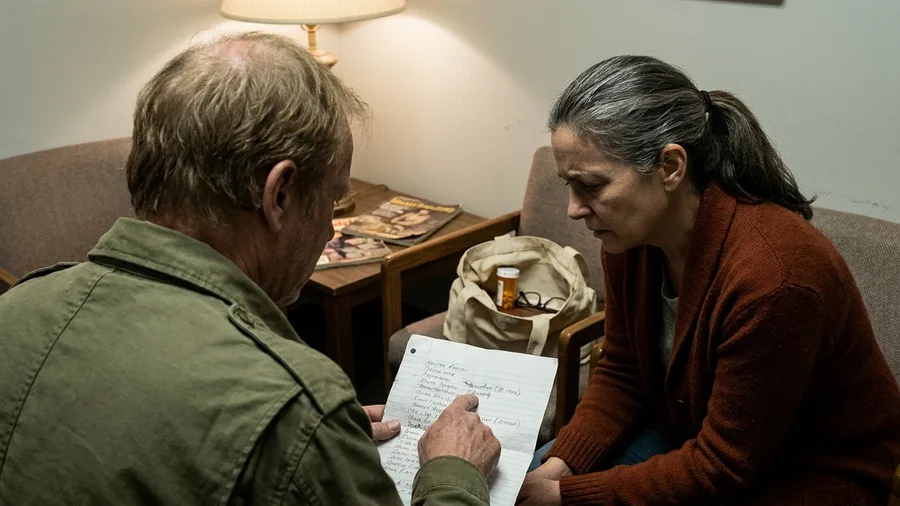
The standard advice is to sit down and have the big talk about aging before something forces it. The couples who manage this well tend to do the opposite: they keep it small, specific, and early, one named change at a time rather than a single reckoning. The body that reshapes desire also reshapes energy, memory, night driving, and what a pill bottle on the counter means, and the broader talk about those changes is usually the one left to wait for a crisis to supply the first honest sentence.
Researchers who study aging and caregiving describe the same pattern often enough that it functions as a rule: couples name the change late, and they name it in the language of an emergency. They avoid mentioning energy, memory, driving, medication, and caregiving until a hospital hallway does the talking for them. What the silence protects is not really privacy. It is the version of each partner that the other still sees, and the fear that naming a decline makes it official.
A driving review after a near-miss is the clearest case. One partner comes home from the store and says the merge onto the highway felt different, and the other hears a verdict on their competence rather than a request for a plan. The talk goes nowhere, so the near-miss stays unaddressed until the next one, or until a doctor asks a question neither of them can answer plainly.
The way in is to name one change in yourself and one you see in your partner, with the example attached and the label left off. 'I have stopped driving at night' lands; 'you are declining' does not. The opener that does the work is unglamorous: 'I want to name one change I see in me and one I see in you, with examples, not labels.' From there, the conversation turns practical.
What help is acceptable now, and what would feel like losing independence, are two different questions, and both need asking. Appointments, driving, household tasks, a parent who needs care, a medication that has changed the mornings. The first decision that cannot wait for a crisis gets named rather than tabled, because a crisis leaves no room to weigh what each partner is willing to accept.
For a couple with no current changes, the move is not to force a crisis talk. It is a twice-yearly check-in, twenty minutes, where each partner says what they have noticed and what they would want. The quieter version, done on a schedule, tends to do what the emergency version cannot: it keeps the conversation from being a verdict.
🩺 How to Run the Health Talk in Four Steps
Set the clock before you sit down
Twenty minutes, timer visible, no follow-on topics. The schedule is what keeps it from becoming a verdict.
Write yours, then read theirs
Each partner writes one change in themselves and one in the other, with the example attached. Swap while the timer runs, then read in silence.
Split help into now and never
Two columns: help you would accept this month, and help that would read as losing independence. The second column is the one that gets skipped.
Book the next one before you leave
One decision gets a date; the rest go on the twice-yearly calendar. Skip the talk entirely if nothing has changed since the last one – say so and end early.
Family Loyalty and Old Hurts
These conversations are the hardest to schedule because they touch family history and old wounds — the ones you have both agreed to leave alone. The silence protects a fragile peace.
But the peace has a price, and the price is paid by the marriage itself. Naming one recurring friction, and one old hurt, costs less than another decade of quiet scorekeeping.
5. The Adult Children Talk Becomes a Loyalty Test

A health change in one partner rarely stays inside the marriage. It reaches into how much the adult children are told, who decides, and whose family gets consulted first, and that is where the cost starts. A boundary the couple never set becomes a loyalty test neither of them signed up for, usually in front of an audience.
The usual version: holiday plans are made by text, a grandchild's rules are contradicted at the table, advice is offered and not taken. One partner feels their family slighted, the other feels their marriage overruled, and neither says the real sentence, which is 'I am afraid of betraying where I came from.' The test is not whose family is right. It is one recurring friction, described as the last time it happened, not as a case against a person.
The words that keep it from becoming a loyalty test can be said almost as written. 'I want to take one recurring friction, holiday plans, advice, money, or grandchild rules, and walk through the last time it happened, not decide whose family is right.' Then, plainly: 'Whose family loyalty feels at stake for you here?' That question turns the argument from love into boundaries.
The couple then agrees who speaks to whom and what message gets delivered before the next visit, so no one is improvising a defense in the doorway. Where both families are already clear and low-conflict, the same talk sets expectations for the next stage instead of relitigating past visits. Either way the silence charges less once the message is agreed in advance.
6. Old Resentments Get Filed Under 'That's Just Them'

The advice to let the small stuff go is good until the small stuff is the same thing every time. A recurring hurt that never gets named does not dissolve; it gets filed under 'that is just them,' and the ledger it lives in leaks out in small fights and quiet distance. Boundary arguments with adult children often draw on older hurts inside the marriage, and this is the silence underneath them.
The counterintuitive move is not to forgive harder. It is to name one incident, not a character, and ask for what would change it. 'I want to talk about one recurring incident, not your character: what happened, what it meant to me, and what I'd ask for next time.'
Filed away, the cost is scorekeeping, less repair after conflict, and a loneliness that sits inside the marriage. Some quirks are harmless, and the test is whether the pattern causes repeated hurt or avoidance. Where it does, the couple agrees on one repair phrase or action for the next time it starts, a named pause, a five-minute break, a return time, so repair is not invented under stress.
Naming an Old Hurt: What Works and What Backfires
Name It This Way
- One specific incident with a date and a place.
- What it meant to you, in plain feeling words.
- The request, stated as one sentence.
- A repair phrase or action agreed together.
Don't Name It This Way
- The whole pattern, stated as a character verdict.
- 'You always' or 'you never' as the opener.
- A comparison to a sibling, parent, or ex.
- A demand disguised as a question.
End-of-Life Decisions
This last conversation gathers the earlier ones. If you've done the retirement math, named the body changes, and cleaned up one old hurt, you are already prepared to say what you want at the end.
Most couples skip it. The forms get signed anyway, and the most important part — the actual wishes, said out loud — never gets spoken.
7. The End-of-Life Talk Gets Buried in Paperwork

Old hurts can be named and repaired. This one cannot be repaired afterward, which is exactly why it gets pushed to last. Here is the question underneath it: have you actually told each other what you want at the end? For most long-married couples, no. The documents exist, the wishes do not. A spouse ends up guessing in a hospital corridor at two in the morning, holding a folder that says nothing about whether their partner wanted the ventilator or the quiet room. Holding that conversation while a parent can still answer is the work the inheritance conversation walks a family through, step by step.
Paperwork has quietly replaced the conversation. Signing a directive feels like having had the talk, so the talk never happens, and the forms cannot answer the bedside question of what the person actually wanted. The move is to sit down before any document comes out of the drawer. Each of you writes three wishes and one fear about dying, care, or funeral plans, then says them aloud, and each names who would speak for them.
The opener: 'I want to hear three wishes and one fear you have about dying, care, or funeral plans before we look at any forms.' Then check whether the forms on file match what was just said, and confirm the legal requirements with the official source rather than memory. Why now is simple. A crisis leaves no room for guessing, and adult children can be pulled into decisions the couple never rehearsed.
Are You Ready for the End-of-Life Talk?
Frequently Asked Questions
How do we start one of these conversations without it turning into a fight?
Use the opener as written, book the time in advance, and set a 20-minute limit. Say explicitly that the goal is understanding, not deciding. If voices rise, use a repair phrase you've agreed on and return to the topic at a set time.
What if my spouse refuses to engage?
Start with the conversation that has the least emotional charge — usually the retirement notes. Write your own answers first and leave them on the table. The paper does the asking so you don't have to. If refusal continues across months, consider a couples counselor as a neutral third party.
How often should these conversations repeat?
The retirement and end-of-life talks should have a short annual check-in. Money and health should happen twice a year. The adult-children and old-hurt conversations can repeat only when a specific incident comes up, not on a schedule.
What if we've already had one of these conversations and it went badly?
Go back to the opener and the 20-minute limit. Bad first attempts usually mean the scope was too wide or the stakes got named too loudly. Shrink the topic to one incident or one number, and try again in a week.
Is it too late if we've been avoiding these for decades?
No. The silence has a cost, but the cost is not irreversible. Most long-married couples report that a single honest conversation changes the tone of the next one. Start with the topic that has the nearest deadline, not the one that scares you most.
Seven Waits, One That Cannot
Silence is never neutral. Every conversation you skip keeps charging interest, in separate plans, small fights, and a loneliness that lives inside a shared house. Many of the regrets people carry by seventy-five trace back to exactly these unspoken conversations. One twenty-minute start changes the account, and it does not require all seven.
Rank them by urgency first. If a deadline is near, money and retirement or health and end-of-life go to the front. Then rank by least shame, which is often the money rule or the health check-in, before sex or the old hurts. Pick one this week and say the line: 'I'd like us to spend 20 minutes this week on the one conversation we've been avoiding, not to settle it, just to hear where each of us is.' Set a timer for twenty minutes, and leave the table with the same day next week, same time, on the calendar.
After that, 'we're fine' stops being a default and becomes something you can report. The marriage does not need seven hard talks this week. It needs one honest start and a date to come back to it, which is how the quiet house begins to speak.
Pick Your Opener Now
Scroll back to the entry that matches your nearest deadline. Say its opening line this week, set a timer, and book the follow-up before you leave the table.