
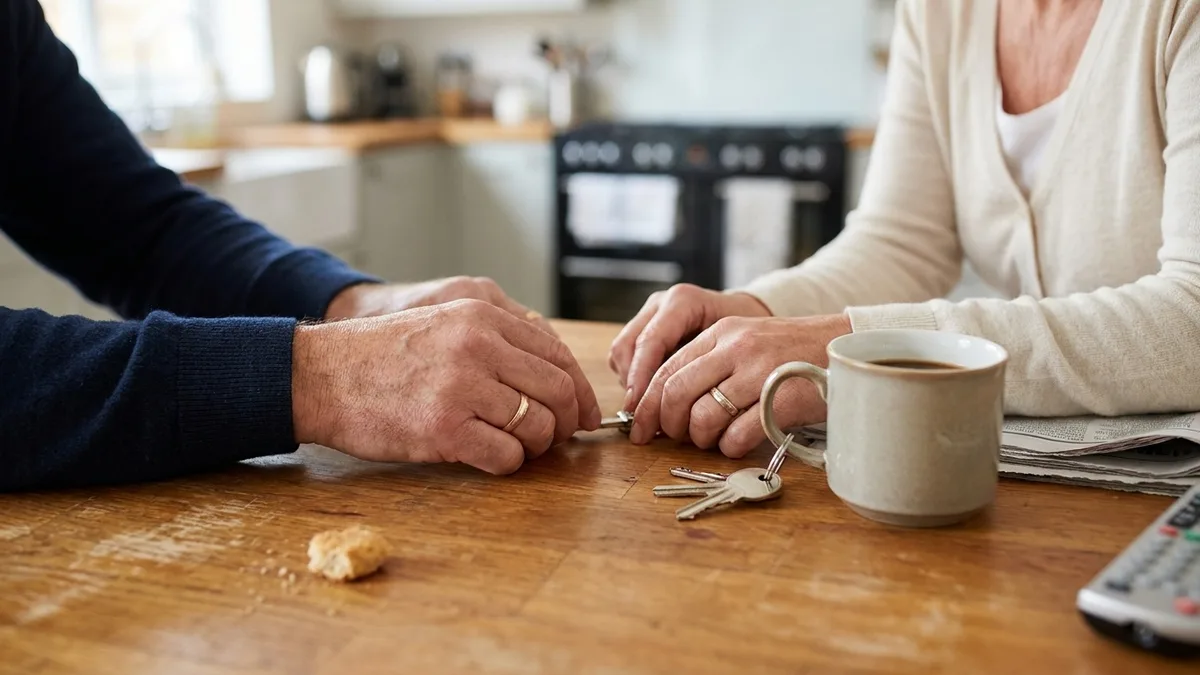
The first year of retirement is not a compatibility test you failed. It is a math problem: thirty-eight years of separate buildings collapse into one 1,900-square-foot house, one kitchen, one television, every weekday by 8 a.m. The radio volume, the counter wiped twice, the news commentary repeated a dozen times before lunch, none of it is about the radio.
You walk in believing the weekends proved something. They did, but they were a sample. Retirement is the whole week, and the friction follows the number of shared hours and the logistics nobody assigned, not the quality of the marriage. That is the whole mechanism, and it is regular enough to plan for.
What feels sudden is a set of eight shifts, each recognisable while it is still small. Below, they arrive in the order they usually do, so you can see what is already in the kitchen, start the two smallest moves this week, and say the caregiving question aloud once before a surgical calendar says it for you.
Quick Tips Before You Start
Name your solo hours
Pick a daily stretch that is yours alone and take it without guilt.
Claim one corner
Each of you gets a room or chair that is yours to arrange and to be left alone in.
Use the fridge calendar
Reconcile schedules on paper, not in an argument at 7 a.m.
Set a no-questions amount
Agree on a monthly personal spending figure the other person does not audit.
Ask before reorganizing
The kitchen drawers are someone's domain, even if you are home all day now.
Time and Space
The first three changes are about quantity. Work used to ration your hours together and assign each of you a separate building for most of the day.
Retirement cancels both arrangements at once, and the house does not get bigger to compensate.
1. Togetherness jumps from evenings to every hour

Sixteen. That is the number of waking hours the two of you now spend inside the same walls, every weekday, both of you home by 8 a.m., and the figure does not change from Monday to Friday.
Before the last day of work, the shared time was a slice: evenings, weekends, holidays, a vacation week twice a year. That is what a couple came to trust as the measure of compatibility, and it was a fair sample of a small part of the week. Retired, the slice becomes the whole loaf. The same sixteen hours repeat daily, and the habits that lived inside them stop being occasional. The radio goes on at the same volume a dozen times before lunch. The counter gets wiped down while someone is still using it. The news gets a running commentary that repeats the same three observations by mid-afternoon.
The obvious advice is to talk it through, to get to the bottom of why the radio volume bothers you now. That advice is wrong here. Nothing has surfaced that was hidden for 38 years; the habits were always there, just spaced out by two work schedules that kept them apart. Irritation that rises with the hours is a response to quantity, not a verdict on the marriage. Treating it as a compatibility problem sends you looking for a fault in the relationship that does not exist, and the search itself becomes a new thing to argue about, which is what a late-life divorce untangles.
The move is quantity control, and it is smaller than it sounds. Each person names a daily stretch of solo time and takes it, out loud, on the record. The model is already in the house: his golf three mornings a week and her volunteer shifts two mornings. That leaves five weekday mornings when both of you are home, and the point is not to fill them but to break the unbroken run. Name the stretch, put it on the refrigerator, keep it even on the days you would rather stay in.
The line to say is plain: "I am taking Tuesday and Thursday mornings until noon, no plan, just my own." Say it before the irritation builds, not in the middle of the radio argument, and let it stand as a fact of the week rather than a favor granted. When the same sixteen hours repeat, the days that break them repeat too, and that is what keeps the small habits small.
💡 Tip: Start with one hour a day, five days a week, and protect it like a meeting.
| The change | How it shows up | What to do about it |
|---|---|---|
| Togetherness jumps | Both home by 8 a.m. five days a week | Name a daily solo hour and take it |
| One kitchen, one office | Fights over the counter, the thermostat, the desk | Give each person one room or corner that is theirs |
| Two body clocks | His 5:30 a.m. start against her 8 a.m. one | Protect peak hours; reconcile on the fridge calendar |
| Work gave a title | Aimlessness, too much attention on the partner | Make one weekday commitment with other people |
| One retires first | The at-home spouse starts acting like a boss | Do not reorganize the other person's domain |
| Fixed income | Small purchases start to feel like big ones | Set $200 a month each that the other does not question |
| Family claims the calendar | Two afternoons of grandchild pickup, a mother 40 minutes away | Set a limit before the calendar fills, with a review date |
| The care question | A knee replacement turns one spouse into a caregiver | Have the who-drives, who-cooks talk now |
2. One kitchen, one office, two ideas of home

I once spent a Saturday explaining, calmly and at length, why the mail belonged in a tray and not on the end of the counter, which was a fine use of an afternoon and did nothing to move the mail. The obvious advice is to sort out whose system is right. The better move is to stop treating it as a system at all.
Nineteen hundred square feet, one kitchen, one television, one home office carved out of a spare bedroom: that house held two busy people comfortably. It feels crowded because both of you are in it all day, using the same rooms at the same time. The counter, the thermostat, the desk, the chair that has quietly become someone's chair are compressed space, not a verdict.
"That corner is mine now, and I would rather you did not rearrange it." "I am taking the kitchen counter at the end by the window; the rest is yours." "I will ask before I move anything on your desk, and I would like the same from you."
💡 Tip: The chair by the window is now his. Buy a second one for the den and stop negotiating.
⚠️ COMMON MISTAKE
Don't turn the house into a shared project
Retirement is not a renovation. The spouse who suddenly wants to reorganize the kitchen drawers, repaint the hallway and rearrange the furniture is often the one who has not found a weekday commitment yet. Fix the schedule first, the furniture second.
3. Two body clocks now ring in the same house

"I'm not asking you to sleep in. I'm asking you not to start the day at 5:30 in the same hallway." His alarm goes at 5:30, hers at 8, and the house between those two and a half hours carries every footstep, every cupboard, every burst from the kitchen radio. For years his early start happened while she was already out the door, and hers landed after he had left. Territory settles where things go. Waking hours settle when the same rooms get used.
That is the quiet trade. Protecting his mornings is cheap, and protecting her late afternoons costs nothing either, but only if nobody treats the mismatch as something to negotiate away. The schedule her job used to absorb now lands on the refrigerator calendar, twenty minutes each Tuesday, written down instead of argued over at the counter.
The aim is not a conversion. Nobody has to become a morning person, and nobody has to feel guilty about the hour they wake. Put both rhythms on paper before the hallway does it for you.
A sample week that protects both schedules
The five weekday mornings not covered here are the ones to watch. That is where the friction lives.
Roles and Identity
Work supplied more than a paycheck. It supplied a title, a schedule, a social world and a set of tasks that told each of you who you were between 8 and 5.
When that disappears, the question is not "who am I?" in the abstract. It is "what do I do with Tuesday?" — and the answer often lands on the spouse.
4. Work gave a title; home gives no job description

Because the house has hours now but no job description, and a man who ran a facilities crew for decades walks into a Tuesday with nothing on it that anyone is waiting for.
The first months show it plainly: he circles the kitchen at 9:15 looking for something to repair, offers to drive you to an appointment you already had covered, and invents an errand to the hardware store for a hinge that is not broken. That is not a crisis. It is a man missing the thing a schedule quietly supplied, which was a title and a room full of people who expected him at a certain hour.
A hobby you hand him will not fill it. What tends to work is a recurring commitment with other people in it, his Thursday golf league or her Monday volunteer shift, something with a start time that does not depend on you. It lands hardest on the person whose job was also the whole of their social world, because there is no one left to call.
Couples who come out of this well tend to have those separate weekday commitments in place by the end of the first month, not the first year. Your part is not to entertain him. It is to stop treating the empty weekday as a problem you are responsible for solving.
💡 Tip: If he was in facilities management for thirty years, the golf league is not a hobby. It is the replacement for the crew he used to see every morning.
5. When one retires first, the other gets a boss

You come home Thursday evening with a week of work behind you. There is a stack of mail sorted by someone else, three errands listed on a pad by the door, and a question about the gutters before you have taken off your coat. He has been at home since 65 while you finish to 63, and the house has quietly reassembled itself into a workplace with him as supervisor — the identity shift of retirement already underway.
The two years of staggered exits are not the problem. The problem is a household that has lost the separate domains work used to hand it, where your schedule is still yours and his day does not depend on yours.
It is fine when the at-home partner has a week of his own that you are not required to fill, and when the working partner comes home to evenings rather than a standing handover meeting. It is not fine when the to-do list is waiting by the door and kitchen drawers get reorganized without a word. One rule covers most of it: nobody reorganizes the other's domain, kitchen drawers included, without asking first.
The dividing line is whether the working partner feels consulted or reported to. Ask, and it is a household. Assign, and it is a job with a boss.
Before and after the last day of work
Before retirement
- Shared time was evenings and weekends.
- The house was empty from 8 to 5.
- Work absorbed the 5:30 a.m. versus 8 a.m. mismatch.
- Money arrived as a paycheck every two weeks.
- Family requests had to fit around a work calendar.
After retirement
- Shared time is all sixteen waking hours.
- Both of you are in the same 1,900 square feet.
- Two body clocks ring in the same kitchen.
- Income is fixed and every purchase feels bigger.
- Every open afternoon looks available to everyone.
Money and Family
The next two changes come from outside the house. One is the shift from a paycheck to a fixed income; the other is the family requests that fill an open week.
Both feel like money and logistics. Both are usually about something else.
6. A fixed income turns small spending gaps into fights

The standard advice says the fights are about the numbers, and that arithmetic is the way out. It is not. Once a paycheck becomes a fixed income, the total can be the same and every purchase still feels newly consequential, because it now draws on something finite and identical every month.
What surfaces is old material that the pay packet used to absorb: who decides, and how anxious either of you feels about spending anything at all. The $850 for groceries and supplies and the $200 each of you can spend without being questioned are not about the money. That second number is there to keep the marriage out of the arithmetic.
For the larger questions, a fee-only planner and the official benefits source go further than either of you guessing at rules at the kitchen table.
💡 Tip: If the $200 is spent on something the other person thinks is foolish, that is the point. The rule protects the marriage from the arithmetic.
7. Grown children and aging parents claim the calendar
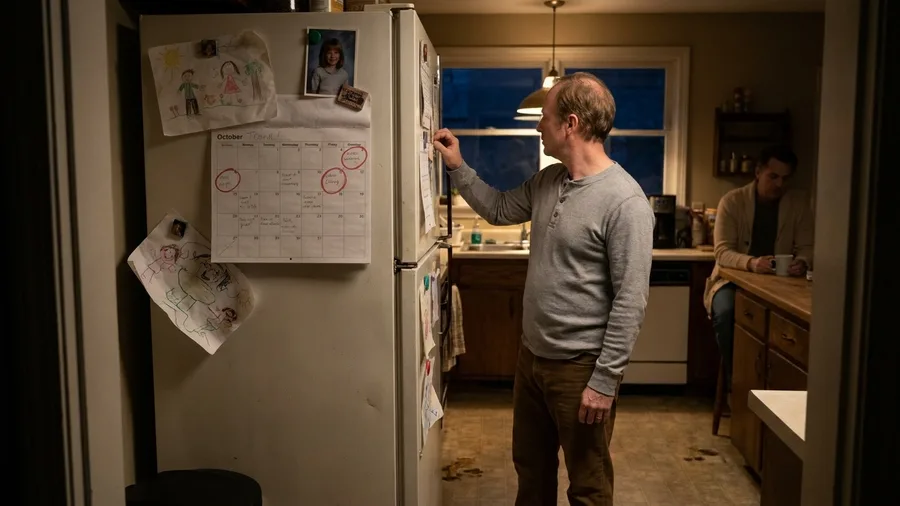
The cost of getting this wrong shows up as resentment, not as a fight. One of you starts doing the Tuesday and Thursday school pickup because the other was in a meeting the first week it came up, and by the fourth month it is simply understood that this is whose job it is now. Nobody agreed to that.
Look at what a week actually holds. Two afternoons of collecting grandchildren from school, and an 89-year-old mother living 40 minutes away who needs checking on, driving to, and sitting with. Neither of those was negotiated. Both arrived because the calendar had space in it, and space reads as availability to everyone who needs something.
The fight is almost never about whether to see them. It is about who decided. One of you hears a request from a grown child and feels the lift of being needed; the other hears the same request and feels a duty landing on an already-claimed day. Same phone call, two completely different readings, and the disagreement is over the split rather than the visit.
So agree the limit before the week is full, and put a date on the refrigerator calendar to look at it again. Something like: two pickups a week is what we can do well, and we revisit it in three months. A number with an expiry is a different thing from a rule, and most people can live with the first one.
Worth saying plainly: for plenty of couples this stretch is the good part. The grandchildren are a pleasure and the mother's company is precious, and the only real injury is being told rather than asked. If that is your house, the fix is a sentence before the commitment, not a smaller commitment.
The reason this snuck up is that work calendars used to do the limiting for you. A job answered half the requests without anyone deciding anything. With the week open, every ask looks like it fits, so the boundary has to be said out loud now because nothing else is going to say it.
The fight is rarely about the visit. It is about who was asked and who was told.
— What couples in the first retired year keep discovering
The Long View
The last change is the one nobody schedules, and it is the one that turns a spouse into a caregiver.
It arrives as a date on a surgical calendar, and it rearranges the whole house.
8. The care question arrives before anyone plans for it

A scheduled knee replacement turns a spouse into a caregiver, and nobody plans for it because it looks temporary.
Six weeks of limited walking means she does the driving, the cooking, the stairs. The part nobody arranges is her own relief: one hour a week someone else covers, and one person she can call at 7 p.m. on a bad day. Paperwork and coverage rules belong with the official source, not with anything read in a magazine.
So say the question aloud once, before the spring: if one of us cannot drive or do stairs for six weeks, who drives, who cooks, who gets called. It does not need an answer yet. It needs to have been said, because work schedules used to hide who could drop everything, and a health event finds out.
🗓️ The first month of retirement, in order
Name the solo hours
Each person picks a daily block that belongs to one person only.
Claim one territory
Assign a room or corner to each spouse and leave it alone.
Put both schedules on the fridge
Reconcile the golf mornings and volunteer shifts on paper, not in bed.
Set the $200 rule
Agree on the personal spending amount the other does not question.
Book one outside commitment
The retired person joins something with other people in the first month.
Say the care plan out loud
Name who drives, who cooks and who gets called, once, before anything happens.
Frequently Asked Questions
Is it normal to feel irritated by my spouse all day after retirement?
Yes, and the irritation is usually about quantity of time rather than the person. You went from seeing each other a few hours a day to sixteen, and the small habits that were once background noise are now in the same room. Naming a daily solo hour for each of you takes most of the edge off within a week or two.
How do we handle it when one of us retires years before the other?
The still-working partner needs evenings that are not a handover meeting, and the at-home partner needs a week that does not depend on someone else's schedule. The single rule that prevents most of the friction: no reorganizing the other person's domain, including kitchen drawers, without asking first.
Should we combine our spending money or keep it separate?
Keep a shared account for household expenses and a personal amount for each of you that the other does not question. In the example here, that is $850 a month for groceries and supplies and $200 each for personal spending. The point is not the number; it is that the small purchases stop being a referendum on the marriage.
How do we set limits with adult children and aging parents without a fight?
Set the limit before the calendar fills, with a review date attached. "Two afternoons a week is the maximum, and we review it in three months" is a complete sentence. The fight is rarely about the visit; it is about one person being told rather than asked.
What should we do now about the possibility of one of us needing care?
Have one conversation about who drives, who cooks and who gets called if the well spouse needs to leave the house. Name one backup person. The paperwork and the decisions belong with the surgeon's office, the insurance plan or the hospital's discharge coordinator, not with a summary you read online.
Rank the Eight by How Soon They Bite
Not by how serious they sound. By how soon they will be in your kitchen. The jump in togetherness and the fight over territory are almost certainly already underway — they start in the first month, sometimes the first week. The staggered-retirement problem, if it applies to you, is on the same clock. The fixed-income argument arrives with the first monthly statement. The family calendar fills when the first request lands. The care question waits for a date on a surgical calendar, which is why it is the one to say out loud once now, not solve.
Start this week with the smallest version of the two that are already happening. Name one solo hour a day and take it. Claim one corner of the house that is yours to arrange and to be left alone in. That is the whole first move. A strained first year is a predictable stage with known moves, not a verdict on thirty-eight years of marriage.
Start with the fridge calendar
Put both schedules on paper this week: the golf mornings, the volunteer shifts, the grandchild pickups. The argument gets smaller when the week is visible.

