

Most parents assume that if an adult child goes quiet, it is a verdict on how they were loved. It usually is not. It is a boundary the child has already tried to explain, and distance is the cheapest way they found to stop a pattern that kept repeating.
You come to this at night with a 31-year-old son, about 20 months of little or no contact, a grandchild who just turned two. Contact is a birthday card and shared photos now. Phone calls were the first thing dropped.
The belief that carries you through those nights – that more explanation, more care, one more visit will prove the love and end the silence – is the move you have already made. Three long emails, two voicemails, one unannounced visit, a family group text. Each one raised the cost of answering.
What follows is a way to lower that cost instead: one two-to-four-sentence message naming a single specific thing, no request attached, sent once on one channel. Then months of question-free contact, a year before you judge whether anything has shifted, and a life you keep building while the answer is still unknown.
Quick Tips Before You Start
Write the Message First
Draft the two-to-four sentences before you pick the channel, not after. Deciding where to send it first is how the message grows a request.
No P.S.
The second sentence you are tempted to add is the one that turns a statement into an ask. Hand the message to someone else and ask if they can find a question in it.
Plan for the Year
Three months is the reply window; a year is the read window. Mark only the year on the calendar, or the three-month date becomes a verdict you did not agree to.
Skip the Holidays
Birthdays and December are the heaviest weeks to make contact in. Choose an ordinary Tuesday instead, when a reply does not announce itself to the whole family.
Book Help in Advance
A family therapist runs $150-$225 per 50-minute session, a certified family mediator $150-$300 an hour, a support group free to about $30. Have one booked before you need it, not after a silence.
Why they went quiet
Before you can change anything about the silence, you have to understand what it is. These first two entries cover the most common misreadings — that the cutoff is a punishment, and that the reason was never given — and what the field actually sees when adult children step back.
1. The silence is a boundary, not a punishment

It looked like a verdict. Twenty months of near-silence, and the way some of us read it at first was scoreboard: the birthday card arrives, the shared photos go up, and nothing else does, so the accounting starts. What did I do to deserve this, and how many months until the debt is paid.
The child who stops calling is usually trying to end a pattern, not deliver a message. The pattern needs no further negotiation this way; distance asks for nothing, argues nothing, and holds. A punishment has an aim too, and it is different in kind: it wants a reaction, and proof that it landed. What landed here, a card and photographs and twenty quiet months, is distance.
The line that keeps score changes everything. Say some version of after everything I did for you to a son or daughter who has stepped back, and the years of driving and paying and showing up turn into an invoice for contact, which confirms the account that giving in this family costs something. It does not prove the child cruel. It makes replying more expensive, and that is enough.
One exception, stated plainly: where contact was coercive or unsafe, the distance is a safety measure. Reconciliation is not the goal there, and specialist help belongs ahead of any reconciliation talk.
💡 Tip: Before your next message, ask: does this invite a reply, or does it invoice one?
| What you write | What it can sound like | What tends to land better |
|---|---|---|
| "After everything I did for you…" | A bill for contact, with interest | One specific thing you got wrong, no ledger |
| "Sorry, but you have to understand…" | The defense is still being argued | "I see the effect it had," and stop there |
| "I've emailed twice, why won't you answer?" | The boundary won't hold | One card with no question in it |
| "You've changed since you met them." | Your judgment is being overruled again | One behavior, one owned concern, no verdict |
| "Can I at least see my grandchild?" | A wedge between parent and child | A gift addressed to the whole household |
2. You have already been told the reason

The honest answer is that they probably already did, in the last few arguments before the quiet, and it arrived in a form that was easy to hear as mood rather than information. A raised voice, a complaint about being overruled, a request repeated a third time. The cutoff is that request being followed through on, not a new case being opened.
The two memories do not match, and both are sincere. The parent remembers a tense dinner that blew over. The child remembers the same ask going up and getting waved away. Nothing was hidden; it was filed under ingratitude and left there.
So do this on paper, today. Write down the last three things your son or daughter said in anger before the silence, as close to word for word as memory allows. Then read them looking for the request under the tone rather than building a defence against the tone. It is usually one sentence, repeated, and it names what they wanted to stop.
If the reason genuinely never came, ask once, in writing, with no defence attached and no history attached. Then stop. A second ask does not read as openness; it reads as pressure wearing a question's clothes.
One open channel, kept quiet, does more than five active ones.
The moves that dig it deeper
The hardest part of this list is that some of the most well-intentioned moves are the ones that keep the silence in place. The next three entries cover the specific patterns psychologists see most often: reaching out too often, apologizing with a hook attached, and needing the child to agree with your version of the past.
3. Reaching out more often reads as pressure

Three long emails, two voicemails, one unannounced visit and a family group text: the parent who sends all four in a fortnight is trying to prove the love is still there. The child reads something else. Each one is evidence that the boundary will not hold, and each one makes the next reply feel more expensive than the last.
So the instinct to reach out more often is the wrong first move. Keep one thread open. Say plainly that you will not follow up for about three months, then hold to it. No second channel, no surprise appearance at the door, no text to a sibling asking them to pass a message along. A single open line is easier to answer than four competing ones.
That said, a quick safety check is not pressure. A child in crisis or struggling with addiction is a different situation and needs emergency or specialist help, not the ordinary rules of a strained boundary. The distinction matters: one message asking whether they are safe is care; a fifth attempt at the same conversation is escalation.
What lowers the cost is contact that asks for nothing in return. A card goes out on the birthday with no question written inside. A photograph arrives with no caption asking why they have not called. Text, cards and photos stay open because they ask nothing back. Phone calls were the first thing dropped, and leaving them closed is not giving up. It is accepting the route the child chose and keeping the quiet one open.
💡 PRO TIP
What low-pressure contact looks like
A card with no question in it, a photo, a sentence about the weather. Nothing asked for. The text thread, the card and the photos stay open; phone calls, which are the first thing dropped, stay closed for now.
4. An apology with a 'but' does not count

"I'm sorry, but you have to understand what that year was like for me."
You sent it at 11 p.m. after three drafts. It has the word sorry in the first clause, and one word doing damage in the second. The but is a hinge: everything before it gets quietly retracted, and everything after it goes back to the defense. Your son reads it as the same account arriving with a softer opening. His version is still being argued. If extra emails and voicemails arrive as pressure, an apology that reopens the case is that same pressure with an apology stapled to the front.
The version that lands is much smaller. Two to four sentences. Name one specific act. Give no explanation of what you meant. Ask for nothing. Send it once.
Say: "I told you at the restaurant that you were being dramatic in front of everyone. I did that, and it wasn't mine to say. You don't need to answer this." That's four sentences. There's no but, no backstory from the year of the move, no question mark at the end. It names what happened, owns it as an act, and closes. The closing is what lets it be read without a defense going up.
The hardest case is when you truly don't remember it happening or hold it differently. You don't have to concede a version of events you don't accept. You do have to own the effect. "I know that growing up, decisions got made for you and it didn't feel like you had a say. Whatever I meant, that landed. I'm sorry for that." Name the impact of one thing. Stop there. The moment you add the year, the divorce, the money, the illness, you have reopened the courtroom.
An apology is not a transaction. Nothing is owed back. Any line inviting a reply, like "I hope this means we can talk" or "please tell me if this helps," turns the apology into an invoice the child has to pay or refuse. Send it once. Expect no answer, and don't send a follow-up asking if the message landed. The apology doesn't end the silence; it lowers the cost of the day it might.
💡 Tip: Read the apology back and count the requests. If the count is above zero, cut until it is zero.
Avoid These Mistakes
5. Winning the argument about the past loses the future

You are in the kitchen with the phone to your ear, and the argument is about 2014. The thing he says you did. The thing you remember differently. Two versions, and only one can be right.
Two people can hold different memories honestly. They hold different years, different roles, different stakes. Your identity is on the line, but his safety is not the same wager. His version tends to include the tone, the repetition, the moment he asked you to stop and you kept going. Yours tends to leave those out. He reads the gap as continued denial.
The move is to address the pattern he is protecting against, not the disputed incident. Being overruled. Being lectured. Being managed. A relationship needs a changed pattern, not a jointly signed history. Where abuse or denial is actually at the centre, that belongs with a licensed family therapist. Memory is not a bargaining chip.
What a parent sends vs. what the child hears
What you think you are saying
- "I miss you and want to understand."
- "I'm not the person you remember."
- "Let me explain what really happened."
- "I just want to be part of your life."
What your child may hear
- "Manage my feelings for me."
- "Your account of me is wrong."
- "The defense is still running."
- "The boundary is still negotiable."
Other people, and what is left to you
The last three entries look at the people around the silence — a partner, a grandchild — and at what is genuinely still inside your control. This is where most parents either find the one lever they can pull or push the last door closed without meaning to.
6. The partner is usually not the cause

The advice people give most is to bite your tongue about the partner, and it does not work: silence on a subject this loaded leaks out sideways. It comes out in the tone of a question about whether the partner is working, in the pause before a birthday wish, and your adult child hears the leak long before you say a word.
The line that tends to do the real damage is "you've changed since you met them," and it never lands as a worried observation. To your son it says he cannot be trusted with his own life, that something has been done to him rather than chosen by him – the same overruling he is trying to step out from under, arriving in a new suit. It also demotes you in one stroke: the parent who says that stops being the safe listener and becomes one more person whose approval has to be managed.
Blaming the partner has a second cost that is easy to miss, which is that it recruits the partner into the rift as a defender rather than leaving them an ordinary person in a kitchen. If your daughter's husband has heard that your family thinks he is the reason she pulled away, then every call she takes from you becomes a small negotiation inside her own home. He has grounds to say, gently, "see, I told you what they think of me," and she has to defend her marriage on top of defending her life. The fight that was two people wide now has a third chair in it, and nobody in that chair is on your side.
There is a version of speaking up that works, and it is built on one behaviour plus a concern you own rather than a ruling on his character. The script is three lines. "I've only seen Tom after he's had a few drinks, and I noticed I get tense when that happens. That's my reaction and I'm not asking you to do anything with it. I want to be in your lives and I'm working on being easier to be around." No verdict on him, no request to choose, no suggestion that the marriage was a mistake dressed up as worry. Your son can hear that, because it tells him what you saw and what it did to you, and leaves his household his to run.
The counterweight matters here, because sometimes the partner genuinely is controlling. If your adult child has been cut off from friends, if money is tracked, if every visit is supervised or cancelled at the last minute, then access is not the goal any more. Safety and specialist help belong at the top of the agenda, ahead of reconciliation, and a licensed family therapist or a domestic-abuse service is the right call rather than an ordinary boundary protocol. What does not work in that situation is the ultimatum. "It's them or me" delivers, on almost every occasion, the answer you were dreading, and hands the partner exactly the crisis they can point to as proof the family is against the marriage.
The question to hold before you say anything at all is the one from the top of this piece: does this line make a reply cheaper or dearer? A specific behaviour, a concern you own, and no demand for a choice is the version that lowers the cost. A character judgment, an ultimatum, or a crack about what he has done to your son is the version that raises it, every time.
7. Grandchildren are not a way back in
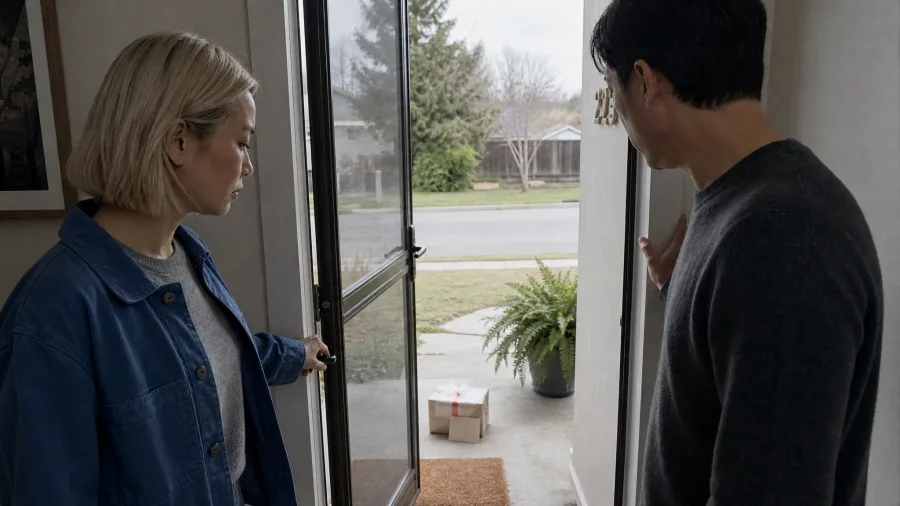
What a grandchild offers is not an opening. If the partner cannot be blamed for the distance, the children cannot be used as a way past the adult child either, and the manoeuvres that look like grandparent devotion tend to prove exactly what the silence was meant to stop. The surprise pickup from daycare, the gift mailed straight to a two-year-old's door, the appearance at the school gate: each one tells the adult child that the boundary was advisory. It also puts the child in the middle as the thing standing between you and a grandchild, and anything that makes the child a wedge raises the cost of contact.
Grandparent visitation, where it exists at all, is a matter of state law, differs from state to state, and is not something to infer from a forum thread; if you are weighing it, take the question to a family-law attorney. There is no automatic right of access to a grandchild.
What keeps a door open is smaller and duller than a surprise visit. A birthday card and a gift addressed to the whole household, with nothing attached, treat the adult child as the parent of a family rather than as a gatekeeper to be worked around. And if the question ever comes back, why contact stopped, the answer that helps owns the decision to follow their lead and leaves it open to talk about later, with no blame in it and nothing asked for.
What support actually costs
8. Change comes from a pattern, not one conversation

Three months of one channel, no questions, nothing escalated. About a year before you judge whether anything has moved.
Even with every side route closed, nothing gets repaired by a single better conversation. What the people who work with estranged families describe, consistently, is that what shifts a situation is a pattern visible over months: the same channel, no pressure, ordinary steadiness. Words do very little of it. The first move is still one message of two to four sentences, naming one specific thing, sent once, with no explanation of intent and nothing asked for. Then a card, or a short text, at intervals, in the same place, without escalation.
Help exists, and in US metros it is priced plainly. A family therapist runs about $150 to $225 for a 50-minute session; a certified family mediator about $150 to $300 an hour; an estranged-parent support group is often free and rarely more than about $30 a session. NAMI's family support line, at nami.org, is a place to start when you want to talk to someone who has heard this before.
One possibility has to be named honestly: the answer may be no, and the silence may outlast everything you send. That is why the week needs work in it, friends in it, your health in it, and support that is not a reply from your son. Reconciliation can be one project among several. It cannot be the only one.
💡 Tip: Mark a date on the calendar today — twelve months out — for an honest review, not a verdict.
🗓️ The first three months, step by step
Pick the one channel
Choose whichever thread is still open and commit to staying on it alone.
Write the two-to-four sentence message
Name one specific act, attach no request, and send it a single time.
Stop adding
No second email, no voicemail, no surprise visit for at least three months.
Keep the card going
Send one card or photo with no question in it during the waiting period.
Fill your own week
Book work, friends and health commitments so the silence does not become your whole calendar.
Frequently Asked Questions
How long does it usually take for an estranged adult child to reply?
There is no fixed timeline, but a realistic working figure is three months of one-channel, no-question contact before expecting anything back, and about a year before you can honestly judge whether the pattern is shifting. Contact often stays minimal for much longer, and some parents find the silence simply continues.
Should I keep sending birthday and holiday cards?
Yes, as long as the card asks for nothing. A card with no question, no guilt paragraph and no request for a reply is one of the lowest-cost ways to remain present. A gift addressed to your child's whole household keeps the same door open without putting your adult child in the role of gatekeeper.
What if my child's partner is actually controlling or dangerous?
That is a different situation from ordinary estrangement. Access is not the goal; safety is. Skip the ultimatums, which tend to produce the answer you fear, and speak to a licensed family therapist or a domestic-abuse service about what steps are realistic and safe for everyone involved.
Do I have a legal right to see my grandchild?
Grandparent visitation rules vary state to state and there is no automatic right of access. Check your state's rules with a family-law attorney before assuming anything, and treat any legal step as separate from the relationship work described here.
Where can I get support for myself while I wait?
An estranged-parent support group is often free to about $30 a session, a licensed family therapist runs $150–$225 per 50-minute session in US metros, and NAMI's family support line at nami.org is a place to start if you need a person to talk to. Support is not a backup plan; it is what keeps the waiting sustainable.
What to Send This Week, and What to Stop Expecting
Send the message this week. Two to four sentences, one specific thing you did, no explanation of intent, no request, sent once on the single channel you have left. Then mark a date three months out and keep that channel quiet until it, or send the card or photo you already planned.
Because the route that stayed open is the quiet one: a 31-year-old son, twenty months of little or no contact, a two-year-old grandchild you know through shared photos, a birthday card that still goes out. Phone calls are the first thing dropped, so text, card and photos are where you work.
Support is not the afterthought. A licensed family therapist, a support group free to about $30 a session, or NAMI's family support line at nami.org – and a week of your own that is not on hold for a reply.
The silence may outlast every bit of this. Most parents assume the quiet is a verdict on how they loved; it is a boundary, and the answer to a boundary was never more proof. Send the small message, lower the cost, and live the life that does not wait on an answer.
Before you send anything else
Open your notes app and reread the last three things your child said in anger. Look for the repeated request. That is the sentence your next message should answer — and nothing more.