

Why did we stop talking after Mom died? That is the question people type at eleven at night, months after the funeral, when the group text that used to light up with her reminders about Grandma's birthday now sits with three read receipts and no reply. This is what that silence usually is.
The belief you walk in with is that love would have kept the calls going, so the quiet must mean something about the relationship. Usually it means something else. One person was the calendar, the host, the news service and the referee, and when that hub goes, contact has to be rebuilt on purpose or it simply stops happening. Old scores surface at that exact moment, because nobody has the energy to referee them.
Below are eight ordinary mechanisms that turn a parent's death into distance. By the end you should be able to point at the one running in your family and leave with a single move for this week, whether that is a check-in text, a named issue, or a small ritual that belongs to the siblings alone.
Distance like this is not a verdict on how much anyone loved anyone. It is a missing structure, and a ledger that opened at the worst possible time.
Quick Tips Before You Start
Put a date on it
Replace "we should get together sometime" with a specific day before you leave the funeral parking lot.
Own one task
Pick a single concrete job — the obituary, the utility accounts, scanning the albums — and finish it without asking permission.
Name the invisible work
Say the caregiving you did out loud once, without turning it into a scoreboard.
Split the two conversations
Estate questions go to the attorney. The "I was the one who showed up" feeling goes to your sibling, not the lawyer.
Ask for specific support
Say "call me Thursday for twenty minutes" instead of "be there for me" — it gives the other person a move.
The Shared Structure Disappears
Before anyone can have a hard conversation, something practical has to vanish first. In most families that something is the parent's role as the hub: the house that hosted, the address list, the phone call the week before a birthday, the relay of news from one child to another.
The distance that follows is not usually chosen. It is what fills a slot nobody noticed was load-bearing until it went empty. The next two causes are both versions of that same disappearance — one social, one logistical.
1. The parent was the only shared calendar

"I only ever knew what was going on with my brother because Dad would mention it on the phone."
That is the most common answer to the question in this entry's heading, and it describes a system, not a closeness problem. One parent ran the whole thing: the turkey in November, the birthday list on the fridge, the call three days before each due date so a card arrived on time, and the relay service – your sister got the promotion, your brother's roof needs replacing, the niece has a recital on the 12th. Siblings heard about each other, but they did not talk to each other, because there was no reason to.
Ask yourself one straight question, and answer it before you finish the next sentence: in the last year before your parent died, how many times did you contact a sibling directly, without that parent mentioned in the call or copied on the text? If the answer is close to zero, the line between you was your parent's, and it went out with the estate.
The families that stay in touch share an odd feature – someone had already built a channel the parent did not control, a Sunday call, a running text thread about nothing, a yearly weekend that predates the death. If nothing like that exists in yours, the replacement is duller and smaller than people expect: a group message restricted to logistics and photos from the house, or a twenty-minute call on a set date each month, arranged on the spot in the funeral home parking lot while everyone is still standing together and can agree to a time.
💡 Tip: If nobody has started a sibling-only thread yet, start it today and give it a job: "Sending the photos from the attic. Reply with which ones you want."
🌱 GROWING TIP
Book the sibling slot in September
Pick one recurring thing that belongs only to the siblings — a November dinner, a first-week-of-August call — and put it on the calendar before anyone's partner claims the date. A ritual with a date survives the year; a good intention does not.
2. Distance splits logistics from the grief

The usual advice is to split everything as evenly as possible, and it assumes the siblings are starting from the same place. They are not. Evening it out fairly means measuring who lives twenty minutes from the probate office and who lives two time zones away.
On a Tuesday afternoon the local sibling is doing a walkthrough of the house with a realtor and still has to get to the pharmacy before it closes. The far sibling finds out about the roof after it is fixed, hears the update third-hand, and carries guilt plus a $400 flight that cannot happen on a Tuesday. With that spreadsheet running under every call, the conversation turns to dumpster rental and closing dates and nobody ever says the thing about Dad.
This is the part where distance gets misread. It is not indifference, and a sibling who lives three states away can be one of the closest in the family. What separates the two is whether someone says it plainly, once: "I am far away and I know that puts too much on you." Stating it does not solve the logistics. It stops the room from silently rewriting the distance as not caring.
The remedy is concrete. The far sibling claims one whole task – the obituary, the utility accounts, digitizing the photo albums – and asks for a scheduled update instead of waiting for news to travel. Sunday, 7 p.m., fifteen minutes, on the calendar for both of you.
That single request does two things at once. It gives the local sibling a break from being the news service, and it gives the far one a real role in a process that otherwise happens entirely without them, twenty minutes at a time.
When the task is owned and the call is scheduled, the distance is a fact you have worked with. When neither exists, the phone only rings about the dumpster.
💡 Tip: Do not offer to "help with whatever." Name the task you are taking and the day it will be done.
What People Assume About Sibling Drift
Old Roles and Fairness Surface
Once the practical tasks thin out, a second layer shows up — the ledger. Who did the caregiving, who got the loan, who was always the favorite, who was never called. The parent used to referee that ledger, or at least absorb it.
With the referee gone, siblings discover they have been keeping score for years. The next three causes are all versions of that scoreboard opening at the worst possible moment.
3. Caregiving falls unevenly and breeds resentment

The errands do not just pile onto whoever lives nearby. They quietly become a moral ledger of who showed up.
The visible column is countable and counted: six oncology appointments, the medication list taped to the refrigerator, four months of pharmacy runs, the utilities and the probate meetings. The invisible column rarely gets a line – the 2 a.m. call nobody else heard, the hour spent keeping a frightened parent calm, the family updates texted out one at a time. Then the urgent tasks stop and the calendar empties, and the anger that had nowhere to go while there was still a prescription to fill finally has room.
Some families escape this. Those who split care by a written schedule, or who had paid caregivers carrying the load, are arguing about something else. For the rest, naming the invisible work out loud once, without turning it into a scoreboard, is the way back.
What Each Side Remembers a Year Later
The one who logged the hours
- Still holds the receipt list, felt glad to do it
- Mentions a hard week once, months in, carefully
- Stops volunteering for the next family task
- Answers the group text a day late, then two
The one who lived out of state
- Remembers the calls, not the driving
- Reads the late reply as a verdict on them
- Brings up the old split only when cornered
- Hears silence and assumes it is about money
4. Inheritance turns grief into a fairness audit

The worst conversations happen in a kitchen six weeks after the funeral, over a set of dishes nobody wanted, and they cost more than the dishes. A dollar figure lands on a lifetime of who drove to the appointments and who sent a check, and the number becomes a way of asking whether your years counted. That is why settling the estate splits families that never argued about money before.
There is a house, a loan from 2016, a will nobody can find, jewelry with no list behind it. One sibling wants the estate divided by the number of children; another wants it divided after the caregiving years come off the top. Each is holding a defensible definition of the word fair, and the two definitions do not meet. Say the split out loud early, with a neutral executor and something on paper, and you discover the disagreement in a lawyer's office instead of across a casserole.
Keep the money questions and the love questions in separate rooms. If the estate paperwork is unclear, that goes to the estate attorney or the county's self-help page, not to a sibling's memory of what Dad wanted.
💡 Tip: Before the first estate meeting, each sibling writes privately what "fair" means to them. Compare the lists with the attorney present.
⚠️ COMMON MISTAKE
Don't settle the estate in the kitchen
The worst place to divide a house, a ring and a 2016 loan is a table with no agenda and no witnesses. Book one meeting with the attorney, send the inventory in advance, and keep the emotional conversation separate from the asset conversation.
5. Old family roles harden under stress
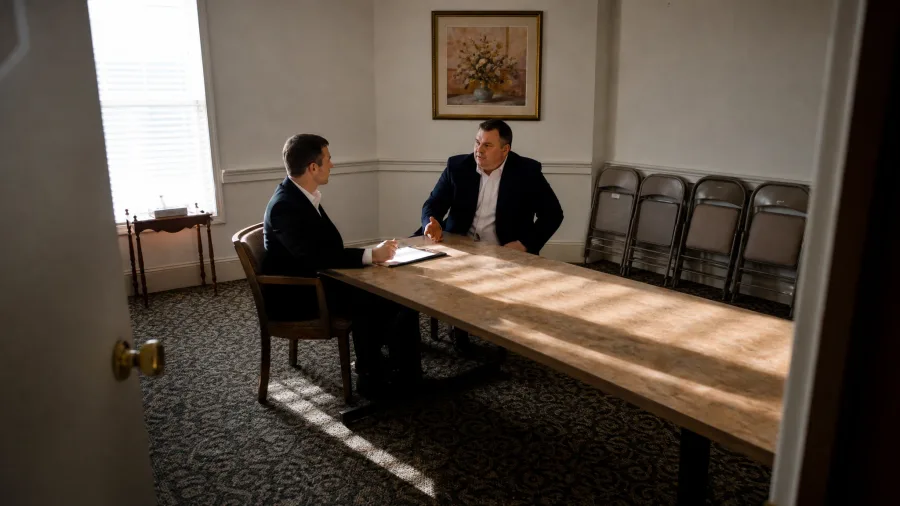
Whatever part you played at twelve, mostly, and the casting was set long before you could question it: one of the reasons adult children pull away from their parents, the caretaker who does it all, the one who can do no wrong, the rebel who won't set foot in the church, the mediator who smooths every silence, the invisible one nobody thinks to call.
The church booking, the obituary draft, the 'I'm not good at that' – the script revives within hours, and by the second day everyone is a child again, fighting about who is doing it wrong. It holds because the others keep rewarding it. Some families quietly reset once the parent who cast the parts is no longer in the room.
Naming it once is what interrupts the scene: 'we're doing the thing where I do everything and you get the blame.' Then change one behavior – the caretaker hands off a single task and does not redo it. That's how a role loosens.
💡 PRO TIP
Hand off once and let it be imperfect
The obituary will come back with a typo. The flowers will be the wrong color. Say thank you and leave it. Redoing a handed-off task proves the old script right — and it teaches everyone that the caretaker will always cave.
Grief, Partners, and Silence
The first five causes explain how the infrastructure broke. These last three explain why the gap sometimes closes and sometimes hardens into years of silence.
Grief styles differ, partners have opinions, and avoidance is easier than a hard phone call. That combination decides whether a pause stays a pause.
6. Different grief styles read as coldness

I once mistook a brother's calm for indifference and said so, and it took a year to walk that back. He had been the one on the phone with the hospice at two in the morning; he simply did not cry where I could see it. Siblings can sort out every old part they played and still collide over grief, because no two of them do it the same way, and the mismatch starts reading as evidence.
One wants to tell the hospital story again at ten at night. One would rather price the caterer than sit still. One stops answering and needs the door shut. Each behavior gets filed as proof: the talker is demanding, the organizer is cold, the quiet one never cared. Over months that filing hardens into a family story that is retold every holiday, and the cost is a sibling you now describe instead of call.
The fix is smaller than matching anyone's style: ask for the support you actually want, like a twenty-minute call on Thursday. The quiet one often says yes.
7. In-laws create competing holiday loyalties

Eight days in December, split across four households and two states, and someone has to lose. When the house that held every Thanksgiving goes on the market, the question of who hosts stops having a default answer, and your brother's wife has a mother who expects the same week you do. Nobody in that negotiation is being cruel; there are simply more claims than dates.
Watch what the partner does to the room. One drives your sister three hours to the cemetery and waits in the car. One absorbs the brother who starts shouting about the will, so the two of you can talk on the porch after. One frames every visit as a choice between his family and yours, and that is the version that hardens into years.
What tends to work is boring and early: the holiday settled by September, years alternated in a text everyone can see, and one dinner in November with no partners at the table at all. Some couples never need it, because the partner stays out of it and lets the two of you land somewhere awkward but yours.
When the Quiet Becomes the Default
There is a point where distance stops being a gap and becomes a habit, and nobody sits down and decides it. It builds instead, out of small reasonable choices: the call you meant to return on a Tuesday and didn't, the December you stayed home because the drive was six hours and the weather was bad, the question about the house you let go quiet because raising it felt like an accusation. Each one on its own is unremarkable. Stacked, they become a pattern nobody named.
The mechanism is simple and it is about cost. Early on, calling your brother costs a little awkwardness and might produce something good. Two years in, calling him means admitting the silence happened, picking a subject, risking the fight you have both been avoiding, and possibly being rebuffed. Not calling costs nothing today. So the balance tips, quietly, and the silence becomes the easier option rather than the sad one.
This is the cause that decides how the rest of it ends, and it is also the one most fixable with the smallest move. A pause hardens when the door looks expensive to walk through. It stays a pause when the door looks cheap.
8. Avoidance turns a pause into a cutoff

It's a Thursday in March and you're driving home from work with the phone in the cup holder, and you think: I should call. The thought is clean and specific and you can see the exact moment you could do it. Then you remember the last conversation was four minutes long and mostly about a parking permit, and you let the exit go by.
The obvious advice is to have the conversation. Sit down, clear the air, say the thing about the house and the loan and the year you were the only one who showed. That advice is usually wrong, because the conversation is precisely what both of you have been avoiding, and proposing it is the surest way to extend the silence another season. What turns a pause into a cutoff is rarely one fight. It's a series of skips that each made sense at the time, and by the second year the silence has become the default: calling now costs more than not calling, because it would require explaining why you didn't call in the first place.
Grief makes this easy to fall into. Energy is low, the fight feels expensive, and there is a strange courtesy in not wanting to burden the other person, who is also grieving, also tired, also probably waiting for you to go first.
So the move that works is smaller than the conversation. It's a message that asks nothing and demands no reunion: "I found the photo of the lake. Want me to send it?" That's the whole text. A door with no charge on it, low enough to walk through without either of you having to explain the last two years.
Some pauses are not cutoffs. Some siblings genuinely need a year, or more, before they can come back to the table, and pushing them only lengthens the wait. The door being open is what lets them return when they're ready; the door being shut is what turns the pause into the ending nobody chose.
💡 Tip: Send the small message on a weekday morning, not a Sunday night. It arrives when the other person has somewhere to be and a lower bar for replying.
Is This a Pause or a Cutoff? — At a Glance
📆 How long
The year mark is the fork, not the verdict
📞 Last contact
Who sent it last? That asymmetry is the signal
💰 Unresolved issue
Name it only after the neutral door is open
🎄 Missed events
The second skipped holiday is the default hardening
🚪 Your next move
Send the no-charge text. Then wait one full week
The honest test
Skip this move if the last attempt was met with a clear no. A door held open is not a door pushed on; one person asking for more time deserves the time.
Frequently Asked Questions
Is it normal for siblings to drift apart after a parent dies?
Yes, and it is common. The parent was often the only shared calendar, the relay for news, and the referee of old fairness questions. When that role disappears, contact has to be rebuilt deliberately, and most families never do it. That is a missing structure, not a missing love.
How do I bring up caregiving resentment without starting a fight?
Name it once, in plain words, and say what you want: "I handled the appointments for two years and I'm still angry about it. I don't want an apology, I want us to acknowledge it." Keep it to one issue and do not turn it into a scoreboard. Then let the other person respond before you add anything.
Should we split the estate equally or fairly?
Both words are honest and they can mean opposite numbers. Equal means divided by the number of children; fair means offsetting the years of care or an old loan. Write down what "fair" means to you before the meeting, then take the question to the estate attorney rather than settling it at the kitchen table.
My sibling seems fine while I am falling apart. Does that mean they don't care?
Usually not. Three common grief styles — talking, organizing, withdrawing — look like indifference to each other from across the room. The organizer's "I'm handling it" and the withdrawer's silence get filed as evidence of not caring, which is usually the wrong reading. Ask for one specific kind of support instead.
How long is too long to go without talking before I reach out?
If a year has passed with no specific attempt from either side, the silence has become the default and it will not break on its own. Send something small that asks for nothing — a photo, a one-line memory — rather than proposing a reunion or a big conversation. You can send it this week.
What if my sibling's partner is the reason we stopped talking?
Then the fix is the sibling, not the partner. Settle the holiday in September, alternate years in writing, and protect one sibling-only slot — a dinner with no partners at the table. You are not asking your sibling to choose; you are asking for a single recurring date that belongs to the two of you.
Sort Your Situation Before You Send Anything
If the drift is recent and practical, send one low-pressure message this week: a photo from the house with no ask attached, or four words, coffee the week of the 14th. If caregiving or inheritance is the center of it, name one concrete thing and ask for a conversation rather than a verdict. I want to talk about the six thousand, not about who loved Dad more. Thursday?
If avoidance has hardened, add one small sibling-only ritual you can actually keep: fifteen minutes the first Sunday of the month, or a shared album with one upload a week. It carries no history and no argument, which is exactly why it survives.
The thread with the read receipts is still sitting there. The next message does not have to be large, and none of these eight causes is a verdict on anyone. They are structures, and structures can be rebuilt by two people who decide to. Send the photo, or ask for the Thursday.
Pick the Cause That Fits Your Family
Scroll back to the one cause that made you wince, and do that section's single replacement move this week. One message, one date, one named issue.