
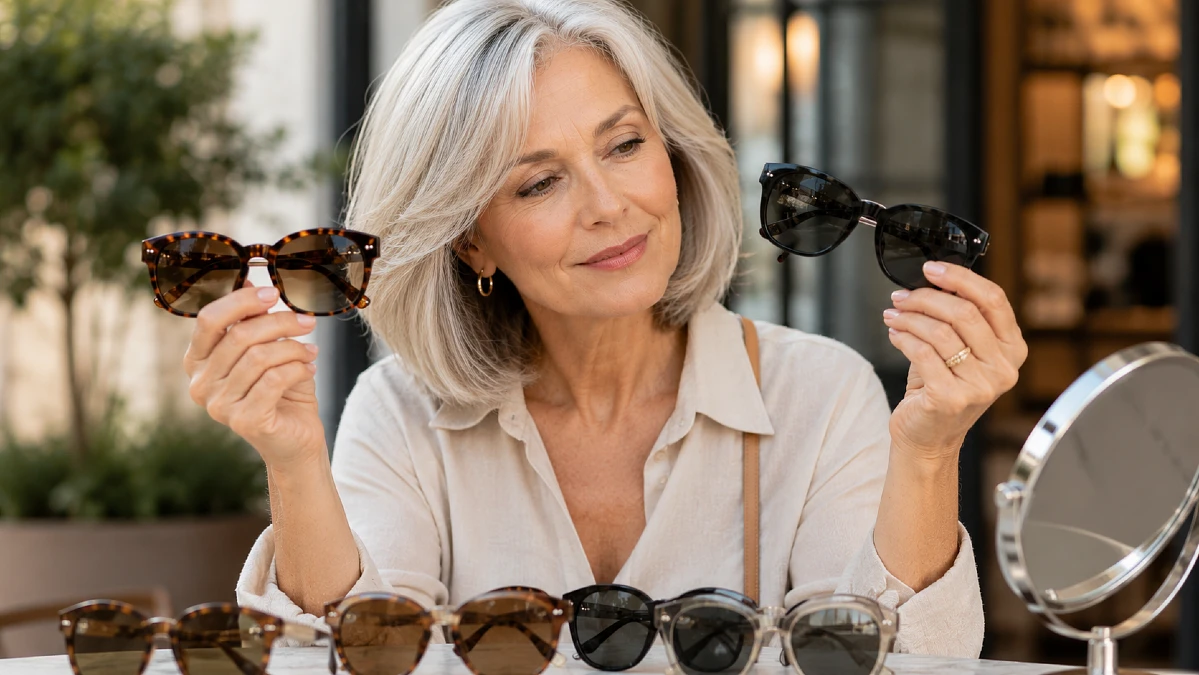
Choosing sunglasses can become surprisingly frustrating when frames that once looked good suddenly feel too harsh, too heavy, or simply wrong.
For women over 50, the challenge is rarely about following a strict face-shape rule. Changes in hair color, brows, skin tone, and facial softness can affect how a frame looks just as much as the shape of your face.
The good news is that you do not need a drawer full of trendy sunglasses. A few smart choices around proportion, frame weight, color, and fit can make sunglasses feel polished and modern while supporting your style confidence over 50.
Face Shape Is a Starting Point, Not a Rule
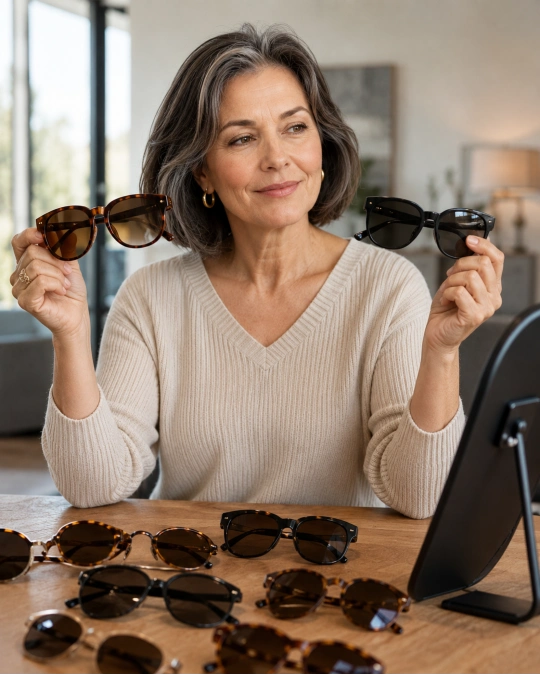
Most sunglasses advice begins by placing your face into a category: round, square, oval, heart, or long. That can be useful, but real faces rarely fit neatly into one label.
You may have a softly square jaw with fuller cheeks, or an oval face with a wider forehead. Instead of trying to diagnose your face perfectly, look for the features that stand out most.
Notice the width of your forehead, the shape of your jaw, the fullness of your cheeks, and whether your face looks longer or wider overall.
The goal is usually balance. A frame can either echo your natural lines for a softer effect or contrast with them to create more definition.
Here is a simple way to translate traditional face-shape advice into something more useful.
| Face Shape or Feature | Frames Worth Trying | Why They Often Work |
|---|---|---|
| Soft, round features | Rectangular, softly square, subtle cat-eye | Adds a little structure and definition |
| Strong or square jaw | Oval, rounded square, curved frames | Softens sharper facial lines |
| Oval proportions | Most medium-scale shapes | Balanced proportions handle many styles |
| Wider forehead, narrower chin | Soft cat-eye, oval, rounded frames | Keeps the upper face from looking too heavy |
| Longer face | Deeper lenses, oversized frames, rounded shapes | Adds visual width and breaks up length |
Treat these as fitting-room suggestions, not restrictions. If a supposedly “wrong” pair makes you feel fantastic, that matters more than the chart.
Frame Proportion Matters More Than the Trend
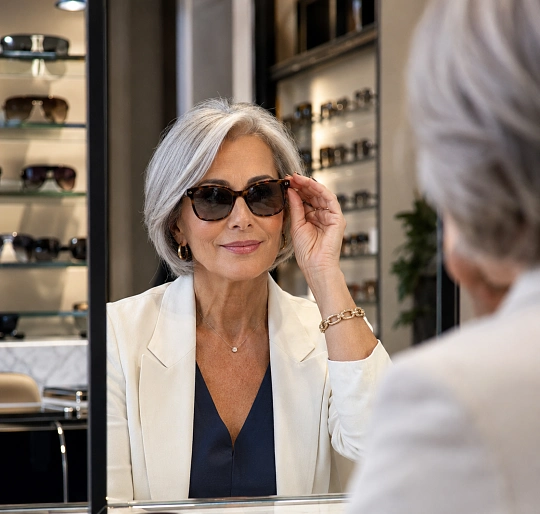
One of the most common reasons sunglasses look wrong has nothing to do with age or face shape. The scale of the frame simply does not suit the face.
Very small lenses can make the face look larger by comparison, while extremely oversized frames may overwhelm your features. A medium-to-generous frame often gives enough presence without taking over your face.
Look at where the outer edge of the frame ends. In many cases, sunglasses look balanced when they sit close to the width of the face rather than extending dramatically beyond it.
The depth matters too. If you have a longer face, a slightly deeper lens can bring more balance. If your features are petite, a huge frame may feel costume-like even when oversized sunglasses are fashionable.
Try this: take a quick phone photo while trying on sunglasses. A straight-on photo often reveals proportion more clearly than staring closely into a store mirror.
Choose Frames That Work With Your Features Now
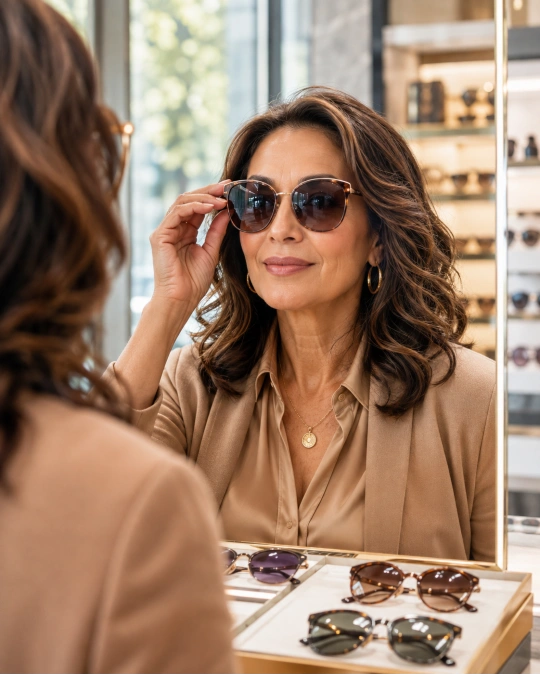
Sunglasses sit near your brows, cheekbones, hair, and eyes, which means small design details can make a big difference.
A frame with a slightly lifted outer corner can give the face a fresher sense of direction. It does not need to be a dramatic cat-eye; even a gentle upward angle can create that effect.
Frames that droop heavily at the outer corners can sometimes pull the eye downward. If that bothers you, compare them with a shape that runs straight across or lifts slightly.
Your eyebrows also matter. Frames generally look more harmonious when the upper edge follows the natural direction of the brow instead of fighting against it.
A Few Fit Checks That Matter
- The frame should not press into your cheeks when you smile.
- Your eyelashes should not brush against the lenses.
- The bridge should stay comfortably in place without constant pushing.
- The arms should feel secure without squeezing the sides of your head.
- The frame should sit level rather than sliding noticeably to one side.
Comfort is part of looking polished. Sunglasses that constantly slip down your nose will become irritating no matter how stylish they are.
Color Can Be More Flattering Than Black

Black sunglasses are useful, but they are not automatically the best choice for every face.
Very dark frames create strong contrast. That can look striking, but softer colors may feel more harmonious if your hair has become silver, grey, blonde, or lighter overall.
Tortoiseshell, warm brown, soft navy, burgundy, olive, taupe, champagne, and translucent grey can all provide definition without looking severe.
If you enjoy black, you do not need to give it up. Try a slimmer black frame, a translucent black finish, or a shape with softer curves if a thick solid frame feels too dominant.
This is especially useful when building chic outfits for women over 50, because sunglasses can repeat the undertone already present in your shoes, handbag, jewelry, or hair.
Use this guide when deciding between frame colors.
| If You Want… | Try… | Why It Helps |
| Softer contrast | Taupe, translucent grey, champagne | Defines the face without a heavy outline |
| Warmth | Tortoiseshell, caramel, warm brown | Works well with camel, cream, rust, and gold tones |
| A polished dark neutral | Navy, espresso, burgundy | Feels rich without the starkness of black |
| More personality | Olive, berry, muted blue | Adds color while remaining easy to wear |
| Strong definition | Black or deep charcoal | Creates crisp contrast and a modern finish |
Color note: try the frame in daylight if possible. Indoor shop lighting can make both skin tone and frame color look different.
Lens Color Changes the Look Too
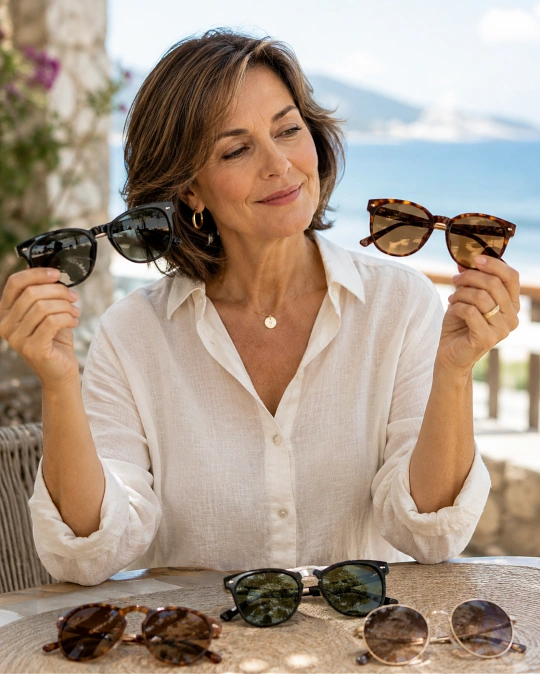
The lens is not just functional. Its color changes how heavy or soft the sunglasses appear on your face.
Solid dark lenses create a strong, classic look and can work well with structured clothing. Gradient lenses tend to look lighter because the lower half of the lens is more transparent.
Brown and amber-toned lenses can soften warm tortoiseshell frames, while grey lenses keep the look neutral.
For everyday use, think beyond the mirror. Choose lenses with proper UV protection and use sunglasses that are comfortable enough to keep on when you are walking, driving, traveling, or sitting outdoors.
A stylish frame is far more useful when it also works for your real life.
Let Your Hair Color Influence the Frame
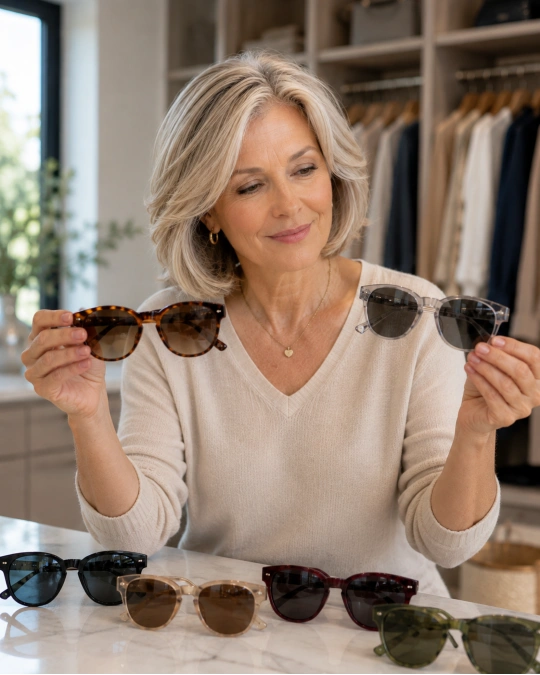
Hair often changes the way sunglasses read on the face.
Silver or grey hair can look beautiful with black, navy, burgundy, clear grey, deep green, or rich tortoiseshell. These shades give enough contrast to frame the face without competing with the hair.
If your hair is blonde or light brown, caramel, soft tortoise, taupe, olive, and translucent frames can create a gentler transition.
Dark hair can carry stronger frame colors easily, but that does not mean you need a heavy frame. A slim dark frame can offer definition while keeping the look refined.
The same sunglasses may also feel different after a haircut. Short hair exposes more of the frame, while longer layers can soften its edges.
This is why dressing over 50 works best when you respond to what you see now rather than trying to recreate a look that worked ten years ago.
What Can Make Sunglasses Feel Dated
Older sunglasses are not automatically dated. Many vintage-inspired shapes look wonderful.
The issue is usually the combination of shape, decoration, and proportion.
If a pair feels slightly off, compare these small changes before ruling out the whole style.
| Instead of… | Try… |
| Very narrow lenses that barely cover the eye area | A slightly deeper lens with similar styling |
| Thick decorative temples with lots of detail | Cleaner arms or one subtle metal accent |
| A very low, drooping outer edge | A level or gently lifted frame |
| A frame that slides down constantly | A better bridge fit or adjustable nose pads |
| Choosing a shape only because it is trendy | Picking the trend in a scale that suits your features |
You do not need to avoid fashion trends. The better approach is to borrow the part of a trend that works for you.
For example, if oversized sunglasses appeal to you, choose an oversized frame with clean lines instead of the largest pair you can find.
Build a Sunglasses Formula You Can Repeat

The easiest approach is to think of sunglasses the same way you might think about a personal uniform.
Formula: medium-scale frame + slight upward or balanced shape + wearable neutral color + comfortable bridge fit.
That combination works with many everyday outfits for women over 50, from jeans and a linen shirt to wide-leg trousers and a lightweight blazer.
You can then vary the formula rather than starting from scratch every time.
For casual errands, try tortoiseshell with brown lenses. For lunch or travel, a polished black or navy frame can add structure. For summer, translucent champagne or soft olive can make the same wardrobe feel lighter.
The frame changes, but the fit logic stays the same.
Conclusion
Good sunglasses are less about finding the “correct” frame for your age and more about finding a shape that works with your face, hair, wardrobe, and daily life.
Use face-shape advice as a starting point, then trust proportion, comfort, and the way the frame makes you feel. Style confidence over 50 grows when you stop chasing rigid rules and start recognizing what suits you now.