

Why do some people grow remarkably gracious as they age, while others turn sharp, resentful, and bitter over the exact same decades?
You notice it at family gatherings, in neighborhood grocery lines, or across long-standing friendships where two people facing identical physical aging paths arrive at completely opposite emotional destinations.
This article settles what happens beneath the surface of personality over time, examining the specific psychological shifts that turn accumulated friction into either warmth or enduring bitterness.
At a Glance
How the Accumulation of Unresolved Grievances Hardens the Mind

You sit across the kitchen table from a relative who is cataloging every slight, unmet expectation, and perceived injustice from decades past with the exact same raw intensity as if it occurred this morning.
The conventional advice tells you to simply forgive and forget, urging people to let go of the past as if memory were a light switch you could just flip off at will.
That obvious recommendation backfires completely because it treats deep habituation as a simple choice rather than recognizing how accumulation actually works over time.
Instead of forcing a sudden release you cannot sustain, acknowledge the stack explicitly by saying out loud that the old score has been recorded and you are choosing to close that ledger for today.
⚠️ COMMON MISTAKE
The Danger of Keeping Score
Constantly rehearsing past wrongs trains your emotional baseline to expect hostility, making kindness feel like a risk rather than a natural reflex.
Why Cognitive Flexibility Determines Your Emotional Trajectory

Three seconds is usually all it takes to notice whether an unexpected change in plans triggers a curious question or an immediate, rigid defense.
When expectations are locked into fixed scripts about how people and circumstances are supposed to behave, every deviation from that mental blueprint turns into a personal affront.
Ask yourself how often you spend the evening running through past grievances just because someone failed to follow the exact sequence you envisioned.
If the answer is most days, rigidity is quietly running the show, whereas catching that impulse early allows you to drop the script and meet reality as it actually arrives.
The Divergence Timeline Over Decades
What Happens When Time Horizons Shrink?

As people realize their remaining years are finite, their emotional priorities undergo a radical sorting process.
Psychologists who study life span development point out that an awareness of limited time horizons forces a very clear choice: spend your remaining energy fighting reality, or invest it in meaningful connection.
Those who choose bitterness spend their remaining capital trying to prove they were right about every past grievance, treating every interaction as a final courtroom trial.
That stance quietly costs them their remaining peace, because keeping old arguments alive requires a daily investment of attention that could otherwise go toward simple enjoyment.
Meanwhile, those who choose kindness focus entirely on being present with whoever is in front of them today, letting the ancient scorekeeping drop away because the energy cost has finally become too high to justify.
Emotional Priority Shift — At a Glance
⏳ Time Perception
Finite Horizon
🎯 Primary Focus
Present Connection
🛡️ Defense Level
Drastically Lowered
The Core Shift
Limited time strips away patience for petty arguments and unnecessary conflicts.
How Social Circles Shrink and Amplify Existing Habits
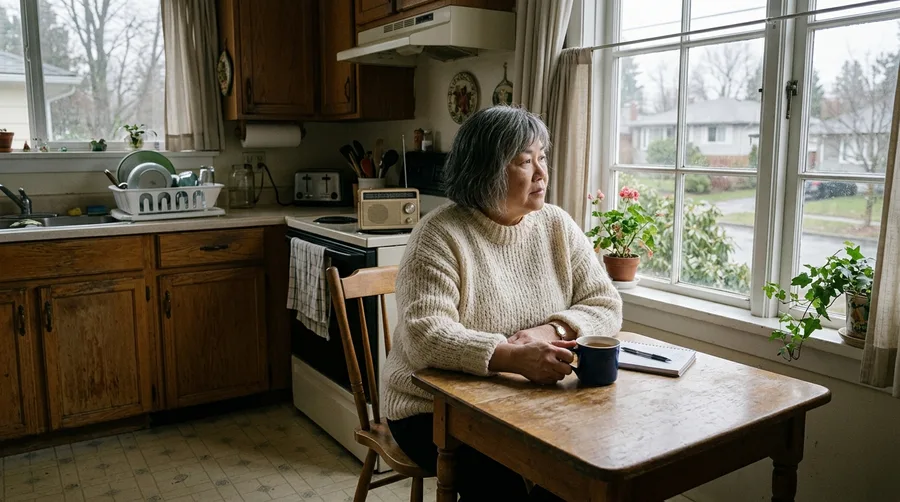
People often assume that becoming isolated in later life simply means you have more peace and quiet.
You sit at the kitchen table on a Tuesday morning with the radio low, watching the sunlight move across the linoleum while the hours stretch out entirely unscripted.
When your world contracts like this, the daily friction you encounter no longer comes from diverse colleagues or conflicting opinions, but from the same looped thoughts echoing in an empty room.
Instead of finding tranquility, you find that every minor annoyance with the local grocery store or a distant relative grows larger because there is nothing else in the space to push against it.
To break that loop, pick one public place this week where you have to exchange brief, neutral pleasantries with a stranger and stay for twenty minutes without checking your phone.
The Two Trajectories Compared
The Bitter Trajectory
- Rehearses past slights daily
- Views change as a personal threat
- Interprets neutral acts as hostility
- Clings tightly to control
The Kinder Trajectory
- Practices radical acceptance
- Allows others to be imperfect
- Releases minor grievances quickly
- Focuses on shared presence
Can You Change Your Trajectory After Decades of Habit?

Is it genuinely possible to rewrite decades of automatic responses when your patience feels completely worn down?
You stare at the coffee table after a frustrating exchange, convinced that forty years of entrenched habits leaves you trapped as you are.
The hidden cost of that belief is enormous because it hands over your remaining years to autopilot long before you actually need to surrender.
Researchers who study adult development consistently find that while baseline personality traits remain steady, behavioral loops remain surprisingly elastic right up to the end.
You notice this elasticity when someone who spent a lifetime snapping at minor inconveniences suddenly pauses, breathes, and simply lets a dropped set of keys hit the floor without a sigh.
The observer misreads that shift as a natural softening born of passing time, but it is actually a deliberate interruption of a very old neural shortcut.
Instead of letting the grievance run its standard course through your internal monologue, you catch the familiar tightening in your jaw and choose a completely different action.
Try naming the loop out loud the next time it starts to form by saying, I am running that old story again, and let it drop right there.
🌱 GROWING TIP
Interrupting the Resentment Loop
When you catch yourself replaying an old argument, pause for five seconds, name the urge to stay bitter, and deliberately choose to let the thought pass.
Frequently Asked Questions
Why do some people become more bitter as they get older?
Bitterness usually stems from decades of accumulated, unresolved grievances and a rigid refusal to accept unmet life expectations. When past hurts are rehearsed daily, they harden into a permanent defensive worldview.
Is personality fixed after midlife?
While core traits remain relatively stable, behavioral habits and emotional reactions can be actively reshaped at any age through conscious awareness and intentional practice.
How can I stop myself from becoming bitter?
Start by identifying recurring resentments and practicing radical acceptance of things you cannot change. Catch yourself when keeping score and deliberately drop minor grievances.
What role does social connection play in aging with kindness?
Diverse and supportive social interactions challenge insular thinking and prevent isolation, which is a major accelerator of bitterness and resentment.
The Choice That Arrives Every Morning
You do not have to fix every old wound or rewrite your entire history to experience a softer second half of life.
Drop the need to keep score on yesterday, and let the small annoyances of today pass without a fight.
Run Your Own Resentment Check
Look at the scorecard above and pick just one old grievance to release this week.