

Finding your best colors can suddenly feel much harder when your hair turns silver, your skin looks softer in tone, or shades you wore for years no longer seem quite right.
That change can make dressing over 50 more confusing than it needs to be. You may wonder if grey hair automatically makes you a cool season, if black still works, or if your old color analysis is now useless.
The good news is that grey hair does not erase your natural coloring. You simply need to look at undertone, contrast, depth, and clarity together. Once those pieces make sense, choosing clothes, makeup, scarves, and jewelry becomes much easier.
Why Your Best Colors Can Feel Different After 50

Your basic skin undertone usually remains fairly stable, but the overall way your coloring reads can change. Grey or white hair may lower your contrast, remove warmth around your face, or make softer colors suddenly feel more harmonious.
Skin can also appear less visually contrasted against the eyes and hair than it once did. That does not mean you need to abandon color. It means you may need to adjust the intensity, depth, or temperature of the shades you wear near your face.
For example, a woman who once looked balanced in deep chocolate and warm rust may find that slightly softer camel and terracotta now feel more natural. Someone who wore strong black beautifully may prefer charcoal, navy, or cool berry once her hair becomes silver.
The goal is not to find colors that make you look younger. It is to find colors that let your face appear clear, balanced, and connected to the rest of your outfit.
Start With Undertone, Not Hair Color
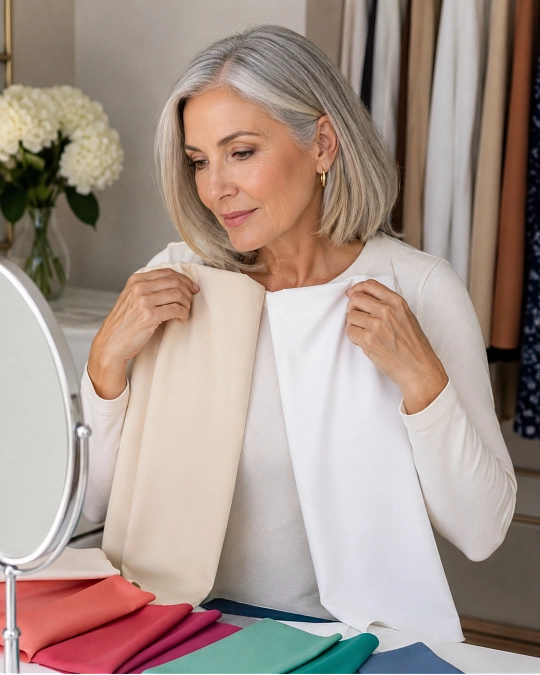
Grey hair creates one of the biggest misunderstandings in seasonal color analysis: silver hair does not automatically make you cool-toned.
Your hair is only one part of the picture. Your skin’s undertone matters much more when deciding between warm and cool color families.
Warm undertones often look balanced beside shades such as cream, camel, olive, peach, warm teal, tomato red, and golden brown. Cool undertones often respond well to crisp white, blue-grey, cool navy, raspberry, plum, icy pink, and blue-based red.
Neutral undertones may sit comfortably somewhere between the two.
Try comparing similar colors rather than asking whether one random shade looks good. Hold cream beside pure white, coral beside raspberry, camel beside cool grey, or olive beside blue-green.
Look at your face rather than the fabric. The better color often makes your eyes seem clearer and your complexion more even without requiring extra makeup.
This quick comparison can help you see what you are actually testing.
| Compare | Warmer Option | Cooler Option |
|---|---|---|
| Light neutral | Ivory or cream | Crisp white |
| Mid neutral | Camel | Cool grey |
| Green | Olive | Pine or blue-green |
| Pink-red | Coral or tomato | Raspberry or cranberry |
| Brown-purple | Cinnamon | Plum |
Color note: Do these comparisons in natural daylight and without heavily tinted foundation. Indoor yellow lighting can make almost every color look warmer than it really is.
Look at Contrast Before Choosing a Season
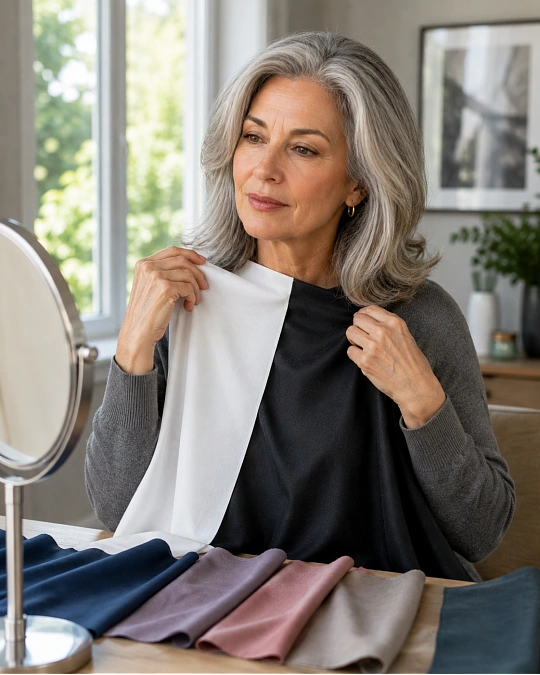
Temperature is only part of seasonal color analysis. Contrast often becomes even more useful once hair turns grey.
Contrast describes the difference between your hair, skin, and eyes. Someone with bright white hair, darker brows, and clear eyes may still have fairly high contrast. Someone with soft silver hair, light brows, and gently blended features may have lower contrast.
This matters because two women with equally cool undertones may need completely different palettes.
A higher-contrast face can often carry clearer combinations such as navy with white, charcoal with raspberry, or black with icy pink. Lower contrast may feel more balanced in combinations such as soft navy with dusty rose, mushroom with blue-grey, or pewter with muted lavender.
Try this: take a photo of yourself in natural light and convert it to black and white. You are not judging your appearance. You are simply checking how much visual difference exists between your hair, skin, eyes, and brows.
That gives you a useful clue about how much contrast your clothes can handle.
Here is a simple way to translate contrast into outfit choices.
| Your Coloring Reads As | Try Near Your Face | Be Careful With |
| Soft and blended | Dusty blue, sage, mushroom, muted berry | Very sharp black-and-white contrast |
| Medium contrast | Navy, teal, rose, soft white | Extremely pale head-to-toe neutrals |
| Clear contrast | Cobalt, cranberry, charcoal, crisp white | Very muddy or heavily muted shades |
| Light overall | Pearl grey, light navy, soft aqua | Large areas of very dark brown or black |
None of these are strict restrictions. If you love a stronger shade that feels slightly harsh, move it away from your face and use it in trousers, shoes, bags, or prints instead.
Decide Whether You Look Better in Clear or Soft Colors
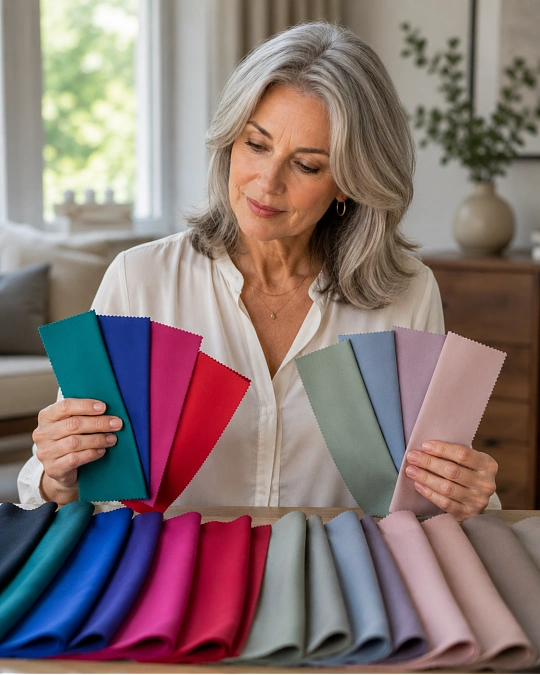
One of the most useful tests for women with grey hair is comparing clear colors with softened colors.
Clear colors have more visual brightness. Think cobalt, emerald, bright coral, clear turquoise, or strong raspberry.
Soft colors look slightly muted or dusted down. Think sage, smoky blue, dusty rose, muted teal, mushroom, mauve, and soft plum.
Grey hair often makes softer colors feel more connected to the face, but this is not true for everyone. Bright silver hair paired with clear eyes can look wonderful beside rich, clean color.
Watch what happens to your face when you test each type. If the color arrives in the room before you do, it may be too intense. If your face seems tired or disappears beside the fabric, the shade may be too muted.
The best color usually supports your features without stealing attention from them.
Use Depth to Narrow Down Your Color Season
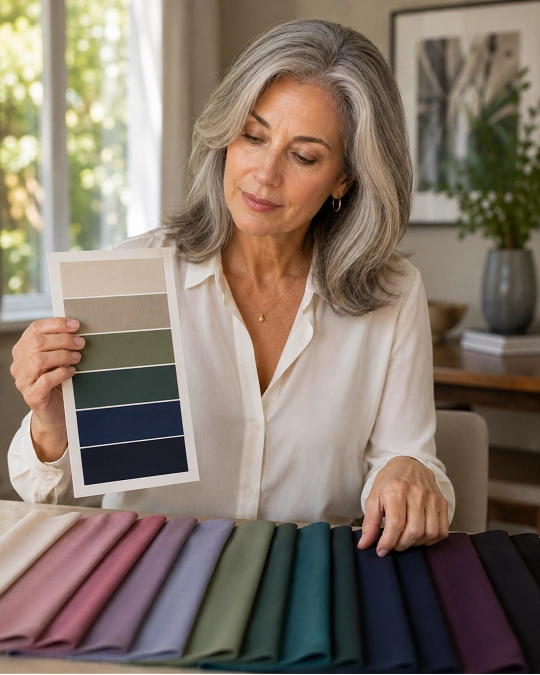
Next, notice whether lighter, medium, or deeper colors give your face the best balance.
Depth is especially helpful because grey hair can change how much darkness you want near your face. A deep palette that once worked beautifully may suddenly feel heavy when your hair becomes much lighter.
Instead of automatically replacing every dark shade with a pastel, experiment with medium-depth colors first. Navy, medium teal, burgundy, forest green, denim blue, aubergine, and charcoal often provide enough definition without overwhelming softer coloring.
Fit note: Color and silhouette work together. A large dark turtleneck creates much more visual weight near the face than the same color used in an open-neck blouse or fine cardigan.
Necklines can therefore help you keep beloved darker shades. A V-neck, scoop neck, open collar, or soft jacket exposes some skin between the fabric and your face, reducing the strength of the color.
That small adjustment can make dressing over 50 feel much less restrictive because you do not have to remove half your wardrobe just because your coloring has changed.
Find Your Likely Season Without Getting Trapped by Labels
Traditional seasonal color analysis divides coloring into Spring, Summer, Autumn, and Winter, with many modern systems adding sub-seasons such as Soft Summer, Deep Autumn, or Bright Spring.
Those names can be useful, but the label matters less than the pattern behind it.
Spring palettes generally lean warm and clear. Summer palettes are usually cool and softer. Autumn colors tend to be warm, earthy, and muted or deep. Winter palettes are generally cool, stronger, and more contrasted.
Grey hair can appear in every season.
A warm-toned woman with silver hair may still belong in an Autumn or Spring family. A woman whose grey hair looks beautifully connected to cool blue, plum, and charcoal may lean Summer or Winter.
Use this table as a starting point rather than a verdict.
| If You Look Best In | You May Lean Toward | Useful Colors to Test |
| Warm, fresh, clear shades | Spring | Warm turquoise, coral, cream, leaf green |
| Cool, gentle, muted shades | Summer | Dusty blue, mauve, soft navy, berry |
| Warm, earthy, softened shades | Autumn | Olive, rust, teal, camel, warm burgundy |
| Cool, clear, stronger shades | Winter | Cobalt, cranberry, charcoal, icy pink |
If you sit between two categories, that is completely normal. Real people do not always fit neatly into four boxes.
Your personal palette might be “mostly Summer with a few Winter colors” or “warm Autumn shades but lighter than traditional Autumn.” That practical information is far more useful than forcing yourself into a label.
Build a Personal Color Formula You Can Actually Wear
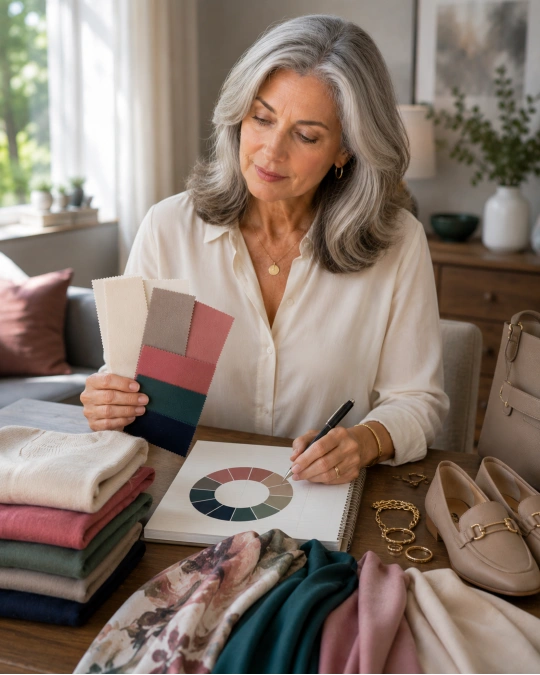
Once you understand your temperature, contrast, softness, and depth, turn them into a small personal formula.
You do not need thirty approved colors. Start with two neutrals, three everyday colors, and one stronger accent.
Formula: best neutral + comfortable everyday color + one face-brightening accent.
For example, you might wear soft navy trousers with an ivory knit and warm teal scarf. Another combination could be charcoal jeans, a dusty blue shirt, and berry earrings.
For stylish outfits for women over 50, this works because the palette creates repetition. Your wardrobe begins mixing more easily, and getting dressed stops depending on finding one exact “correct” color.
A useful starter palette could look like this:
- Two neutrals: navy and ivory, charcoal and soft white, camel and cream, or mushroom and denim.
- Three core colors: shades you enjoy wearing repeatedly in tops, cardigans, dresses, or jackets.
- One stronger accent: perhaps berry, turquoise, coral, cobalt, plum, or red.
- One metal direction: silver, gold, mixed metals, or whichever feels most natural against your skin.
Do not replace clothes simply because they fall outside your palette. Use your most supportive colors closest to your face and keep less flattering favorites in skirts, trousers, shoes, handbags, or prints.
That approach protects cost-per-wear while still making your wardrobe feel more intentional.
What Can Throw Off a DIY Color Test
Home color analysis works best when you remove a few distractions. Small testing mistakes can make you think a good color is wrong or a difficult color is better than it really is.
- Testing under warm bathroom lights: Move beside a window during daylight so the light does not distort your skin.
- Judging your hair instead of your face: Watch your eyes, skin, shadows, and overall balance.
- Wearing full makeup during testing: Strong blush, bronzer, or lipstick can make unsuitable colors appear more harmonious.
- Testing only one shade: Compare warm against cool and clear against soft so you can see an actual difference.
You are looking for patterns, not one dramatic before-and-after moment. Several small comparisons usually tell you more than one supposedly definitive test.
Frequently Asked Questions
Does grey hair mean I am a cool color season?
No. Grey hair can be silver, white, salt-and-pepper, or slightly warm, but your skin undertone still plays a major role.
Warm-toned women can have grey hair and still look wonderful in cream, camel, olive, coral, or warm teal.
Can your color season change as you get older?
Your underlying coloring usually does not flip completely, but your best versions of certain colors can shift.
Lower contrast or lighter hair may make slightly softer, lighter, or less severe shades feel more balanced than the colors you preferred years ago.
What colors look good with grey hair?
Grey hair can work beautifully with navy, teal, berry, plum, blue, green, soft pink, ivory, charcoal, and many other shades.
The better question is whether your coloring needs those shades to be warm or cool, muted or clear, light or deep.
Is black flattering with grey hair?
It can be. Bright white or silver hair with clear features can look striking beside black, while softer coloring may feel more balanced with charcoal, navy, or deep grey.
If black feels severe near your face, try an open neckline, scarf, necklace, or softer-colored jacket between the black and your complexion.
How can I find my color season at home?
Begin in natural daylight with no strong makeup and compare pairs of colors: cream versus white, camel versus grey, coral versus raspberry, and muted blue versus clear cobalt.
Notice which side makes your skin appear more even and your eyes more noticeable, then repeat the test several times before deciding.