

Glasses can suddenly feel harder to choose when the frames you once loved no longer seem quite right. A shape that used to brighten your face may now feel too heavy, too harsh, or simply disconnected from the way you dress today.
That frustration is common for women over 50, especially when most frame advice still relies on rigid face-shape charts. Those rules rarely account for changing hair color, softer features, comfort, progressive lenses, or the fact that your personal style may have changed too.
The good news is that flattering glasses are less about finding one “correct” shape and more about proportion, color, fit, and personality.
Start With Frame Width and Bridge Fit Before Worrying About Face Shape

The most flattering glasses usually begin with fit, not fashion. Frames that are too wide can make your features look smaller, while very narrow frames may pinch visually and physically.
Look at where the outer edges of the frame sit in relation to your face. Ideally, they should stay close to the width of your face rather than extending dramatically past it.
The bridge matters just as much. If glasses constantly slide down your nose, the frame may be too wide through the bridge or simply built for a different nose shape.
Use this quick fit check when trying on frames:
| Frame Area | What to Look For | Why It Helps |
|---|---|---|
| Overall width | Frame edges sit close to your face width | Keeps proportions balanced |
| Bridge | Comfortable contact without pinching or sliding | Helps frames stay properly positioned |
| Temples | Arms sit straight rather than bowing outward | Prevents pressure and an overly tight appearance |
| Brow line | Frame follows or sits slightly below your natural brows | Keeps your expression visible |
| Lens depth | Enough room for your prescription without overwhelming your face | Creates better visual balance |
Fit note: Look straight ahead when checking frames. Glasses that seem attractive when tilted or pushed higher than they naturally sit may feel completely different once you wear them normally.
Let Your Features Guide the Shape Instead of Following a Face-Shape Chart
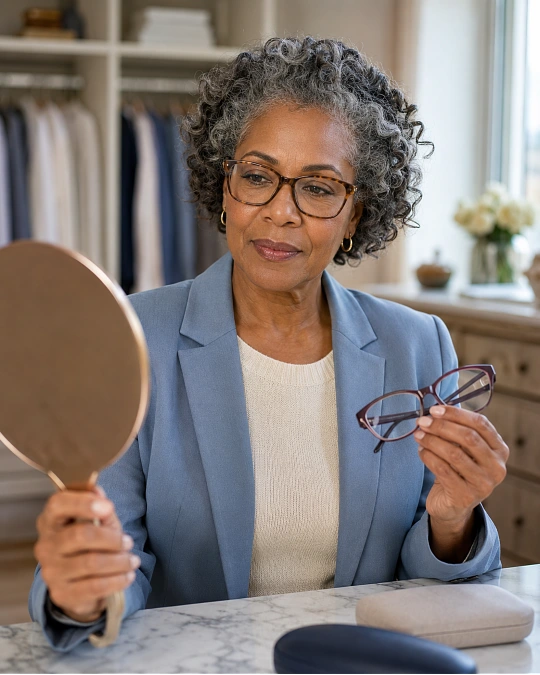
You have probably seen advice telling round faces to wear square frames and square faces to wear round ones. That can be a useful starting point, but it is far too simple to work for everyone.
Instead, pay attention to the overall balance between the frame and your features.
If your features feel soft, a frame with a little structure can add definition. Gentle rectangles, soft squares, subtle cat-eye shapes, and slightly angular frames can all create that effect without looking severe.
If your features already have strong angles, rounded rectangles, oval-inspired shapes, or frames with softened corners can create a calmer balance.
The goal is contrast without exaggeration.
A dramatic geometric frame can look wonderful if bold accessories are already part of your personal style. If you normally wear simple earrings, soft knits, and neutral clothing, a cleaner shape may feel more natural.
That is an important part of dressing over 50: your glasses should make sense with the woman wearing them, not just match a diagram.
Choose a Frame Color That Brings Life to Your Face

Frame color sits directly beside your eyes, skin, and hair, so it can affect your appearance more than the color of many clothing pieces.
Black frames are popular, but they are not automatically the most flattering option. A very dark frame can sometimes create more contrast than you want, especially if your hair or coloring has become softer.
Brown tortoiseshell, warm amber, deep navy, burgundy, muted green, translucent taupe, soft gray, and clear frames can give definition without creating a hard border around the eyes.
Try holding several colors near your face before deciding. The right frame often makes your eyes appear clearer and your complexion look more awake.
Pay Attention to Your Current Hair Color
Your natural hair color from twenty years ago does not need to determine the glasses you wear now.
Silver, gray, white, highlighted, brunette, red, and blonde hair can each interact differently with frame colors.
Cool gray hair often looks striking with navy, charcoal, berry, cool tortoiseshell, soft blue, or translucent frames. Warmer hair tones can work beautifully with honey, olive, warm brown, copper-inspired shades, and classic tortoiseshell.
You do not need an exact match. A little contrast usually gives glasses more presence.
This table offers a more flexible way to think about color than traditional rules.
| Old Rule | A More Useful Approach |
|---|---|
| Black frames suit everyone | Compare black with navy, tortoiseshell, gray, or translucent shades |
| Match frames exactly to your hair | Choose a related tone or gentle contrast instead |
| Bright frames are only for younger women | Wear color if it works with your wardrobe and personality |
| Neutral frames are always safer | Pick a neutral that still gives your face enough definition |
| You must know your exact color season | Compare several shades in natural light and notice which brightens your face |
Color note: If a frame seems attractive on the display rack but you notice the glasses before you notice your eyes, try the same shape in a softer color.
Check Where the Frame Sits Around Your Eyes and Brows

A beautiful frame can still feel wrong if its proportions fight with your eyes or eyebrows.
Your pupils should sit reasonably close to the center of the lenses. They do not need to be mathematically centered, but a frame that places your eyes very high, very low, or far toward the inner edge may look poorly balanced.
Your brows also matter. Frames do not have to copy your eyebrow shape perfectly, but the top line should generally work with it rather than cutting awkwardly across it.
For many women, slightly lifted outer corners can bring energy to the face. That is one reason soft cat-eye frames remain useful.
The lift does not need to be dramatic. A subtle upward line can look modern without turning the glasses into a costume.
Lens Depth Matters If You Wear Progressive Lenses
If you wear progressive lenses, very shallow frames may leave less vertical space for different viewing zones.
That does not mean you need oversized glasses. A medium-depth lens can provide useful room while still keeping your features visible.
Ask the optician whether a frame works well with your specific prescription before falling in love with the shape alone.
Comfort is part of flattering style. Glasses you constantly push up, remove, or adjust will rarely feel polished.
Avoid Frame Details That Overpower Your Face

There is nothing wrong with bold glasses. In fact, a strong frame can become part of your signature look.
Problems usually appear when several strong details compete at once.
A thick frame, very dark color, oversized lens, heavy temple, and dramatic embellishment can create much more visual weight than a single statement feature would.
If your frames feel slightly “off,” you may not need a completely different style. Changing just one element can solve the problem.
Try these small adjustments:
- If thick black feels harsh: try the same silhouette in tortoiseshell, navy, clear brown, or translucent gray.
- If oversized frames hide your features: keep the shape but choose a slightly smaller lens.
- If tiny frames feel dated: try a medium-scale version with similar lines.
- If a dramatic cat-eye feels too theatrical: look for a soft upswept corner instead.
- If metal frames disappear too much: try a slightly thicker rim or warmer metal tone.
Here is another simple way to compare common choices:
| If This Feels Off | Try This Instead |
|---|---|
| Heavy dark rectangle | Softer square in tortoiseshell or navy |
| Very small narrow lenses | Medium lenses with a little more depth |
| Huge oversized frame | Similar shape scaled closer to your face width |
| Strong decorative temples | Cleaner arms with interest around the front |
| Completely rimless frame feels invisible | Fine metal or translucent acetate |
The aim is not to make glasses disappear. It is to let them support your face rather than compete with it.
Match Your Glasses to the Clothes You Actually Wear

Glasses are part of your daily wardrobe, especially if you wear them from morning to night.
Think about the colors already hanging in your closet. If you live in navy, cream, denim, camel, gray, olive, and burgundy, frames that work with those colors will earn far more wear than a pair that only works with one special outfit.
This is where the same thinking used for a capsule wardrobe over 50 becomes helpful. Versatile pieces do more work and reduce decision fatigue.
You might still own more than one pair. One neutral frame can handle everyday life, while a more colorful or distinctive frame can work when you want extra personality.
Your frame can also change the mood of the same basic outfit.
| Base Look | Frame Choice | Effect |
|---|---|---|
| White shirt + jeans | Warm tortoiseshell | Relaxed and polished |
| Black knit + trousers | Thin metal frame | Clean and refined |
| Navy sweater + denim | Soft blue or navy acetate | Coordinated without looking matched |
| Cream blouse + camel trousers | Honey or translucent brown | Warm and elegant |
| Simple neutral dress | Burgundy or green frame | Adds personality without extra accessories |
Budget-friendly tip: Before buying several trendy pairs, start with one frame that works with at least three quarters of your everyday wardrobe. Cost per wear matters with glasses just as much as it does with shoes or coats.
Use One Repeatable Formula When You Try On New Frames
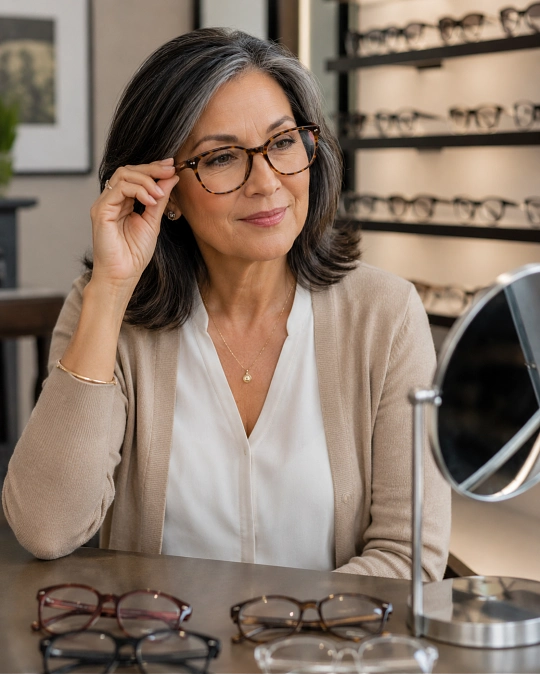
Too many choices can make every frame start looking wrong. Having a simple personal formula makes shopping much easier.
Formula: balanced frame width + comfortable bridge + clear eye area + flattering color + one detail you genuinely like.
That last part matters. Maybe you love an upswept corner, a translucent finish, a fine gold rim, or deep tortoiseshell.
Keep that signature detail while adjusting the other elements around it. You do not have to reinvent your style every time your prescription changes.
For everyday wear, try taking photos of your top three pairs from straight ahead and from a slight angle. Look at the photos later rather than judging only in the mirror.
Often the most flattering pair is the one where your eyes remain the first thing you notice.
Frequently Asked Questions
What glasses make you look younger after 50?
No frame can literally make someone younger, and chasing that goal can lead to choices that do not feel like you.
Instead, look for frames that keep your eyes visible, fit correctly, and bring some definition to your face. A slightly lifted shape, modern scale, and flattering color often create a fresher appearance.
Are cat-eye glasses flattering for women over 50?
They can be very flattering. A soft cat-eye adds gentle lift around the outer corners of the face and works especially well if you enjoy feminine or polished clothing.
You do not need a dramatic vintage shape. Many modern versions have only a slight upward angle.
Are oversized glasses good for women over 50?
They can work beautifully if the width stays proportional to your face and the frame does not hide your brows or overwhelm your features.
If you like the oversized look, try a lighter color, thinner rim, or translucent material to reduce visual heaviness.
Should glasses match your hair color?
They do not need to match exactly. Frames can coordinate with your hair, contrast with it, or bring out another color in your eyes and wardrobe.
The better test is whether the frame brings definition to your face without making your coloring look dull.
What color glasses are most flattering with gray hair?
Navy, berry, charcoal, soft blue, tortoiseshell, translucent brown, and many metal tones can all work with gray hair.
The best option depends on your skin coloring, wardrobe, and how much contrast you enjoy. Try several shades in daylight whenever possible.