

Most people assume the hard part of leaving a long marriage is the decision itself – one moment of clarity, a sign, a last fight that settles it. What actually happens is that no such moment arrives, and the marriage goes on, flat, while you wait for a certainty that never comes.
Picture a couple, both 55, married 24 years. A $520,000 house with $210,000 still owed on it, $760,000 in retirement accounts, a 16-year-old who leaves for college in two years. A life that makes leaving look unaffordable, and maybe unwise.
After that much shared history, the flatness starts to feel like what long marriage simply becomes. Leaving would waste the 24 years and the built life. But flatness can be boredom, which responds to change, or contempt, which does not. The 24 years are spent either way.
The money is countable: mediation at about $9,000 total against roughly $30,000 per person litigated, and a retirement split of $380,000 each before taxes and fees. The question is not whether it is too late. It is whether a living marriage is left to test, and what leaving would cost in dollars and identity. So you run one six-month experiment, with a date fixed in advance and a stated rule for what result means stay and what means go.
Quick Tips Before You Start
Write it down
Keep a private notebook of your answers. Patterns emerge on paper that you miss in your head.
Set a time limit
Give yourself six months to work through these questions. Any longer and analysis becomes avoidance.
Tell one person
Choose a trusted friend or therapist and say the question out loud. Secrecy keeps the loop spinning.
No exit talk yet
Do not mention divorce to your spouse until you have answers and a plan. Words spoken in frustration become weapons.
Get one real number
A single session with a financial advisor or mediator can replace a hundred anxious guesses.
Is It Actually Over?
The first three questions are about the marriage itself. Not how you feel about it, but what it actually does when you push on it. A marriage that is merely stuck will move when you change something. A marriage that is finished will not, no matter how hard you push.
These questions separate boredom from contempt, history from present choice, and quiet from loneliness. Get them wrong and you either leave a marriage that could have been saved or stay in one that has already ended.
1. Boredom Responds to Change; Contempt Does Not

"It's fine. We're just tired." That is the sentence people say at 10 p.m. on a Tuesday when the last real conversation happened three days ago and neither of them can name which one.
A low patch and a finished marriage can look identical from the inside for months. The flat season has no spark and no eye-rolling; the dead end has a fast, habitual contempt playing under everything – the sigh when one of you speaks, the disgust that crosses a face over nothing, the wall that goes up mid-sentence. Those are different weather systems even when both feel grey.
The way to tell them apart is smaller and more honest than another year of private analysis. After a silent dinner, one of you suggests a walk and reaches for the other's hand. The other turns away and says nothing. One of those is a bad night. A pattern of them, unbroken, is the answer forming itself.
Which is why the next six months should be structured: one counseling hour every week, one new thing you do together, one standing honest conversation about the marriage itself. If contempt persists through all three, it has survived the input that boredom does not.
Affection and curiosity still turning up, even faintly, means the marriage can be tested fairly – therapy, or a trial separation, with a real chance of movement. Contempt as the default response to ordinary contact means the same interventions are unlikely to do anything at all. The question is not how flat it feels. It is whether the marriage still moves when you push.
💡 Tip: Track repair attempts for two weeks. Write down every time one of you reaches for the other and what happens. The pattern is the answer.
2. The 24 Years Are a Cost, Not a Reason

Twenty-four years. A $520,000 house with a $210,000 mortgage still on it, two children raised, a shared history nobody else can decode. It feels like a mountain of evidence for staying, and it is evidence – of what has already been paid. None of it is recoverable by staying and none of it is recoverable by leaving. It is spent either way.
Walk the other direction instead. If nothing changes, the next 24 years look like the last several: both of you moving from 55 to 79 through the same silence or the same contempt, the same routines with the same person in the same chair. The past does not get a vote on that, because the past is not what you would be living in.
There is a distinction worth sitting with. Not wanting to lose what you built is grief for history, and it can be real and honest. Wanting to be inside this marriage tomorrow, knowing exactly what tomorrow looks like, is a present-tense choice. The first can be completely true while the second is false.
A long history does justify one real attempt – six months of counseling or a structured trial separation – but only if the present is tolerable rather than contemptuous. History earns the test. It does not earn an indefinite extension.
This is how sunk cost works in a life rather than a spreadsheet. The 24 years feel like a reason, and treating them as one keeps the next 24 hostage to the first. Ask instead what the arrangement buys now, this month, and whether you would sign up for it again from where you sit.
🌱 GROWING TIP
One Real Repair Attempt
Before you decide anything, commit to six months of active repair: weekly counseling, a shared new activity, and a standing honest conversation about the marriage. If nothing moves, you have your answer. If something does, you have a marriage to work with.
3. A Fine-Looking Marriage Can Still Leave You Lonely

The cost comes first: you can talk yourself out of loneliness for years, and most people do, because nothing looks wrong enough to justify the conversation. A marriage where nobody shouts and nobody leaves still has a bill, and it is paid in small, quiet amounts.
Seven o'clock, the four of you at the table. One of you describes the problem with a client; the other answers in short, flat words while a phone stays face-up beside the plate. The 16-year-old clears their plate at 7:20 without being asked. Nobody at the table asks anybody a real question all evening, and nobody names that as strange.
The need you stopped raising is the one that matters most. A weekly hour together with no logistics in it, or simply being asked how the day actually went – you dropped it to keep the peace, so its absence now passes for calm. Researchers who study marriage keep finding the same thing: the silence between two people matters more than the volume of the arguments. 'We never fight' and 'someone in this house knows me' are different reports, and only one of them describes connection.
So the test is specific. Can you name one person inside the marriage who knows your medical history, the fear you have not said out loud, and what actually happened to you today? Some quiet marriages can answer that easily and are content, not lonely. If you cannot, that is real information about the connection – it says the connection needs testing, not that the exit is automatic.
What Leaving Really Costs
The next three questions turn the focus from the marriage to the practical reality of leaving. Here you price the exit: housing, retirement, children, and identity. Fear inflates these costs or denial hides them. A clear number turns fear into a decision input.
This is not about talking yourself out of leaving. It is about knowing exactly what you are choosing so that neither panic nor fantasy makes the choice for you.
4. Two Households Cost More Than One

The equity and the accounts first. The house appraises at $520,000 against a $210,000 mortgage, so $310,000 sits in it before a single fee; a 6% sale takes $31,200 off that, and the $278,800 left splits into roughly $139,400 per person, pre-tax. The retirement total of $760,000 divides into $380,000 each, and that is a balance, not a check you can spend without a tax hit.
Then the fees. Mediation runs about $9,000 for the two of you; going to court runs about $30,000 apiece, and either bill lands on top of the splits above, not instead of them.
Now the part people skip: living. On $150,000 combined, two households means two rents or mortgages, two utility bills, two insurance policies, two grocery carts every week.
The Exit Bill: What Leaving Costs in This Example
5. A Calm Split Beats a Cold War for Kids

The standard line is that you owe it to the kids to hold the marriage together until they are grown. But the timing here cuts the other way: the youngest is 16, two years from a dorm room, and the house is still the daily classroom until then.
The ten-second version: picture a normal Tuesday dinner. Is the table silent, needling, or warm? Your kids are learning that answer, not the speech you give them about commitment.
When you do talk to them, it should come after the two of you have a plan, not before, with college money separated from blame and the holidays and handovers for the 16-year-old spelled out plainly.
One caveat. If the house is volatile rather than cold, moving first on a split without a safety plan can put everyone at more risk, so a lawyer and a therapist come before any family conversation.
💡 Tip: Do not ask your children to choose sides or to be your confidant. Their loyalty should never be a bargaining chip.
⚠️ COMMON MISTAKE
Don't Make the Kids Your Messenger
Sending messages through your children or asking them to report on the other parent puts them in a role no child should hold. Keep adult conversations between adults, even when it is uncomfortable.
6. You Will Lose 'We' but Not Yourself

The mistake here is treating the grief over 'we' as proof that the marriage is alive, and the honest version is that losing the shared identity hurts because it was worth something. The holidays, the in-jokes, the house, the one person who knows your medical history without being told. That loss needs to be grieved, not used as evidence.
Before any decision, restart one thing that had nothing to do with your spouse. The weekly tennis game with a college friend, the book club, the running. None of those roles depended on the marriage, and getting one back is a concrete test of whether the solo self is still there.
The exception is real: some people stay in the married identity because it fits them, and that is a fine reason. The difference is whether staying enlarges you or shrinks you. Identity loss is a cost to plan for, not a sign the connection survived.
How to Decide
The final three questions are about making the decision itself. They confront regret, fantasy, and the paralysis of open-ended analysis. The answer is not another year of thinking. It is a deadline and one real experiment.
These questions will not tell you what the future holds. They will tell you which choice you can live with, and how to test it before you commit.
7. Regret Favors the Path You Didn't Take
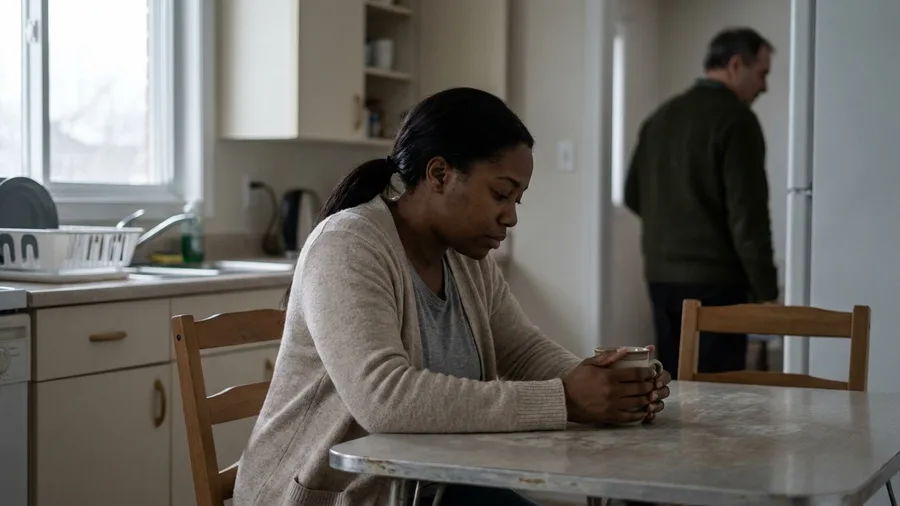
Compare the two regrets honestly and one of them wins by default, because only one of them has a film crew. Staying five more years in the same flatness is a chronic regret: it arrives quietly, a Tuesday at a time, and never announces itself as a decision. Leaving now and losing the shared history is acute: it has a date, a scene, a door closing, and a face you can picture at the moment it happens.
That is why the mind keeps running the comparison and keeps getting the same answer. The unchosen path gets a highlight reel, the chosen path gets its Tuesdays. Your imagined leaving comes with an apartment you like and a lighter feeling on a Sunday morning; it never includes the third load of laundry, the mood that follows you into a new kitchen, or the evening you have a headache and no one to say so to.
Both spouses are 55. The next 20 to 25 years run to somewhere between 75 and 80, so the real comparison is not which regret feels worse tonight but which one is livable at 75. Picture both: alone at a small table in a new apartment, coffee going cold while you scroll, and no one to ask how the night went. Then picture the same table you sit at now, twenty years on, with the same silence and the same turned-away response when you reach across.
Only one of those is tolerable, and which one it is depends on facts you can gather rather than dread you can rehearse. Regret of leaving is sharp but can be blunted by a plan: a budget, mediation quotes, one friend who knows the whole story. Regret of staying drifts on and on, with no plan to soften it because nothing in it ever changes shape.
The Regret Equation
What 20 more years of the same actually looks like
8. A Fantasy of a New Life Skips the Tuesday
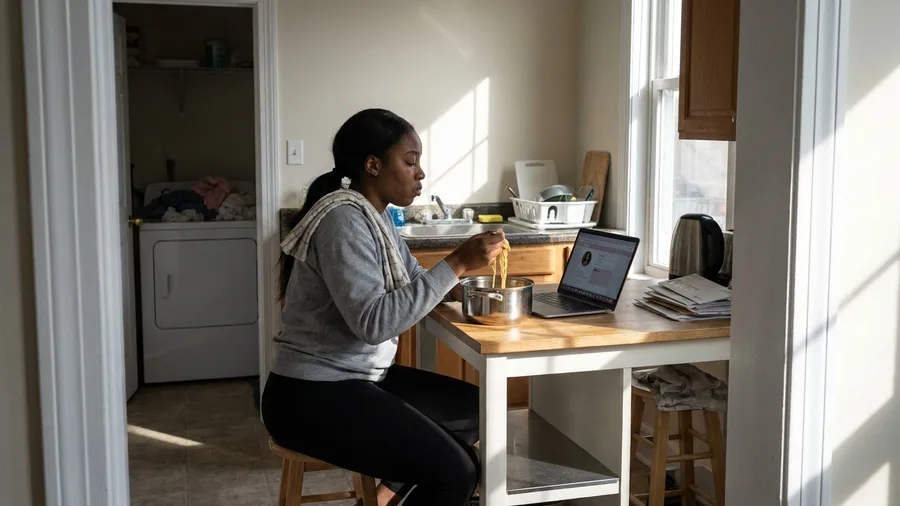
It is a Wednesday, seven twenty in the evening. You are standing at the counter in a smaller kitchen, eating pasta from the pot you cooked it in because there is no one to make it worth plating. The laundry is spinning. Your phone is propped against the dish rack. No one asks about the meeting that went badly, and no one already knows it went badly before you say it.
That is the Tuesday the fantasy skips. The imagined exit is freedom, a new partner, a clean apartment with good light, and it is a real thing, but it is a highlight reel. The chores, bills, and moods do not leave when you do. They follow you into the new place and set up in the same order.
So run the comparison properly, on ordinary days rather than on the wedding. Take tonight. Tell me what you would actually miss: not the ceremony or the anniversary, but who else knows the exact medication you take and the surgeon's name, who laughs at the thing nobody outside the house would laugh at, who notices the bad day before you have said a word about it. Some of those will still be missing on a solo Wednesday; some are worth checking whether they have simply gone quiet.
The script for this is short. Tonight, before bed, say: "If I picture my next ordinary evening without you, here is what I see." Then describe it out loud, not the freedom, the ordinary part. The next morning, ask the harder one: "Can you name the last time you asked me a real question, not about the house or the kids?" And once, quietly to yourself, or out loud if you are brave: "What would I miss tomorrow, not at the wedding?"
Both sides of the scale are Tuesdays. The shared one has chores, bills, and moods too, and the comparison only works if you weigh those honestly against the solo morning in the new kitchen. If your imagined-alone evening comes back clearer and more livable than the one you just lived, that is information worth sitting with. If it comes back emptier than tonight's table, the fantasy was doing the work, not the facts, and the staying has more left in it than you were willing to admit.
Staying vs. Leaving: The Honest Comparison
Staying
- Financial stability: one household, no split of retirement or home equity
- Daily companionship, even if it is quiet or flat
- Shared history and family rituals stay intact
- The loneliness or contempt, if present, continues
- The model of marriage your children see remains unchanged
Leaving
- Immediate costs: mediation ~$9k or litigation ~$30k per person, plus dual living expenses
- Loss of daily companionship; solo Tuesdays become your reality
- Grief for the shared identity and history
- Potential for a clearer, more authentic solo life
- Children see a different model, which may be healthier if conflict is managed
9. A Deadline Decides Better Than Another Year of Analysis

For years the advice given to anyone stuck like this was to keep thinking, keep talking it through, give it more time. That advice is what produces another decade of the same Tuesday.
counseling every week, a structured separation with rules and a lease, or a financial plan finished down to the last account. Six months is enough to see whether anything moves. A single trial of all three produces noise, not movement.
Name the criterion on paper now, while the outcome is unknown. If the eye-rolling and the turned-away hand are still the ordinary response on that date, the answer is to leave. If someone reaches and it is received, and curiosity has come back, the answer is to stay and mean it. A fixed date can rush a decision, so it belongs after one real attempt has been made, never as a substitute for making it – and where contempt is the daily pattern, the date can come sooner.
The point is that the date turns dread into something you can actually read. The experiment tests the marriage, not how much silence you can absorb.
Frequently Asked Questions
How do I know if my marriage is just stuck or truly over?
Look for contempt. A stuck marriage has no spark but still responds to change. A marriage that is over has contempt as the default response: eye-rolling, disgust, stonewalling. Test it with six months of active repair. If contempt persists through that structure, more time rarely fixes it.
Is it selfish to leave a marriage that isn't bad?
No. If you are lonely and unseen, that is a legitimate reason to question the marriage. Staying for the children or for appearances can teach them a model of loveless marriage. The question is whether the marriage is a living connection or just the price of leaving.
What does leaving actually cost in this example?
The house nets about $278,800 after selling costs, split roughly $139,400 each. Retirement accounts of $760,000 split to $380,000 each before taxes. Mediation runs about $9,000 total; litigation about $30,000 per person. Then there are two households to fund on a combined income of $150,000.
Should I stay until my youngest child leaves for college?
Not automatically. Your 16-year-old leaves in two years. What they see daily matters more than a speech. If the marriage is calm but flat, that is one thing. If there is contempt or conflict, a respectful split with a safety plan may be healthier for them than watching a cold war.
How do I stop going back and forth without a decision?
Set a fixed deadline six months out. Choose one experiment: weekly couples therapy, a structured trial separation, or a completed financial plan. State your criterion in advance. If contempt and failed repairs haven't changed by the date, you leave. If affection and repair have returned, you stay.
The Deadline That Ends the Debate
The verdict is this: 'too late' is answered by neither the calendar nor the 24 years. It is answered by whether contempt has become routine, and by whether one real experiment over the next six months changes anything. The exit cost is real, and it is plannable.
Set the date six months from today. Pick one experiment – couples therapy once a week, or a structured trial separation – and go in with a financial plan in hand. The rule is simple: if contempt and failed repair attempts are still there on that date, you leave. If affection, curiosity and repair have come back, you stay and recommit.
The 16-year-old leaves in two years. The $520,000 house still carries its $210,000 mortgage, and the $760,000 splits into $380,000 each before taxes and fees. The same facts that made leaving look impossible now frame the deadline. Leaving is not a verdict on the 24 years, and staying is not a verdict on love. The decision belongs to the present and the 20 or 25 years after it, tested by one ordinary Tuesday and one six-month experiment.
Pick Your Date Now
Take out your calendar. Circle a date six months from today. In that circle, write the one experiment you will run. You just made the decision possible.