

One person reaches sixty-five, notices the quiet social withdrawal, and retreats into silent resentment while their world shrinks; another recognizes the exact same friction, names it plainly, and restructures their daily life to protect their independence.
Cultural scripts sell late adulthood as effortless leisure, automatic deference, and easy family harmony. The daily reality introduces sudden public invisibility, minor physical setbacks that become permanent baselines, and adult children whose affectionate concern quietly borders on micro-management.
Naming these uncomfortable realities separates natural developmental milestones from preventable loss of agency. The following analysis provides the communication scripts, environmental adaptations, and psychological reframes required to maintain daily autonomy and avoid quiet isolation.
Quick Tips Before You Start
Drop Your Vocal Pitch
Speak in a lower register to cut through public infantilization immediately.
Lock In Fixed Outings
Schedule standing weekly social commitments that do not depend on mood.
Set Advice Boundaries
Ask adult children for permission before offering solutions to their problems.
Adapt Your Ambitions
Scale deferred dreams to your current physical capacity rather than abandoning them.
Social Invisibility and Shifting Connections
The social world changes its posture toward you long before your mind or spirit feels any older.
Understanding how casual interactions and family relationships transform allows you to respond with firm boundaries instead of quiet hurt.
1. Public Invisibility Sets in Without Warning

Allowing service workers to speak past you carries a compounding cost to your sense of authority.
When a medical receptionist addresses your younger companion or defaults to singsong pet names like "honey," the instinct is to assume you look frail. That misreads the moment. It is merely fast service systems running on automatic youth-bias, not a true measure of your presence or competence.
Reclaim the interaction by looking the worker directly in the eye, using their nametag name, and stating your business in a calm, unhurried, low voice.
2. Friendship Circles Shrink Faster Than Replacement

You reach for your phone to share a private joke about an old job, only to remember that the one person who shared that era passed away late last winter.
While public settings quietly bypass you, your private interpersonal world faces a much faster structural attrition. Lifelong friends relocate to distant states, slip into progressive cognitive decline, or suffer fatal medical crises, steadily shrinking the circle of peers who witnessed your youth and carry the shared history of your early adulthood.
Cumulative bereavement makes every subsequent loss far harder to carry.
Gathering at community centers for cards or bingo provides harmless entertainment, but low-stakes diversion rarely supplies genuine emotional intimacy. Polite remarks about seasonal weather or property upkeep do not create the psychological safety needed to handle the vulnerability of late adulthood, leaving you feeling entirely alone in a crowded room.
Creating durable connection requires replacing passive social drift with intentional commitments. You must propose structured habits built around shared intellectual focus, focused book discussions, or explicit agreements for daily practical safety.
Use a clear script: "I am reading this history volume and would like a dedicated partner to dissect one chapter over coffee every Tuesday." Pair that with a care agreement: "Let us send a brief morning message by eight just to confirm we are well." Concrete obligations build true emotional defense.
💡 PRO TIP
Structuring New Peer Connections
Do not invite new acquaintances to unstructured coffee dates. Invite them to a specific activity with a defined end time, like visiting a regional botanical greenhouse or touring a local architectural restoration.
3. Adult Children Treat Unsolicited Advice as Criticism

Forty years of automatic parental authority cannot be carried into your grown child's living room without triggering an immediate, defensive clash.
As outside friendships contract, emotional focus often shifts onto family, where old conversational habits cause friction. You view suggestions on household budgets or childcare as loving guidance, but your adult children hear an audit of their basic competence. Offering unprompted advice degrades mutual adult camaraderie into a power struggle over their personal boundaries.
Reframe your role from manager to peer by keeping your observations private until asked. If you notice an issue, ask first: "I have an observation on this, let me know if you want my input."
4. Conversations Revolve Increasingly Around Medical Friction

Just as family talks narrow, peer conversations easily collapse into competitive recaps of joint replacements, statin dosages, and specialist calendars.
did your last coffee meetup spend forty minutes on lab results before anyone mentioned their actual life? If yes, the group is using symptom-monitoring as an emotional buffer against health anxiety. Cataloging bodily decline feels productive, but it quietly drains mental energy, reinforces feelings of frailty, and crowds out conversations about books, ideas, or current events.
The habit replaces real connection with clinical inventory.
Breaking the pattern requires setting an explicit conversational container. Allow ten minutes for honest health updates right at the beginning, then deliberately pivot the room with a clean, structured question about an upcoming exhibition, family news, or a shared craft. Protecting that boundary keeps your social circle grounded in living rather than managing decline.
Social Conversation Habits
Symptom Rumination
- Comparing prescription side effects for thirty minutes
- Recapping specialist scheduling delays repeatedly
- Reinforcing mutual feelings of physical vulnerability
- Ending social meetups feeling drained and anxious
Purpose-Driven Dialogue
- Limiting health status recaps to five minutes total
- Discussing current civic issues or non-fiction books
- Trading notes on active woodworking or garden projects
- Leaving conversations mentally alert and engaged
Bodily and Cognitive Friction
Physical adjustments are not personal failures; they are structural realignments of your daily operating energy.
Treating physical changes with practical engineering instead of emotional denial protects your independence.
5. Minor Setbacks Establish Permanent Physical Baselines

The common mistake is assuming a mild ankle sprain or seasonal flu is just a temporary dip before bouncing back to full strength. That expectation fundamentally misreads how physical repair changes over time.
A minor setback often sets a permanent, slightly reduced baseline for daily mobility or stamina. Acknowledging that shift requires a quiet mourning process for lost physical ease that few people talk about openly. Refusing to accept the new floor leads to aggressive overexertion and re-injury, while giving up entirely accelerates muscle wasting and unnecessary dependency.
Adaptive pacing is the exception to premature surrender.
Slowing down is entirely appropriate when it is strategic management rather than passive retreat. The difference lies in calibrating daily output to your actual baseline, inserting twenty-minute rest blocks between grocery runs and yard work. You preserve physical independence over years by protecting your current capacity, not by pretending you still possess the recovery speed of your thirties.
Daily Physical Energy Allocation
6. Cognitive Retrieval Slows Despite Intact Intelligence

"It is on the tip of my tongue, give me a second." Just as physical stamina adjusts its baseline, everyday word retrieval develops a brief delay that can feel terrifying in casual conversation.
Blanking on an acquaintance's name at the grocery store or misplacing your reading glasses triggers an immediate spiral about cognitive collapse. That lag is normal processing slowdown, not neurodegenerative dementia. Your complex reasoning, abstract logic, and deep judgment remain intact even when lexical access takes a few seconds longer than it did twenty years ago.
The silent cost of that panic is social retreat.
Treating normal retrieval delays as medical decline costs you dearly over months. You begin pulling back from dinner debates, avoiding phone calls with old colleagues, and doubting your capacity to manage your own affairs. That constant monitoring creates a layer of performance anxiety that exhausts working memory far more than normal biological aging.
When a specific term refuses to surface, use an unbothered script: "The exact name has slipped my mind for a moment, but the point is this."
Reclaim your confidence by installing practical cognitive scaffolding around your living space. Put dedicated drop trays by the door for keys and wallets, maintain written checklists for complex errands, and give yourself permission to pause unhurriedly. Offloading routine working memory strain keeps your intellect sharp and focused on what actually matters.
🧠 4-Step Daily Cognitive Scaffolding Routine
Drop Zone Placement
Place keys, glasses, and wallet in the entryway bowl immediately upon entering the house.
Written Daily Queue
Write down the three primary tasks for the day on an index card before breakfast.
Conversational Pausing
Take a silent two-second breath when searching for a proper noun instead of apologizing.
Evening Reset
Review tomorrow's appointments and place necessary files on the counter before bed.
7. Sleep Fragmentation Undermines Daily Energy Reserves

Common advice suggests retirement offers all the time in the world to catch up on rest, but biology refuses to cooperate. You find yourself awake at 3:15 AM, alert in the dark while mental sharpness slips away.
Slow-wave deep sleep naturally flattens and circadian rhythms shift earlier, leaving rest shallow and broken. The consequence is persistent afternoon brain fog, frayed emotional patience, and a lower threshold for physical pain. Reaching for drugstore sleep aids or taking forty-minute afternoon naps only breaks the nighttime cycle further.
Real adjustments require behavioral guardrails: set a rigid morning wake time, get outside into direct sunlight early, and cut off fluids three hours before sleep.
8. The Familiar Home Environment Becomes a Hazard Map
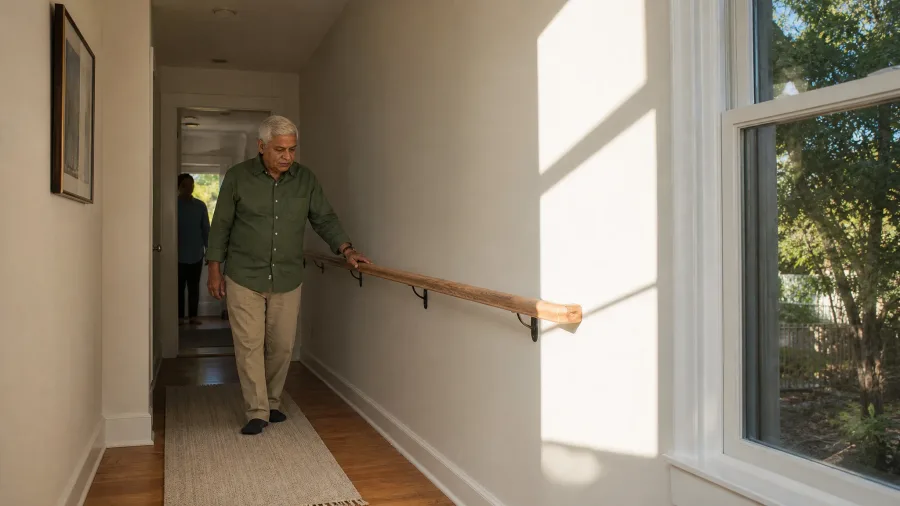
Exhaustion turns an ordinary hallway into a calculated risk.
Environmental researchers track a predictable shift: loose floor rugs, poorly lit staircases, and wet bathroom tiles quietly turn into active hazards. Staying constantly vigilant about every step drains mental reserves and produces quiet anxiety at home. Many people avoid installing wall railings or shower supports because they treat adaptive hardware as a visible badge of decline.
Reframing those home modifications as pragmatic physical engineering protects daily agency, keeping you safely in your own living space far longer than denial ever could.
Identity Loss and Existential Realities
Retirement strips away institutional identity, leaving an open expanse of unstructured time.
Building purposeful daily rituals is essential to replace the validation once supplied by your career.
9. Career Identity Evaporates Without a Structured Stand-In

Popular culture insists that complete freedom from schedules is the ultimate late-life reward. In reality, having no urgent obligations on a Tuesday morning quickly dissolves personal identity and direction.
When institutional standing, project deadlines, and the automatic social validation of a career title vanish, empty calendars feel liberating for six to twelve months. Then existential drift sets in. Without external demands, the days blur together and self-trust erodes in the silence left behind by professional life.
Measuring your value exclusively by economic output leaves you feeling abruptly discarded.
Passive leisure cannot replace the psychological anchor of real responsibility. Rebuilding durable purpose requires treating structure as an active discipline, establishing firm commitments like formal mentoring roles, intensive skill development, or scheduled volunteer posts that genuinely rely on your presence and hold you accountable.
Autonomy is never preserved by avoiding all demands. It is sustained by choosing which obligations earn your focused energy.
Post-Career Purpose Anchor — At a Glance
🏢 Primary Anchor
Civic Committee
⏱️ Weekly Time
6 to 8 Hours
👥 Social Exposure
Multi-Generational
🎯 Output Metric
Project Delivery
Structure Rule
Commit to roles with hard start times and direct accountability to others.
10. Family Decisions Are Taken Over Under Guise of Care

It is tempting to treat early family overreach as harmless affection, assuming that letting adult children handle domestic logistics simplifies daily life without any downside. That calculation proves mistaken the moment your judgment gets bypassed.
When former work identities fade, family members frequently step into the vacuum with uninvited supervision. They book specialist visits without checking, question private banking choices, and weaponize driving concerns to restrict personal mobility. This steady micromanagement chips away at self-efficacy, nudging independent adults toward learned helplessness and submissive withdrawal inside their own homes.
Unchecked paternalism rapidly erodes self-reliance.
Stopping the pattern requires setting explicit conversational boundaries before passive compliance becomes permanent. When relatives attempt to dictate your routine or take over private business, respond with a steady voice: 'I appreciate your concern for my safety, but I make the final decision regarding my schedule and finances.' Sticking to the script keeps the authority where it belongs.
⚠️ COMMON MISTAKE
Surrendering Operational Agency
Do not hand over routine digital accounts or service calls simply because a family member is faster. The moment you stop managing your domestic logistics, others begin making lifestyle decisions for you.
11. The Window for Realizing Deferred Dreams Closes

You collide with a quiet, unadvertised grief that catches most people unprepared.
Psychologists who track late-life development consistently find that confronting unfulfilled aspirations triggers genuine mourning. Decades spent prioritizing workplace demands and family obligations were sustained by the promise of future freedom. Realizing that joint limitations or fixed incomes now rule out grueling backcountry travel or capital-intensive ventures feels like an indictment of those earlier trade-offs.
Stubborn denial of these realities routinely invites physical injury instead.
Pushing through severe physical limits to salvage a dream often produces abandoned efforts, financial strain, or preventable hospital visits. The real ache is existential rather than practical: it is the sudden awareness that certain doors have closed permanently, and the time spent waiting for the perfect moment has finally run out.
Preserving your sense of agency means separating the underlying emotional hunger from the original grand plan. You can keep the core desire alive simply by scaling the execution to your current baseline.
If an international trek across rugged mountains is out of reach, replace it with well-mapped regional nature walks that test your endurance safely. If launching a new company is impractical, apply that same strategic focus to serious local historical research. Adapting the dream keeps you engaged without demanding capacities you no longer possess.
12. Time Perception Accelerates While Remaining Years Dwindle

Four months can evaporate in what feels like three weeks, leaving you standing at the kitchen window on a quiet morning wondering how another season slipped by completely unremarked.
When the milestones of work and raising a family drop away, daily routines become smooth and predictable. The brain stops recording distinct memory anchors, creating the illusion that time is racing out of control. Paired with the constant awareness of a finite future, this rapid pacing induces temporal anxiety, making restful, solitary days feel like wasted opportunities.
Frantic scheduling cannot slow down the ticking clock.
Overfilling your weeks with superficial commitments only produces chronic mental fatigue and hollow experiences. To counteract the rush, focus on novelty and presence rather than volume. Exposing yourself to unfamiliar sensory settings – visiting a new conservatory or tackling a demanding craft – restores distinct memory markers, allowing you to evaluate time by depth of engagement instead of speed.
Weekly Novelty and Isolation Defense Plan
13. Solitude Gradually Drifts into Unspoken Isolation

You set down your morning coffee, rinse the single breakfast plate, and realize the only voice in the house since yesterday afternoon has been the radio. What looks like hard-won domestic independence often disguises a subtle retreat from the world, trading the noise of earlier decades for unbroken, unexamined days of complete stillness.
Solitude quietly hardens into isolation without a decision.
Extended social isolation carries measurable biological costs, driving up baseline cortisol levels and accelerating cognitive decline through sheer disuse. Yet admitting the silence feels heavy is remarkably difficult; pride and the dread of being an emotional burden keep people from picking up the phone to reach out to peers.
Social contact cannot rely on spontaneous mood.
Preserving agency requires non-negotiable structural anchors: scheduled community meals, a reliable weekly volunteer shift, and fixed phone check-ins that guarantee regular human contact without anyone having to ask for attention.
Frequently Asked Questions
How do I handle retail workers who talk down to me?
Lower your vocal register slightly, make steady eye contact, and state your request directly using short, concise sentences. Avoid smiling excessively or apologizing before asking your question.
What is the best way to stop adult children from taking over my affairs?
Thank them for their concern, state clearly that you are making the final decision, and keep financial documents and account credentials private. Manage your own appointments and contractor calls directly.
Is momentary forgetfulness a sign of cognitive decline?
Occasional delays in recalling names or proper nouns are normal processing changes, not structural decline. If your contextual reasoning and daily problem-solving remain intact, use written checklists and deliberate pauses to assist recall.
How can I make new friends when my old social circle has shrunk?
Join structured groups focused on specific, demanding tasks such as community restoration projects, historical research, or master gardening. Shared intellectual projects build lasting trust faster than generic social hours.
Reclaiming Agency in the Unfolding Chapter
Preserving personal agency past sixty-five does not mean denying physical limits or resenting natural shifts in stamina. It begins with accepting new operating baselines, setting firm conversational limits around medical talk, and treating home safety adaptations as sensible engineering rather than defeat.
Durable independence requires replacing passive drift with deliberate structure: shutting down well-meaning family overreach, committing to obligations outside the home, and scheduling non-negotiable human connection. The choice remains the one made at every turning point: let your world quietly contract, or decide the terms on which you inhabit it.
Audit Your Daily Autonomy Today
Review your weekly schedule against section 9 to replace unstructured hours with dedicated community and intellectual commitments.