
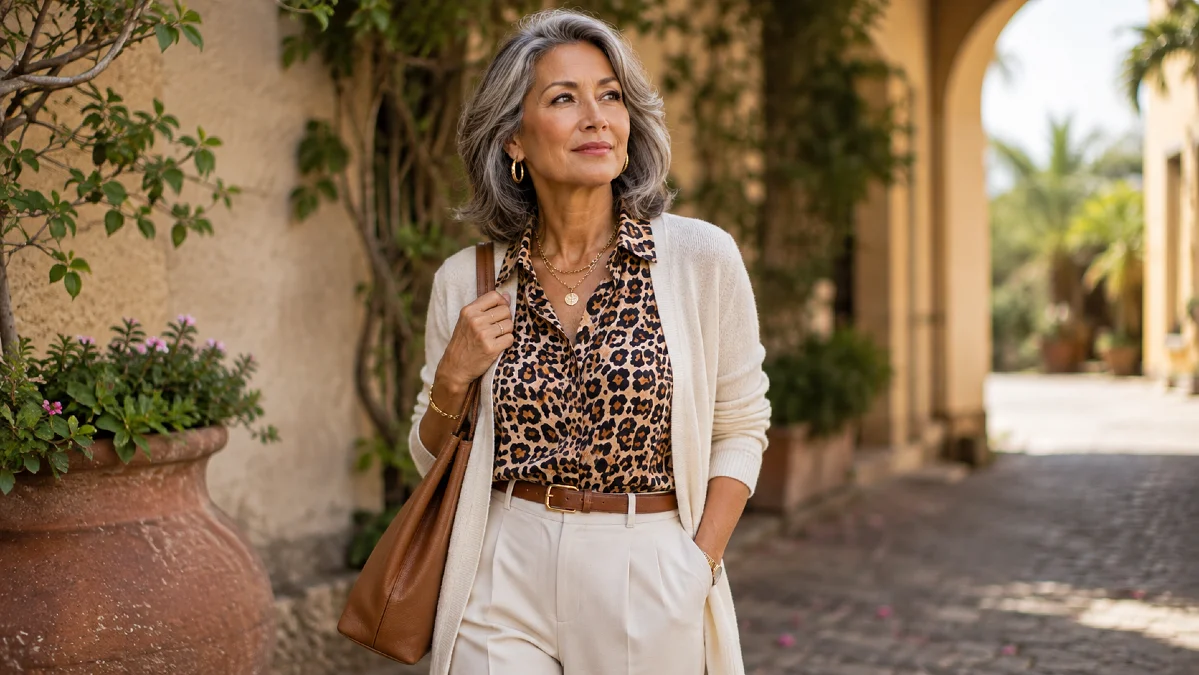
Animal print can feel surprisingly difficult once you want your clothes to look current rather than costume-like. A leopard blouse that once felt chic may suddenly seem too busy, while a zebra skirt can look modern on the hanger but harder to style at home.
For women over 50, the problem usually is not the print itself. It is the combination of print scale, fabric, silhouette, and everything worn around it that decides whether an outfit feels polished or stuck in another decade.
The good news is that animal print can still create some of the most stylish outfits for women over 50. You do not need a wardrobe overhaul. A few changes in proportion, color, and styling can make pieces you already own feel much fresher.
Animal Print Looks More Current When the Rest of the Outfit Stays Quiet
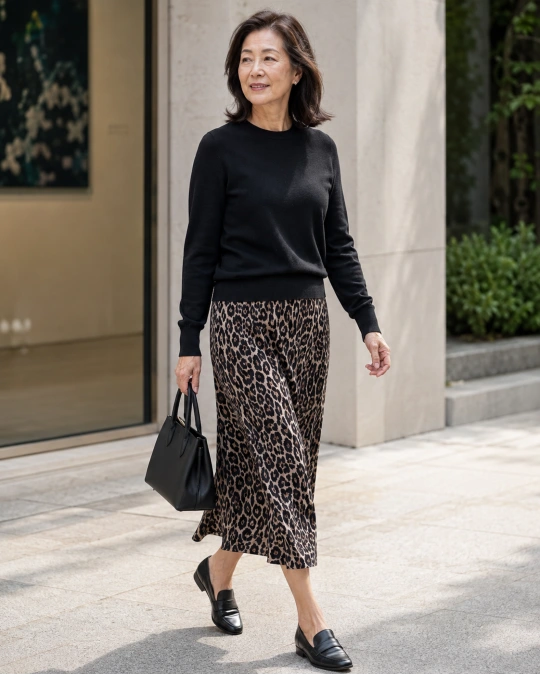
Animal print already creates movement and contrast, so it rarely needs much help. Problems usually appear when several strong details compete at once: dramatic jewelry, distressed denim, a printed handbag, embellished shoes, and a leopard top all fighting for attention.
A more modern approach is to treat the print as the interesting part of the outfit. Surround it with simple shapes and solid colors so your eye has somewhere to rest.
For example, leopard trousers become easier to wear with a black crewneck sweater and simple loafers. A snake-print blouse feels calmer beside dark straight-leg jeans and a clean leather bag.
This balance matters because mature style often looks best when there is a clear visual focus rather than several separate statements.
Here is an easy way to update combinations that feel overly busy.
| If the Outfit Feels Dated | Try This Instead |
|---|---|
| Leopard blouse + chunky necklace + printed bag | Leopard blouse + small earrings + solid leather bag |
| Zebra skirt + ruffled top | Zebra skirt + smooth fitted knit |
| Animal-print trousers + embellished shoes | Animal-print trousers + simple loafers |
| Leopard dress + several statement accessories | Leopard dress + one strong accessory |
| Printed jacket + busy patterned blouse | Printed jacket + cream, black, or chocolate top |
You are not removing personality. You are simply giving the print enough space to do its job.
Choose Softer Prints When High Contrast Feels Too Strong
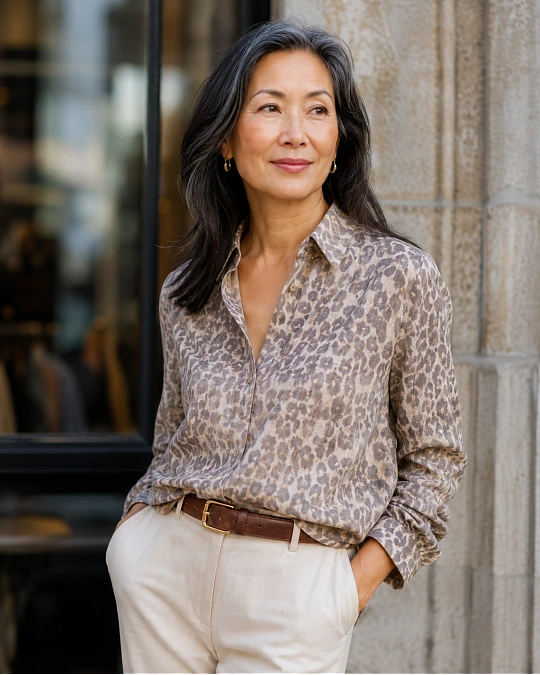
Not every leopard, zebra, or snake print creates the same effect. Some have hard black-and-white contrast, while others use softened brown, camel, charcoal, cream, olive, or taupe.
If traditional animal print feels harsh near your face, look for a lower-contrast version. A blurred leopard pattern in cocoa and beige often feels quieter than sharp black spots against pale tan.
Print scale matters too. Very tiny patterns can sometimes read as visually busy, while oversized markings can dominate a petite garment. Medium-scale prints are often easier to balance because the pattern remains recognizable without taking over.
Color note: You do not have to stay with realistic animal colors. Deep burgundy leopard, navy snake print, or olive-and-black patterns can look sophisticated when the palette already works with your wardrobe.
This quick guide can help when comparing pieces.
| Print Detail | What to Look For | Why It Works |
|---|---|---|
| Leopard | Medium spots with soft edges | Feels less visually crowded |
| Zebra | Cream and charcoal instead of stark white and black | Creates gentler contrast |
| Snake | Matte, muted coloring | Keeps the texture from looking flashy |
| Tiger | Wider spacing between stripes | Gives the eye more breathing room |
| Abstract animal print | Simple two- or three-color palette | Mixes easily with wardrobe basics |
The right animal print should work with you, rather than requiring an entirely different wardrobe around it.
Let One Animal-Print Piece Anchor the Outfit
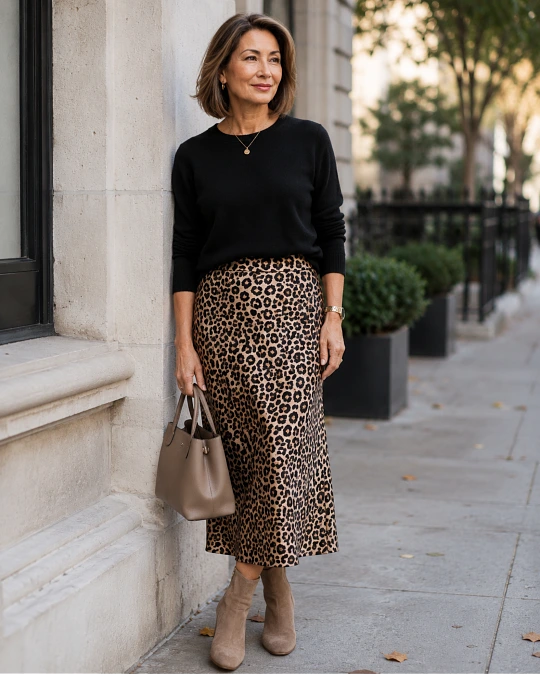
A useful starting point is to choose one printed piece and build outward from there. This creates a clear focal point and makes dressing over 50 much easier on mornings when you do not want to experiment.
A leopard midi skirt, for example, can become the anchor. Add a fine-knit sweater, ankle boots, and a structured bag. The straight lines of the sweater and bag balance the movement of the pattern.
For errands, try animal-print flats with straight jeans, a white shirt, and a lightweight jacket. The shoes bring personality without changing the whole mood of the outfit.
A printed scarf works similarly. Wear it with a camel sweater and dark trousers when you want interest near your face without committing to a full printed garment.
Fit note: When the print is bold, uncomplicated silhouettes usually look fresher. Straight trousers, column skirts, clean blouses, relaxed shirts, and softly tailored jackets give the pattern structure.
Modern Denim and Knits Keep Leopard and Zebra From Feeling Too Dressy
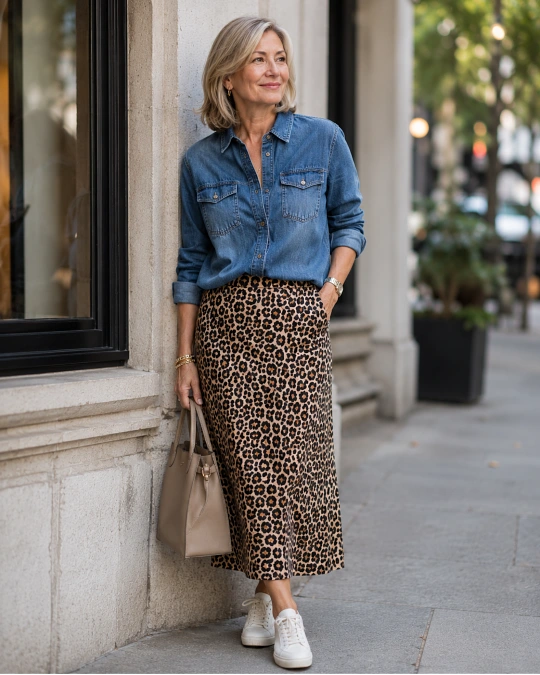
One reason animal print sometimes looks dated is that it is styled exactly as it was years ago. A fitted leopard blouse with skinny black trousers, platform shoes, and large jewelry can instantly place the outfit in a particular fashion era.
Changing the silhouette often fixes the problem faster than replacing the print.
Try these combinations:
- Pair a leopard blouse with straight or slightly relaxed jeans instead of ultra-tight denim.
- Wear a zebra midi skirt with a softly fitted crewneck knit rather than an ornate blouse.
- Add a cropped or hip-length cardigan to animal-print trousers for gentle structure.
- Combine an animal-print skirt with a relaxed denim shirt for a more casual contrast.
- Wear a printed jacket over a simple column of black, cream, navy, or chocolate.
The goal is not to chase every trend. Current proportions simply help familiar prints feel connected to the clothes being worn now.
Comfort upgrade: Look for trousers and skirts with enough movement through the hip and thigh. Animal print attracts attention, so fabric pulling or twisting tends to become more noticeable than it would in a solid color.
Shoes and Accessories Decide How Bold the Print Feels
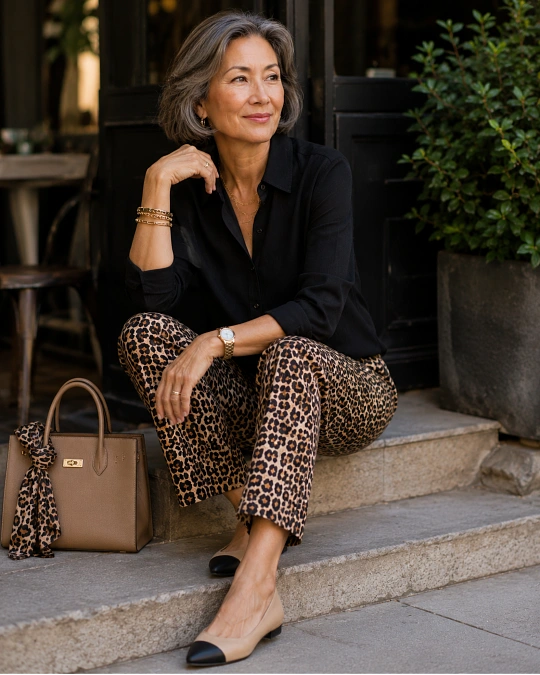
Animal print can be the main event, or it can function almost like a neutral. Accessories determine which direction the outfit takes.
For a quieter look, combine leopard with brown leather, black suede, camel, cream, gold-tone jewelry, or dark denim. These colors echo the tones already inside many animal patterns, which makes the outfit feel connected.
For something fresher, introduce one restrained color such as burgundy, forest green, denim blue, or deep red. Keep the shape simple so the color does not compete with the print.
Animal-print accessories can also be one of the easiest ways to experiment. A belt, flat, small bag, or scarf gives a plain outfit a little tension without asking you to wear a full printed garment.
Here are a few practical formulas for different parts of real life.
| Occasion | Pieces | Why It Works |
|---|---|---|
| Errands | Straight jeans + cream knit + leopard flats | The print stays small and practical |
| Lunch | Zebra midi skirt + black knit + loafers | Clean shapes balance the pattern |
| Casual office | Leopard blouse + dark trousers + simple pumps | Solid separates keep it polished |
| Dinner | Black dress + animal-print clutch + low heel | One printed accent changes the mood |
| Travel | Dark jeans + soft cardigan + animal-print scarf | Comfortable layers still feel considered |
This is especially useful when building everyday outfits for women over 50 because the same basics can support several different prints.
A Few Small Styling Changes Can Rescue an Older Animal Print
You do not have to discard a leopard blouse simply because you bought it years ago. Often the piece itself is fine, while the styling around it is what makes it feel dated.
If something feels off, experiment before replacing it:
- If the outfit feels too tight: add one relaxed shape, such as straight jeans, wide trousers, or a softer jacket.
- If the print feels too loud: move it farther from your face with a skirt, shoe, belt, or bag.
- If the outfit feels overly dressy: add denim, knitwear, suede, or another matte texture.
- If it feels too coordinated: stop matching every brown or black tone exactly and let the outfit feel slightly more relaxed.
Fabric deserves attention as well. Matte viscose, cotton blends, soft knits, brushed fabrics, and fluid woven materials usually make animal print easier to wear casually.
Very shiny fabric can make a strong print feel even louder. If you love shine, using it in one smaller area often creates a more balanced result.
The Animal-Print Formula That Works With Clothes You Already Own
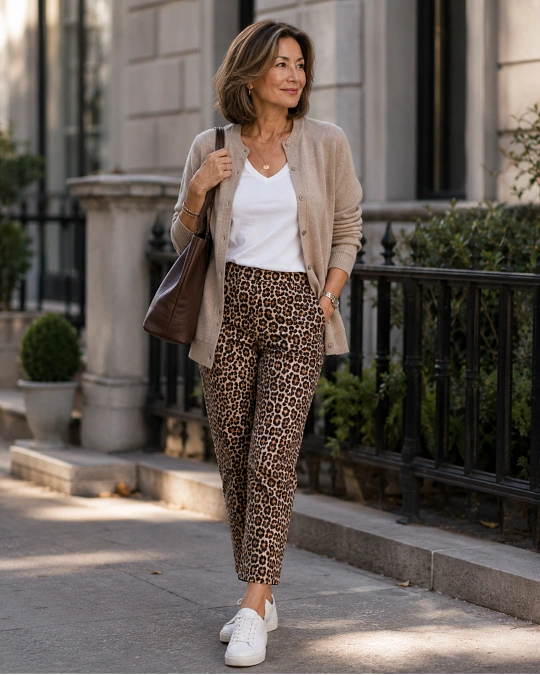
A dependable starting point is:
Formula: one animal-print piece + one solid wardrobe basic + one clean finishing layer
Try a leopard skirt with a black knit and denim jacket, or snake-print trousers with a cream blouse and camel cardigan.
The formula works because every piece has a different job. The print supplies interest, the solid garment gives the eye a resting place, and the final layer adds structure.
You can then change the mood through shoes. Sneakers make the combination casual, loafers create smart casual polish, and a low boot makes it feel stronger in cooler weather.
This kind of repeatable personal uniform is often more useful than memorizing fashion rules. It gives you a framework that can become softer, bolder, dressier, or more relaxed depending on where you are going.
Frequently Asked Questions
The Animal Print Edit
Can women over 50 still wear leopard print?
Absolutely. Leopard print has no age limit, and it works beautifully when balanced with simple solids and current silhouettes.
If a full leopard garment feels like too much, start small. Begin with flats, a sleek belt, a scarf, or a small bag.
Is animal print considered a neutral?
Some animal prints can function almost like neutrals because they contain familiar wardrobe colors like black, cream, camel, brown, and taupe.
Leopard is especially easy to combine with denim, black trousers, cream knitwear, olive, burgundy, and chocolate brown.
What colors look best with leopard print?
Black, cream, camel, chocolate, denim blue, and olive are easy starting points. Burgundy and deep red also work beautifully for contrast.
You do not need to match the exact brown inside the print. A slight variation often looks more natural.
Can you mix animal prints in one outfit?
You can, but it requires more visual control. Keeping both patterns in the same color family and changing their scale prevents competition.
For most everyday looks, wearing one animal print paired with solids is the easier route to a polished result.
How can animal print look elegant instead of flashy?
Choose a good-quality matte fabric, a clean silhouette, and restrained accessories.
Lower-contrast colors and medium-scale patterns make the print feel calmer. The fewer competing details around the print, the more sophisticated it tends to look.