

A midi skirt should not make you feel shorter, wider, or more formal than you meant to look.
That is usually the frustration. The skirt looks graceful on the hanger, but once it is on, the length, shoes, waistline, and top all start competing with each other.
The good news is that midi skirts can create some of the most elegant outfits for women over 50 when the proportions are handled well. You do not need a full wardrobe overhaul or a closet full of new pieces.
You only need to understand where the skirt should sit, what shape works best, and how to balance it with pieces you already wear in real life.
Why Midi Skirts Can Feel Tricky After 50
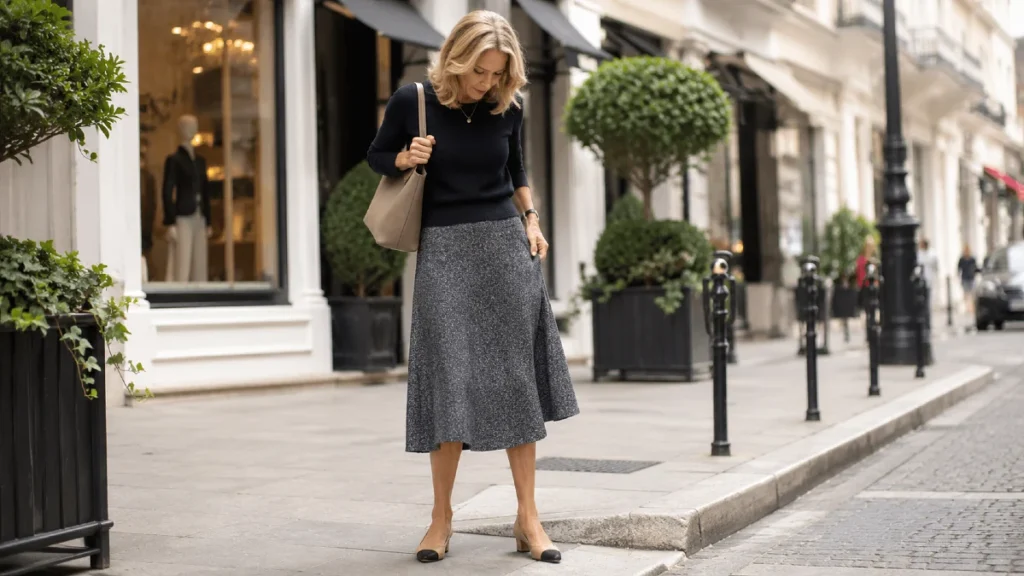
Midi skirts are beautiful, but they ask for more styling than jeans or straight trousers.
The challenge is usually the middle length. A skirt that stops at the widest part of the calf can visually shorten the leg. A waistline that sits too low can make the outfit feel heavy. A top that is too long can hide the shape that makes the skirt work.
This does not mean midi skirts are difficult to wear. It means they need a little more intention.
Fit note: The most flattering midi skirt usually shows some shape at the waist or hip, then moves away from the body. That small bit of structure keeps the outfit polished instead of bulky.
For everyday dressing, think of the midi skirt as a smart casual piece. It can be relaxed with knitwear and flats, elegant with a blouse and slingbacks, or modern with a simple tee and cropped jacket.
The Proportion Rule That Changes Everything
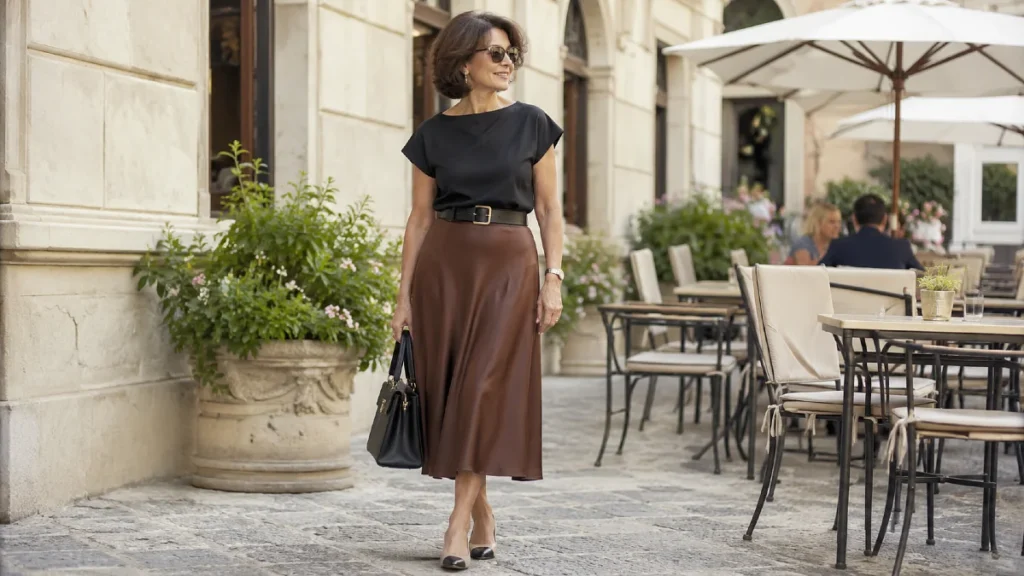
The main rule is simple: define the waist, then keep the lower half long and clean.
Midi skirts already add fabric below the waist. If the top is also long, loose, and heavy, the outfit can lose shape fast. A shorter top, a tucked knit, or a defined waistband gives the eye a clear starting point.
This is why the same skirt can look completely different with two tops. A long tunic may make it feel dated. A soft crewneck sweater that ends near the waistband can make it feel current and elegant.
You do not need a tight top. You just need a top that gives the skirt a boundary.
Try these easy proportion fixes:
- Tuck only the front of a soft blouse if a full tuck feels too neat.
- Choose a sweater that ends at the high hip instead of mid-thigh.
- Add a slim belt when the skirt waistband looks plain or unfinished.
- Wear a cropped jacket that stops above the widest part of the skirt.
The goal is not to show your body in a forced way. The goal is to let the outfit have a shape.
Choose the Right Midi Skirt Fit and Fabric
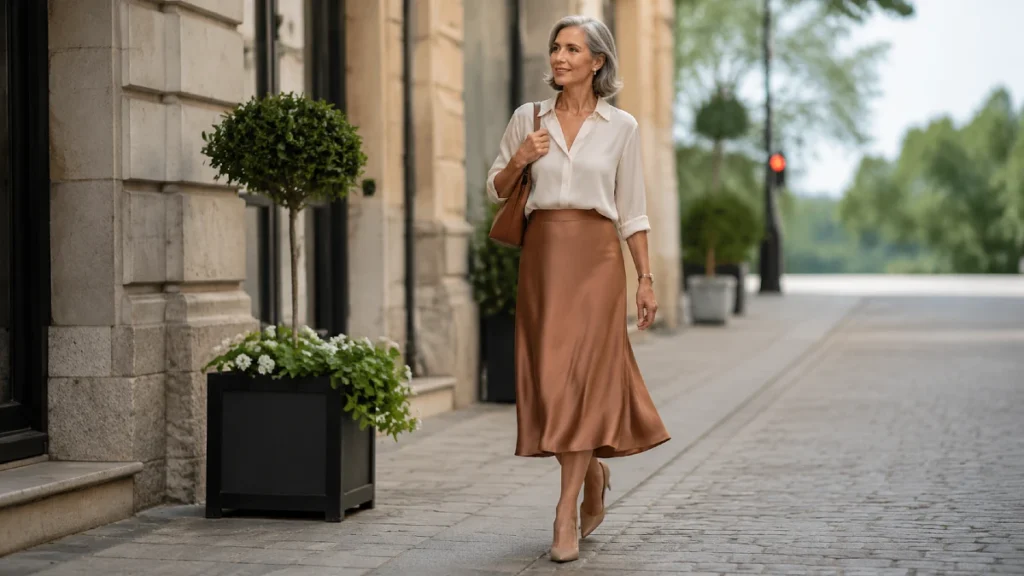
The best midi skirt is not always the dressiest one. It is the one that moves well, sits comfortably, and works with the tops and shoes you already own.
A slightly A-line shape is often the easiest starting point because it gives room through the hip and thigh without adding too much volume. A bias-cut skirt can look graceful, but it should skim rather than cling. Pleats can work beautifully when the fabric is soft and the waistband lies flat.
Here is a quick fit and fabric guide to help you choose wisely.
| Skirt Style or Fabric | What to Look For | Why It Works |
|---|---|---|
| Soft A-line midi | Smooth waistband, gentle flare, mid-calf or lower-calf length | Gives movement without overwhelming the frame |
| Bias-cut satin or crepe | Skims the hips, does not pull across the stomach | Creates a graceful line with simple tops |
| Pleated midi | Fine pleats, flat waistband, fluid fabric | Looks polished without feeling stiff |
| Knit midi skirt | Medium-weight knit, not thin or clingy | Comfortable for everyday outfits for women over 50 |
| Denim midi | Straight or slight A-line cut, front slit for movement | Feels modern with loafers, boots, or simple sneakers |
Fabric note: Thin fabric shows every line and wrinkle, which can make you feel more exposed than elegant. A medium-weight fabric usually hangs better and feels more forgiving.
Color also matters. Black, navy, olive, camel, chocolate, ivory, and soft denim shades are easy to repeat. Prints can be lovely, but a smaller print or soft contrast is usually easier to style than a loud, oversized pattern.
Pair Midi Skirts With Tops That Give Shape
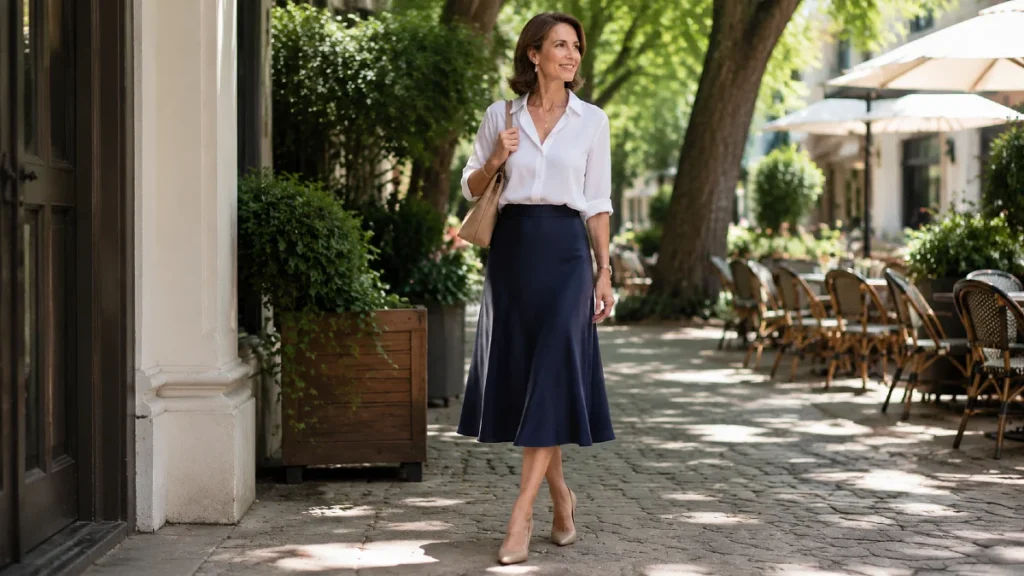
The top decides if a midi skirt looks elegant, casual, or confused.
For a clean look, pair volume with shape. If the skirt has movement, the top should be a little more controlled. If the skirt is straight, the top can be softer or more relaxed.
A fine knit sweater is one of the easiest choices. It has enough polish for lunch, errands, travel, or a casual dinner, but it does not feel stiff.
A button-down shirt also works well when the fabric has drape and the front is tucked or tied neatly at the waist.
For warmer days, a structured tee can look better than a thin, limp one. Look for a neckline that feels open enough around the face, such as a crewneck that is not too tight, a soft V-neck, or a boatneck.
Color note: If you want a longer line, keep the top and skirt close in color. A navy knit with a navy skirt, or an ivory top with a beige skirt, can look elegant without feeling dressed up.
This table shows how one midi skirt can shift for different real-life plans.
| Occasion | Top Choice | Finishing Piece |
| Errands or casual lunch | Soft tee or fine knit | Denim jacket or lightweight cardigan |
| Dinner out | Draped blouse or silky shell | Cropped blazer or wrap |
| Work or meeting | Button-down shirt or knit polo | Structured jacket |
| Travel day | Lightweight sweater | Long cardigan with slim shoes |
| Weekend gathering | Simple tank or tee | Linen shirt worn open |
The small details matter. A pushed-up sleeve, a clean neckline, or a neat tuck can make simple outfits for women over 50 feel much more intentional.
Get the Hemline and Shoes Right
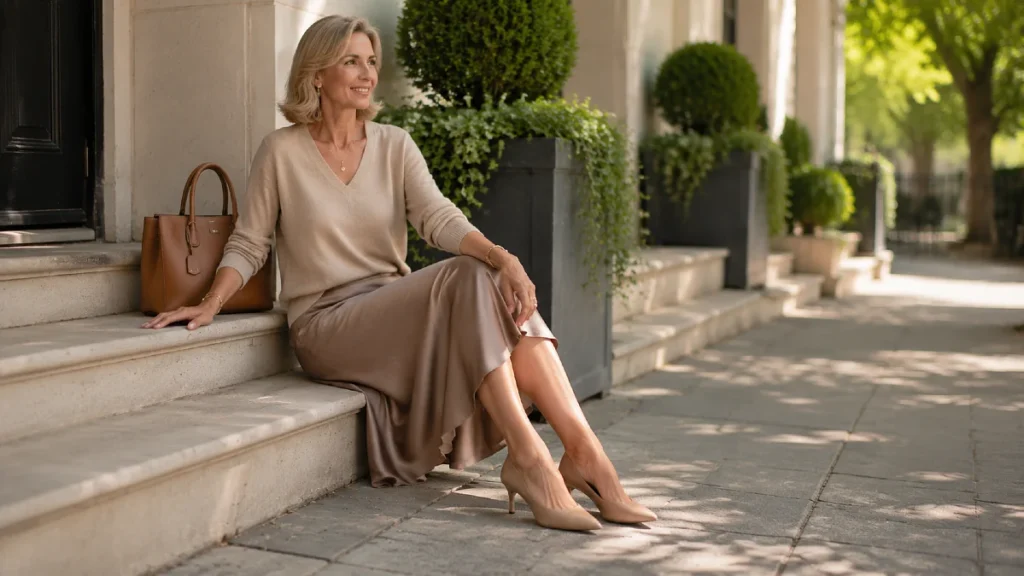
Shoes can make or break a midi skirt because the hemline draws attention to the lower leg.
A skirt that ends just below the knee can feel more classic. One that ends mid-calf can be tricky if the shoe cuts across the ankle. A lower-calf length often feels more elegant because it leaves a clean line between hem and shoe.
That does not mean you need heels. It means the shoe should keep the leg line open.
Pointed flats, slingbacks, low block heels, refined sandals, loafers, and sleek ankle boots all work well. Chunky shoes can work too, but they need balance from a cleaner top or jacket.
Shoe swap: If your midi skirt feels heavy with ankle-strap sandals, try a pointed flat or low-vamp shoe instead. More visible foot can make the whole outfit look lighter.
For colder weather, choose boots that meet the hem or slide under it. A gap between skirt and boot can work, but the proportions need to feel deliberate. When in doubt, a tall boot under a midi skirt creates a smooth, elegant line.
What to Avoid and Why
Midi skirts do not need strict rules, but a few common pairings can make them harder to wear.
Use these as gentle checks, not restrictions.
| Do This | Not That | Why It Works |
| Wear a top that ends near the waist or high hip | Let a long top cover the whole skirt waistband | A visible waist gives the outfit shape |
| Choose shoes with a clean opening | Wear heavy ankle straps with a mid-calf hem | The leg line looks longer and lighter |
| Pick fabric with enough weight to hang well | Choose very thin jersey that clings | Better fabric creates smoother movement |
| Let one piece have volume | Wear a loose top with a very full skirt | Balance keeps the look polished |
| Use a simple color palette | Mix too many bold colors and prints at once | The skirt feels elegant, not busy |
If something feels off, do not blame your body. Check the proportions first.
Often the fix is small: change the shoe, tuck the top, swap the cardigan, or adjust where the skirt sits on your waist.
A Simple Midi Skirt Formula to Copy
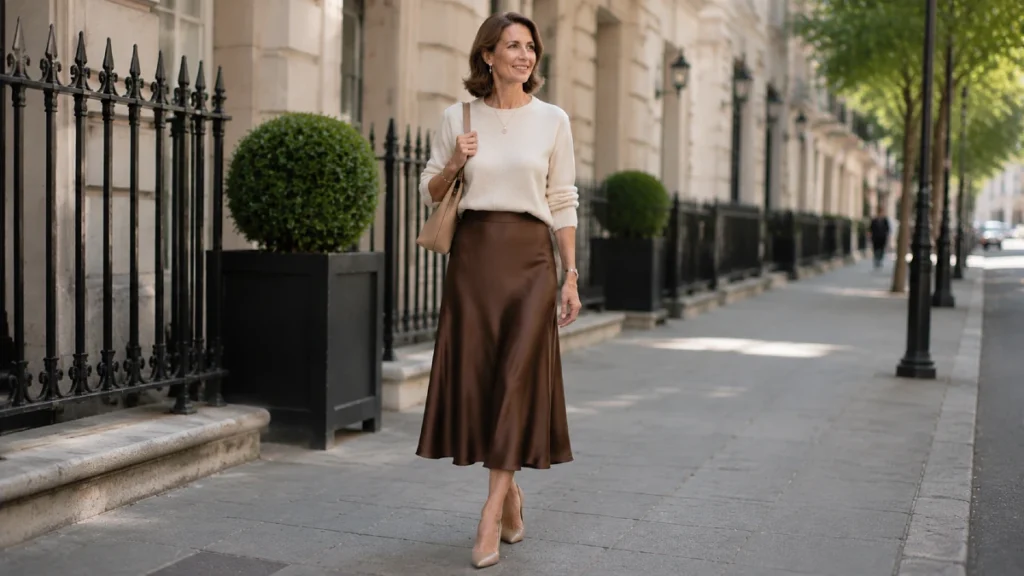
Formula: soft A-line midi skirt + fine knit top + pointed flats or low block heels + cropped jacket.
This formula works because it gives you shape at the waist, movement through the skirt, and a clean finish at the shoe. It feels polished without looking fussy.
You can make it more casual with a denim midi skirt and loafers. You can make it dressier with a satin skirt, a soft blouse, and slingbacks. You can make it warmer with tall boots and a cropped wool jacket.
For chic outfits for women over 50, the repeatable formula matters more than chasing every trend. Once you know your best skirt shape, top length, and shoe style, getting dressed becomes much easier.
Conclusion
Wearing midi skirts over 50 is not about following strict fashion rules. It is about learning the small details that make the skirt work for you: the waistline, fabric, hem, shoe, and top length.