

Statement jewelry can make an ordinary outfit feel finished in seconds, but it can also be surprisingly easy to second-guess. A bold necklace, oversized earrings, or a sculptural cuff may look wonderful on its own, then suddenly feel like too much once the whole outfit comes together.
For many women over 50, the challenge is not wanting to disappear into safe basics. It is finding that comfortable middle ground between interesting and overloaded, especially when necklines, hair, glasses, prints, and changing proportions all compete for attention.
The good news is that dressing over 50 does not require smaller, quieter jewelry. It simply helps to give your statement piece room to do its job.
Let One Piece Be the Visual Leader

The easiest way to wear statement jewelry well is to decide what you want someone to notice first. Your outfit needs a focal point, and bold jewelry works best when it is allowed to become that focal point instead of competing with four others.
If you choose large earrings, for example, you may not need a dramatic necklace as well. A sculptural cuff often looks stronger beside simple earrings than beside stacked bracelets, rings, earrings, and necklaces of equal visual weight.
This does not mean you can only wear one piece of jewelry. The trick is to combine one dominant piece with quieter supporting pieces.
A bold pendant might sit beside small hoops and a simple watch. Oversized earrings can work with a fine chain necklace. The contrast in scale is what keeps the look intentional.
Here is a useful way to think about visual balance.
| If Your Statement Piece Is… | Keep These Quieter | Why It Works |
|---|---|---|
| Large chandelier earrings | Necklace and hair accessories | Keeps attention around the face without crowding it |
| Chunky necklace | Earrings and neckline details | Gives the necklace a clean background |
| Wide cuff bracelet | Other bracelets and rings | Keeps the wrist from looking visually heavy |
| Oversized cocktail ring | Bracelets on the same hand | Lets the ring remain the clear focal point |
| Layered bold necklaces | Earrings | Prevents too much detail around the face and neck |
The point is not minimalism for its own sake. It is hierarchy. When your eye knows where to land, even a very bold accessory can look calm and sophisticated.
Pay Attention to the Space Around Your Jewelry

Statement jewelry needs breathing room. This is especially important with necklaces because the neckline of your top or dress creates the frame around the piece.
A substantial necklace often works beautifully with a clean crew neck, open shirt collar, simple V-neck, or plain scoop neck. The less decorative the neckline, the more clearly the shape of the jewelry can be seen.
Busy details such as ruffles, bows, heavy embroidery, lace panels, or complicated collars can compete with a large necklace. If you love both, you do not have to give either up.
You may simply find that bold earrings work better with the detailed blouse, while the necklace gets saved for a simpler top.
Fit note: Pay attention to where a necklace ends. A pendant that finishes inside an open neckline usually looks more connected to the outfit than one that awkwardly overlaps the edge of the fabric.
Jewelry should also relate to your frame rather than follow a rule about age. If tiny pieces disappear on you, try a little more scale. If very heavy pieces feel uncomfortable or overpowering, look for larger designs made from lightweight materials.
That balance is one of the most useful principles in dressing over 50: choose the scale that feels natural on you, not the scale someone else says you should wear.
Use Simple Clothes as the Best Backdrop

One reason statement jewelry is so useful is that it can make wardrobe basics feel completely different.
A white button-down, dark knit top, simple dress, fine sweater, or plain blazer gives bold jewelry a clean canvas. Instead of buying a complicated outfit for every lunch, dinner, or gathering, you can change the mood with accessories.
A black knit dress with gold sculptural earrings feels quite different from the same dress with a long colorful pendant. A white shirt and jeans can move from errands to lunch simply by adding a cuff, loafers, and earrings with a little presence.
This is where statement jewelry becomes particularly useful in a capsule wardrobe. It gives simple clothing variety without requiring dozens of extra garments.
Try these combinations when you want an easy starting point:
- A crisp shirt + straight-leg jeans + large earrings
- A fine knit + tailored trousers + sculptural necklace
- A simple midi dress + cuff bracelet + small studs
- A blazer + plain T-shirt + pendant necklace
- A monochrome outfit + one colorful piece of jewelry
For stylish outfits for women over 50, the most memorable detail often does not need to be the clothing itself. A strong accessory can give otherwise simple pieces personality.
Match the Weight of the Jewelry to the Weight of the Outfit

Jewelry has visual weight just like clothing does. A thick resin bangle feels stronger than a fine chain. A large metal collar necklace feels heavier than a small pendant.
Your clothes have the same differences. A chunky knit, structured blazer, leather jacket, or dense wool coat carries more visual weight than a fine cotton shirt or soft silk-like blouse.
Matching those levels loosely helps the outfit feel balanced.
Before choosing jewelry, look at the fabric and structure of what you are wearing. This quick guide can help.
| Clothing or Fabric | Jewelry Direction | Why |
| Fine knit or soft blouse | Medium-scale pendant or earrings | Adds interest without overwhelming softer fabric |
| Crisp cotton shirt | Bold earrings or sculptural necklace | Clean structure supports a stronger accessory |
| Chunky sweater | Substantial earrings or cuff | Tiny jewelry can disappear beside heavy texture |
| Tailored blazer | Graphic brooch, cuff, or geometric earrings | The sharper lines work well together |
| Floaty dress | Organic shapes or lighter statement pieces | Keeps movement and softness in the outfit |
There is no need to match everything perfectly. Think of it as visual conversation. Your jewelry should feel substantial enough to belong with the clothing, rather than looking lost or disconnected.
Color Can Make Bold Jewelry Easier to Wear
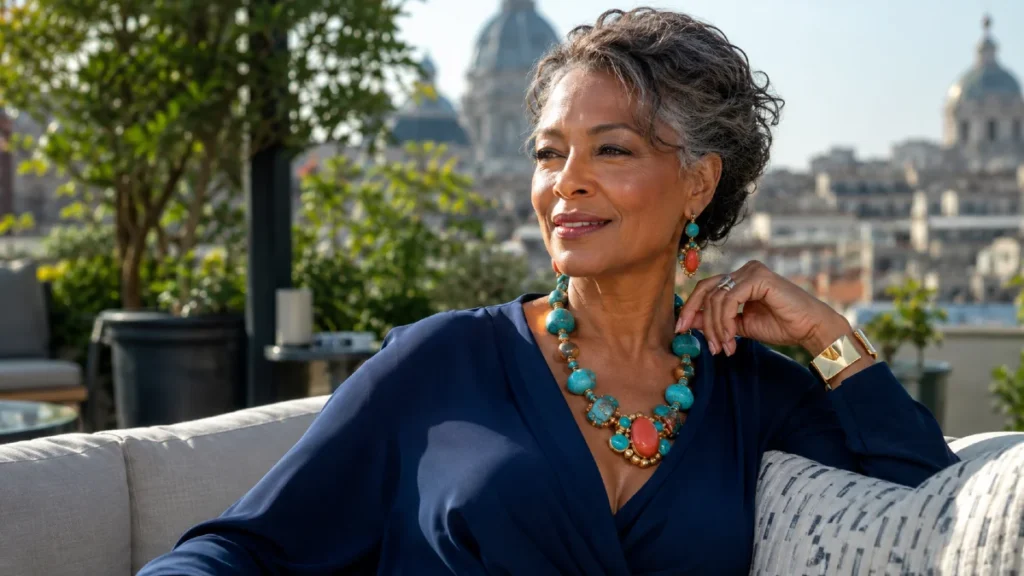
Statement jewelry does not have to mean bright color. Scale, shape, texture, and shine can all create impact.
If bold jewelry makes you nervous, start with a color already present in your wardrobe. Gold, silver, tortoiseshell-style brown, black, cream, deep green, or warm amber can feel dramatic without becoming difficult to coordinate.
A monochromatic outfit is particularly useful when you want to wear colorful jewelry. Navy with turquoise tones, cream with warm metallics, or black with a rich red accessory gives the eye one clear point of contrast.
If your clothing already includes several colors, try pulling one shade from the print into your jewelry rather than introducing another competing color.
Color note: Matching jewelry to your clothes exactly is not necessary. Repeating the general temperature often looks more relaxed.
Warm brown, rust, olive, and cream tend to sit comfortably with warmer metals, while charcoal, navy, icy blue, and black can look crisp beside cooler metallic tones.
These are starting points rather than rules. If silver looks wonderful with your warm-colored blouse, wear it.
Keep Prints and Statement Jewelry in Conversation

Prints do not automatically mean you should skip bold jewelry. The real issue is visual competition.
A large graphic print already creates movement. Adding equally complex jewelry can make it difficult for the eye to know what matters. In that case, simpler shapes often work better than intricate pieces.
On the other hand, a small, evenly repeated print can sometimes handle a substantial necklace or pair of earrings very well.
If something feels off in the mirror, changing just one element is usually enough.
This old-rule-versus-new-approach guide can help when an outfit feels busy.
| Old Rule | A More Useful Approach |
| Never wear statement jewelry with prints | Choose jewelry with a simple shape beside a busy print |
| Bold earrings mean no other jewelry | Add quiet pieces that do not compete |
| Older women should wear delicate jewelry | Choose the scale that suits your features and clothing |
| Metals must always match | Mix them deliberately and repeat one metal elsewhere |
| Large jewelry should only be worn at night | Pair it with simple daytime basics for contrast |
This softer approach leaves room for personality. Dressing over 50 becomes much easier when you stop treating style as a collection of restrictions and start looking at proportion and balance instead.
What Can Make Statement Jewelry Feel Like Too Much
Most overloaded outfits do not have one major problem. They simply have too many strong details trying to lead at the same time.
A few easy adjustments usually solve it:
- Several oversized pieces together: Keep the favorite statement piece and reduce the scale of the others.
- A detailed neckline plus a chunky necklace: Try earrings, a cuff, or a ring instead so the neckline can breathe.
- Bold jewelry with very busy prints: Choose a cleaner jewelry shape or repeat one color from the print.
- Too much shine everywhere: Mix shiny jewelry with matte fabrics such as denim, cotton, linen blends, or soft knits.
Comfort matters too. Heavy earrings that hurt after twenty minutes or a necklace that needs constant adjustment will rarely become pieces you reach for.
Comfort upgrade: Look for hollow metal, resin, wood, fabric-covered beads, or other lightweight materials when you want larger scale without extra weight.
A Simple Statement Jewelry Formula to Keep
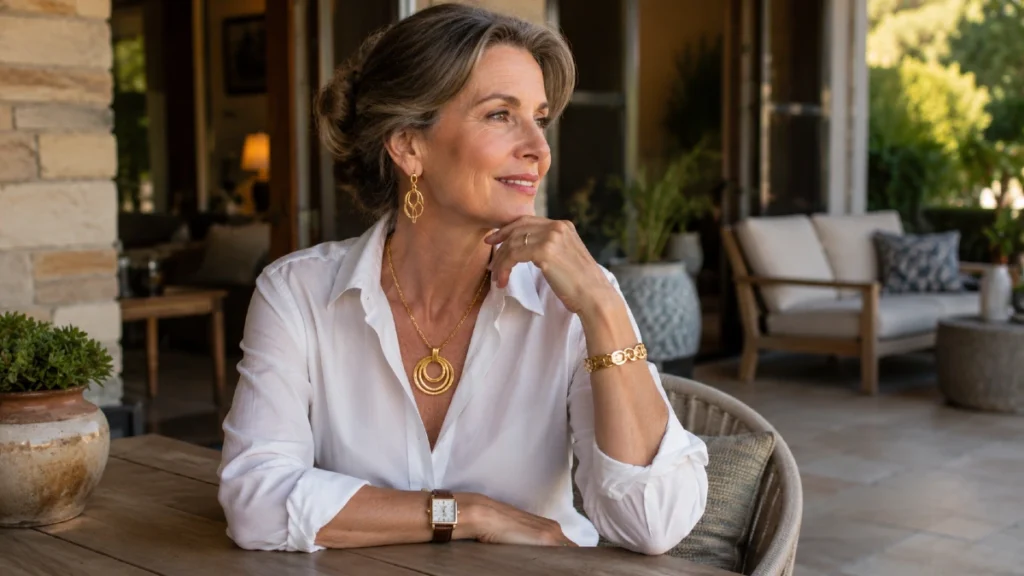
When you are standing in front of the mirror and wondering if the outfit needs more or less, use one simple formula.
Formula: simple base + one strong jewelry piece + one quiet supporting accessory
That might mean dark trousers, a cream knit, sculptural earrings, and a slim watch. Or straight jeans, a white shirt, a bold pendant, and small studs.
The clothing provides calm structure, the statement piece supplies personality, and the smaller accessory prevents the outfit from feeling unfinished.
You can also adapt the same formula to different parts of your week.
A statement necklace may work with a knit and trousers for dinner, while large earrings might make a T-shirt and jeans feel more pulled together for lunch. The formula stays the same even when the pieces change.
Frequently Asked Questions
Can women over 50 wear large statement earrings?
Absolutely. Large earrings can frame the face beautifully and make very simple clothing look more intentional. If they feel visually heavy, keep your neckline and other jewelry quieter so the earrings have space.
Should statement jewelry match my outfit?
It can coordinate without matching exactly. Try repeating one color, metal tone, or general mood from your outfit instead of searching for an exact match. Slight contrast often makes the look feel more modern.
Can I wear a statement necklace with glasses?
Yes. Glasses simply add another strong element near the face, so balance becomes useful. If your frames are colorful or oversized, a statement necklace with a cleaner shape may feel more harmonious than highly detailed earrings.
How do I wear statement jewelry casually?
Pair it with uncomplicated wardrobe basics. Large hoops with a knit and jeans, a cuff with a white shirt, or a pendant over a plain T-shirt can make everyday clothing feel polished without becoming dressy.
Is it okay to mix gold and silver jewelry?
Yes. Mixed metals can look very natural when the combination appears intentional. Repeating both metals somewhere in the outfit, such as in a watch, ring stack, or two-tone piece, helps the mix feel connected.