

Grey hair can change the way familiar colors look against your face. Shades that once felt lively may suddenly seem dull, while colors you rarely considered can make your complexion and silver strands look brighter almost instantly.
That shift can make dressing over 50 feel confusing. You may still love your wardrobe, yet certain beige, brown, or muted pieces no longer seem to give you the same lift.
The good news is that you do not need a completely new closet. A few smarter color choices can make stylish outfits for women over 50 feel fresher, more polished, and far more connected to your grey hair.
Let Your Grey Hair Become Part of the Color Palette

Grey hair is not one single color.
It can contain bright silver, soft white, charcoal, pewter, cool grey, warm grey, or several shades at once. That natural variation gives you more styling freedom than you may think.
Instead of treating your hair as separate from your clothes, think of it as another color already present in the outfit.
A woman with bright silver hair, for example, already has a light neutral near her face. Adding a strong navy blouse below it creates contrast and definition without looking harsh.
Soft grey hair paired with another pale grey top may create less contrast. That can still look beautiful, but adding lipstick, earrings, a scarf, or a darker jacket may stop the look from becoming washed out.
Color note: The most useful question is often not, “Does this color suit grey hair?” It is, “Does this color create enough contrast around my face?”
That small change in thinking makes color much easier.
Clearer Colors Often Bring More Life to Silver Hair

Many wardrobes become heavily neutral over time.
Cream, oatmeal, taupe, beige, camel, soft brown, and pale grey are easy to wear, but when both your hair and outfit sit in a similar muted range, your features can lose definition.
This does not mean neutral clothing suddenly stops working.
It means clearer colors may become more useful near your face.
Think sapphire blue, emerald green, berry, plum, cherry red, deep teal, cobalt, raspberry, burgundy, or a crisp blue-green.
These colors have enough presence to stand beside silver hair rather than fade into it.
Here is a simple starting guide.
| Color Family | Try Near Your Face | Why It Can Work |
|---|---|---|
| Blue | Navy, cobalt, sapphire | Creates clean contrast with silver and white hair |
| Green | Emerald, pine, teal | Adds richness without feeling overly bright |
| Red | Berry, cherry, cranberry | Brings warmth and definition to the face |
| Purple | Plum, aubergine, violet | Works especially well with cool silver tones |
| Pink | Raspberry, rose, fuchsia | Adds freshness without requiring a full bright outfit |
You do not need to wear the loudest version of every color.
If cobalt feels too strong, start with navy. If fuchsia feels intimidating, try raspberry or dusty rose with more depth.
The best color is usually the one that makes your face look clearer before you notice the garment itself.
Build Contrast Close to Your Face

Where a color appears matters almost as much as the color itself.
A bright green shoe may look wonderful, but it will not affect your face the same way a green blouse, scarf, jacket, or necklace will.
That is why tops and outer layers deserve the most attention when styling grey hair.
If a pale beige knit makes you feel washed out, you do not necessarily need to stop wearing it. Place a stronger shade closer to your face.
Try:
- A navy blazer over a soft cream blouse
- A berry scarf with a camel coat
- Emerald earrings with a grey sweater
- A cobalt cardigan over a white T-shirt
- A burgundy jacket with an oatmeal knit
These combinations keep useful neutrals in your wardrobe while adding enough contrast to wake up the whole look.
This can be especially helpful in everyday outfits for women over 50 because it does not require complicated layering or a lot of new pieces.
You are simply moving the stronger color to the place where it has the most impact.
White, Black, and Grey Can Look Stronger Than Beige

Grey hair often looks especially striking beside clean neutrals.
Bright white can echo silver strands. Charcoal creates sophisticated depth. Black offers contrast, while navy gives a slightly softer version of the same effect.
These shades usually have clearer boundaries than muddy beige or yellowed cream.
That definition can make the entire outfit feel more intentional.
If black feels severe near your face, you can soften it without giving it up.
Try black trousers with a white shirt and colorful earrings, or place a softer scarf between a black jacket and your face.
Navy is another useful option because it gives definition without being quite as stark.
This table shows how to adjust common neutrals rather than removing them completely.
| If This Feels Flat | Try This Instead | Smallest Change |
|---|---|---|
| Beige sweater | Cream or ivory knit | Add berry earrings |
| Pale grey top | Charcoal or blue-grey | Add a richer lipstick shade |
| Camel coat | Camel with navy underneath | Add a patterned scarf |
| All-black outfit | Black with white or cobalt | Add silver jewelry |
| Soft brown blouse | Chocolate or burgundy | Add a brighter neckline accessory |
The point is not that beige or brown are bad.
They simply may need stronger partners once your hair becomes lighter.
Jewel Tones Are Useful, but You Do Not Need to Dress Like a Rainbow

Strong color becomes much easier when you use it selectively.
One saturated shade in an otherwise simple outfit is often enough.
A cobalt knit with dark straight-leg jeans and loafers already makes a statement. So does an emerald blouse under a navy blazer.
You do not need matching shoes, handbag, scarf, and jewelry in the same color.
In fact, grey hair often looks more sophisticated when the outfit keeps one clear focal color and lets the rest stay quiet.
For lunch with friends, you might wear dark trousers, a raspberry sweater, silver earrings, and simple flats.
For a casual day, try blue jeans, a white tee, a teal cardigan, and sneakers.
For dinner, a plum blouse with black trousers can look rich without feeling overly formal.
That balance makes bright color easier to repeat in real life.
Use Your Eye Color as a Shortcut

When you are unsure which colors deserve a place in your wardrobe, your eyes can be a useful clue.
Clothing that repeats or deepens your eye color can create a natural connection between your face, hair, and outfit.
Blue or grey eyes may become more noticeable beside navy, cobalt, steel blue, or teal.
Green or hazel eyes often work beautifully with olive, forest green, aubergine, and berry tones.
Brown eyes can gain warmth beside burgundy, deep teal, plum, navy, rust, and rich chocolate.
This is not a strict matching exercise.
The goal is simply to create harmony near your face.
Try holding different tops below your chin in natural daylight. The best shades often make your eyes look clearer and your skin more even before you can explain why.
That simple test is more useful than following a complicated seasonal color chart you may never use again.
Patterns Can Bridge Grey Hair and Strong Color
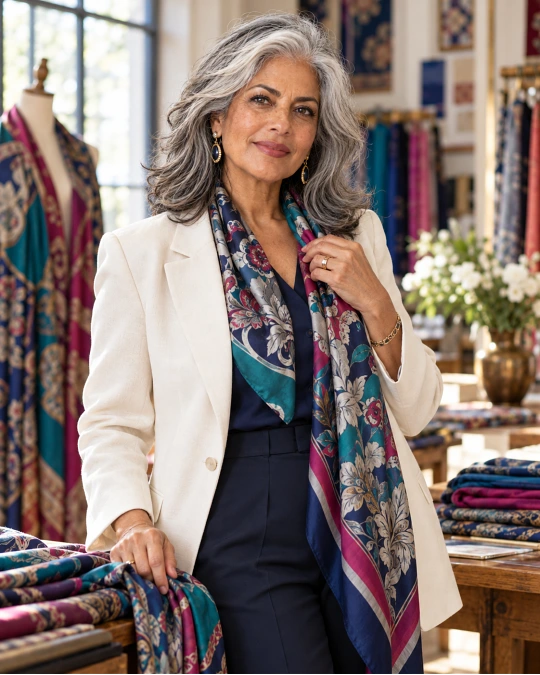
A patterned blouse or scarf can make bright color feel less intimidating because it mixes stronger shades with familiar neutrals.
Look for prints that include one color you already love plus white, navy, black, charcoal, or grey.
For example, a navy-and-berry print can connect silver hair with a rich accent color without making the berry feel overwhelming.
A black-and-white geometric print can also work well because the contrast echoes the natural light-and-dark variation often found in grey hair.
Scale matters too.
Very tiny prints can sometimes look busy from a distance, while medium-scale patterns tend to read more clearly.
You do not need a closet full of prints. One scarf, blouse, or lightweight jacket can help connect several plain pieces you already own.
A Repeatable Grey-Hair Outfit Formula

When color feels confusing, a formula removes most of the guesswork.
Formula: dark neutral base + clear color near the face + silver or simple neutral accessories
That could mean navy trousers, a berry blouse, silver earrings, and loafers.
Or dark jeans, an emerald knit, a charcoal coat, and white sneakers.
Here are a few easy variations.
| Occasion | Pieces | Why It Works |
|---|---|---|
| Everyday errands | Dark jeans + cobalt knit + white sneakers | Clear blue creates contrast while denim keeps it relaxed |
| Lunch | Navy trousers + berry blouse + silver earrings | Strong color stays near the face without feeling dressy |
| Smart casual | Black trousers + emerald cardigan + cream shell | Green adds life while the base stays simple |
| Evening | Charcoal trousers + plum blouse + black shoes | Deep color complements silver hair without looking loud |
Once you find two or three colors that reliably work, repeat them.
That is how a personal uniform begins.
You do not need twenty statement shades. You need a small group that consistently makes you feel pulled together.
Colors That Feel Wrong May Simply Need a Different Placement

Sometimes the issue is not the color itself.
It is where you are wearing it.
A mustard blouse may feel too warm near your face, but a mustard handbag may look wonderful with navy.
A camel sweater may feel dull, while camel trousers paired with a cobalt top can look polished.
If a color you love no longer seems flattering near your face, try moving it lower in the outfit.
You can also separate it from your face with another shade.
A warm tan jacket, for example, may work better over a crisp white or burgundy top than over another muted neutral.
This gives you permission to keep wearing colors you enjoy without forcing them into the most demanding part of the outfit.
The easiest fixes are often small:
- Move muted shades below the waist.
- Add white, navy, berry, or teal near the neckline.
- Use silver jewelry to connect your hair to the outfit.
- Break up warm neutrals with a cooler layer.
Your existing wardrobe may already contain more workable combinations than you think.
Frequently Asked Questions
What colors look best with grey hair over 50?
Clear blues, rich greens, berry shades, burgundy, plum, crisp white, navy, charcoal, and some stronger pinks often create attractive contrast with grey hair. The exact shade matters less than how much definition it gives your face.
Should women with grey hair avoid beige?
No. Beige can still work beautifully, especially away from the face or paired with a stronger color. If beige makes you look washed out, try adding navy, berry, teal, white, or silver near your neckline.
Does black look too harsh with grey hair?
It can on some people, but not everyone. If black feels strong near your face, soften it with a white shirt, colorful scarf, silver jewelry, or a softer neckline.
Can women over 50 wear bright colors with grey hair?
Absolutely. Bright color often looks particularly striking beside silver hair because the contrast makes both the hair and clothing look more deliberate. Start with one strong shade at a time if you prefer a quieter style.
What is the easiest color to try first with grey hair?
Navy is one of the easiest starting points because it provides definition without feeling as severe as black. From there, try cobalt, teal, berry, or plum depending on what makes your face look freshest.
Style Your Grey Hair Like It Belongs in the Outfit
Grey hair does not require a new set of fashion rules. It simply changes the balance of color around your face, which gives you a chance to rethink combinations you may have worn for years.
Start small. Try one clearer color near your face, keep the rest of the outfit simple, and notice what makes your skin and eyes look brighter.