
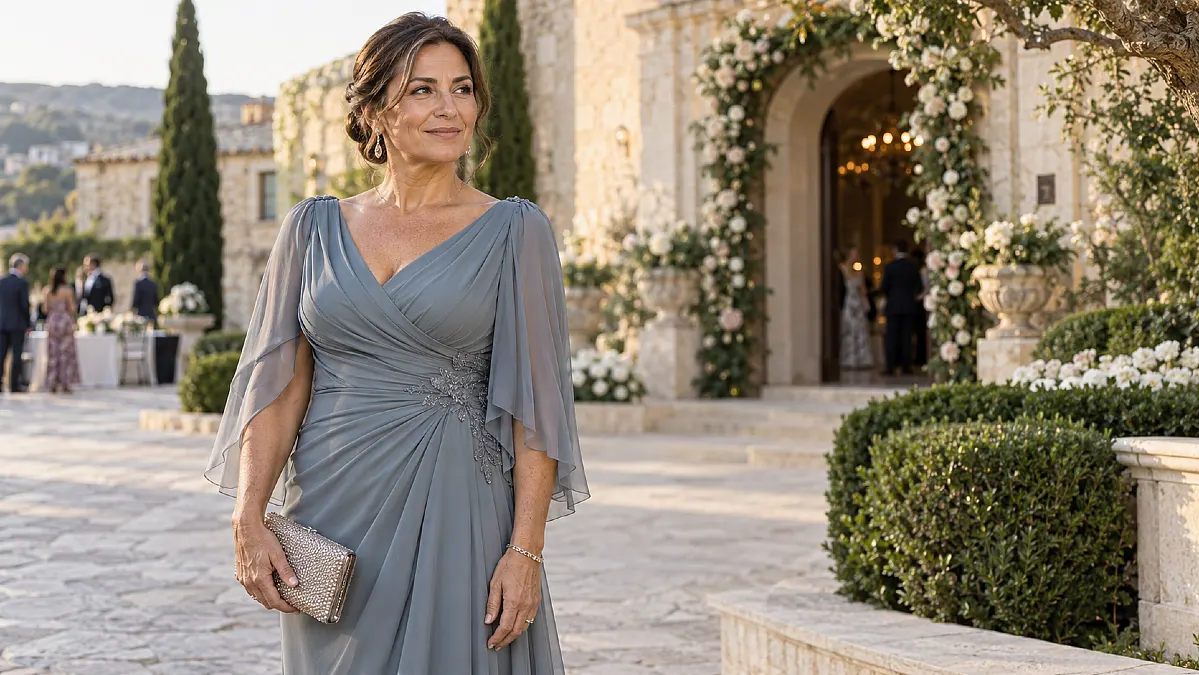
Choosing what to wear to your daughter’s wedding can feel surprisingly complicated. You want to look special in photographs, feel like yourself, respect the wedding style, and stay comfortable through hours of standing, hugging, sitting, dancing, and celebrating.
For women over 50, the problem is rarely a lack of options. It is sorting through dresses that feel too matronly, too bridal, too revealing, or simply unlike anything you would normally choose.
Good dressing over 50 does not mean hiding your shape or following old rules. The goal is an outfit with the right formality, proportion, fabric, and color for you and for this particular wedding.
You do not need a wardrobe overhaul. Start with the wedding itself, then build your look around fit and comfort.
Let the Wedding Decide How Formal Your Outfit Should Be
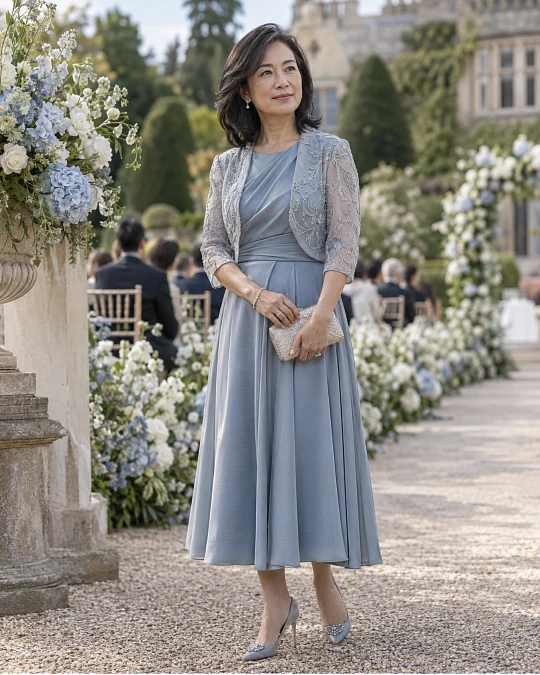
Before thinking about sleeves, necklines, or colors, look at the event. A mother-of-the-bride outfit should belong in the same room as the wedding.
The dress code matters most, followed by the venue, season, ceremony time, and how formal the bridal party will be. Current wedding etiquette also allows far more freedom than older rules did.
Mothers can wear gowns, midi dresses, jumpsuits, trouser suits, or polished separates when the outfit suits the celebration.
A cathedral ceremony followed by a formal evening reception may call for a long gown or sophisticated full-length jumpsuit. A garden afternoon wedding can suit a fluid midi dress, while a small restaurant celebration may look better with elegant separates than heavy eveningwear.
Use this table as a starting point rather than a set of rules.
| Wedding Setting | A Good Starting Point | Why It Works |
|---|---|---|
| Black-tie evening | Floor-length gown or formal jumpsuit | Holds its own beside formal bridal-party clothing |
| Formal hotel or ballroom | Long dress, column gown, refined A-line | Photographs polished without needing excess decoration |
| Garden or vineyard | Midi dress, soft A-line, elegant floral | Easier to move in and works with a lighter setting |
| Beach or destination | Fluid midi or maxi in breathable fabric | Keeps the outfit formal enough without feeling heavy |
| Intimate restaurant wedding | Midi dress, trouser suit, dressy separates | Feels special while matching a smaller celebration |
If the invitation says cocktail, you probably do not need a sweeping sequined gown. If it says black tie, a casual floral day dress may look underdressed even if it is beautiful.
Try this: Ask yourself, “Would this outfit still make sense if I were not the mother of the bride but a very important guest?” If the answer is yes, you are often close.
Choose a Silhouette You Can Move In for Eight Hours
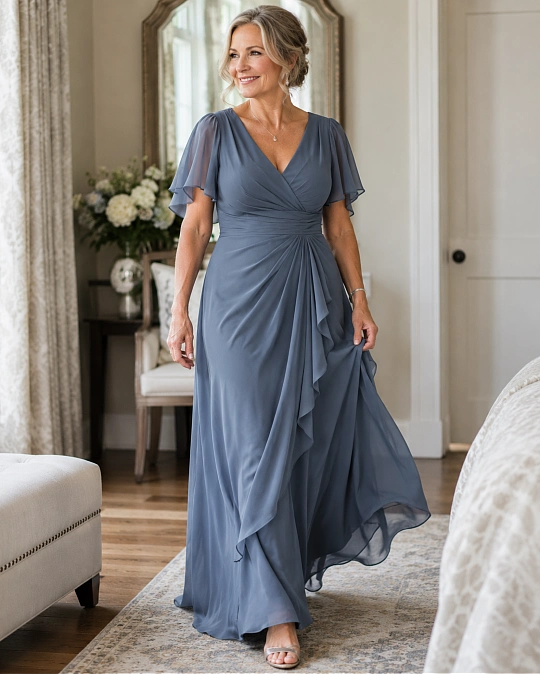
The best mother-of-the-bride dress is not simply the one that looks good while you stand still in a fitting room.
You may sit through the ceremony, climb steps, lean over tables, greet dozens of guests, appear in photographs from every angle, and spend time on the dance floor. Fit needs to work during all of it.
A-line dresses are popular because the shape gives some definition through the upper body while allowing movement through the skirt. A straight column can look clean and modern when the fabric skims rather than grips.
A softly defined waist can also create structure without feeling restrictive. The important point is not where your waist “should” be. It is where the garment sits comfortably on your body.
Draping and ruching can be especially useful because they create movement rather than forcing the fabric to lie completely flat. Draping is also a noticeable direction in 2026 occasionwear, making it a good way to look current without choosing something overly trendy.
When trying on a dress, do more than look in the mirror:
- Sit in a chair for several minutes and check the waist and neckline.
- Raise your arms to make sure sleeves and armholes do not pull.
- Walk quickly enough to see how the hem behaves.
- Bend slightly to check neckline coverage.
- Take phone photos from the front, side, and back.
If a dress needs constant pulling, smoothing, or adjusting in the fitting room, it will probably become more annoying as the wedding day continues.
Fabric, Neckline, and Sleeves Can Change the Whole Look
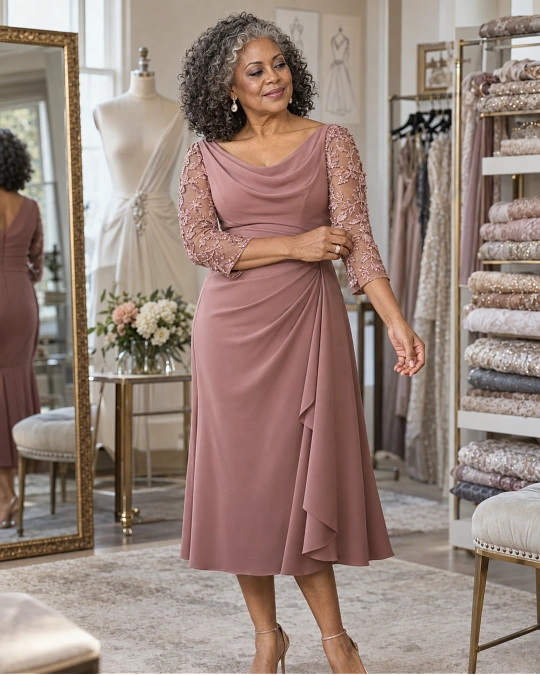
A simple dress in the right fabric often looks more polished than a complicated design made from fabric that pulls, wrinkles, or clings.
For formal weddings, crepe, satin, chiffon, georgette, lace, jacquard, and structured jersey can all work. The choice depends on the shape of the garment and the season.
Crepe has enough body to create clean lines. Chiffon gives movement. Satin catches light beautifully but can show every pull or crease, so construction matters.
Structured jersey can be very comfortable for long events, especially when it has enough weight to skim the body rather than cling.
Here is a quick fabric guide for shopping.
| Fabric or Detail | What to Look For |
|---|---|
| Crepe | Medium weight with enough structure to skim rather than collapse |
| Chiffon | A lined design with controlled volume instead of too many loose layers |
| Satin | Good drape and seams that lie flat without pulling |
| Lace | Modern placement or clean lining rather than excessive matching embellishment |
| Stretch jersey | Substantial fabric with recovery so knees and elbows do not bag |
| Beading or sequins | Smooth lining around the arms so embellishment does not scratch |
Sleeves are a preference, not an obligation. Short sleeves, flutter sleeves, sheer sleeves, elbow-length sleeves, sleeveless dresses, and one-shoulder designs can all look sophisticated.
A V-neck can lengthen the visual line of the upper body. A bateau neckline feels refined and gives more coverage. A soft scoop is often easy to wear with jewelry.
For something more current, an asymmetrical neckline or gentle off-the-shoulder shape can add interest without making the whole outfit depend on embellishment.
Coordinate With the Bridal Party Without Looking Like Another Bridesmaid
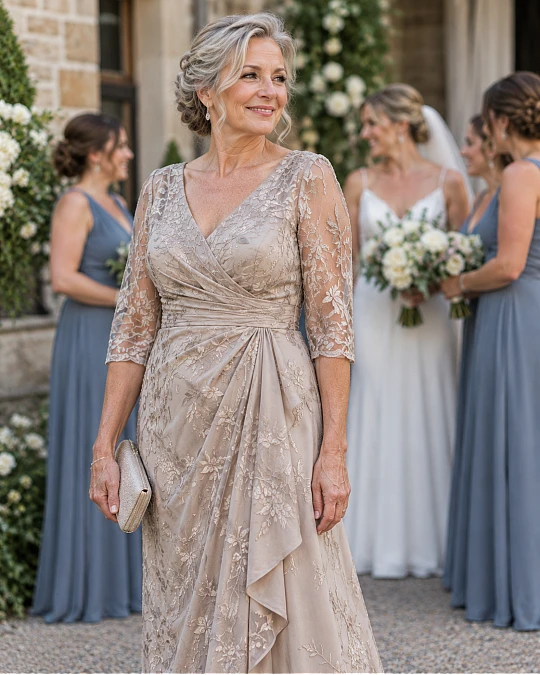
The mother of the bride does not normally need to match the bridesmaids exactly. In many weddings, looking coordinated rather than identical creates a more natural family photograph.
If the bridesmaids are wearing sage green, for example, you might consider navy, dusty blue, plum, champagne pink, deeper green, or another shade that works beside the palette.
Ask the couple before assuming there is a required color. Some brides have a very specific vision, while others would rather their mothers choose something they genuinely love.
White, ivory, and very pale bridal-looking shades are generally best discussed with the couple first. Black can work beautifully, particularly at formal evening weddings, and current etiquette does not treat it as automatically inappropriate.
Think about photographs as well as the room itself.
A color does not have to match the flowers or bridesmaids. It simply needs to sit comfortably beside them without competing for attention.
This approach can make choosing a palette easier:
| If the Wedding Palette Includes | Consider for the Mother of the Bride |
|---|---|
| Sage, eucalyptus, soft greens | Navy, deep teal, dusty blue, plum |
| Blush, rose, champagne | Mauve, berry, navy, soft metallics |
| Burgundy, rust, autumn tones | Forest green, navy, aubergine, bronze |
| Blue bridesmaid dresses | Plum, silver-grey, navy, soft rose |
| Mostly neutrals | Jewel tones, muted metallics, deep blue or green |
Color note: You do not need to choose the palest shade available just because you are part of the wedding family. A rich color can be very elegant and often photographs beautifully.
Keep Jewelry, Shoes, and the Bag in Supporting Roles
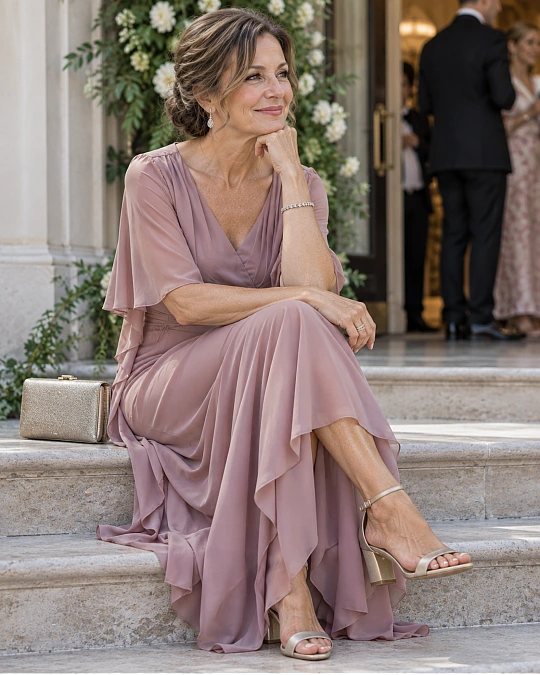
Once the dress has enough presence, accessories do not need to prove anything.
If your gown has beading, draping, lace, or an interesting neckline, simple earrings may be all it needs. With a clean column dress, you have more room for a stronger earring, bracelet, or clutch.
Choose one area to carry the detail rather than adding sparkle everywhere.
Shoes deserve extra attention because wedding days are long. A slightly lower heel, block heel, slingback, dressy flat, or stable kitten heel can look polished without making the reception feel like an endurance test.
If you want height but struggle with narrow heels, look at the shape of the heel rather than giving up height entirely. A wider heel usually gives more stability on grass, stone paths, and long reception floors.
Comfort upgrade: Break the shoes in before the wedding and test them with the exact hem length of your outfit.
Also think about the bag early. A small structured clutch or compact shoulder bag can carry your phone, lipstick, tissues, and other essentials without becoming part of every photograph.
Small Alterations Can Make an Ordinary Dress Look Custom
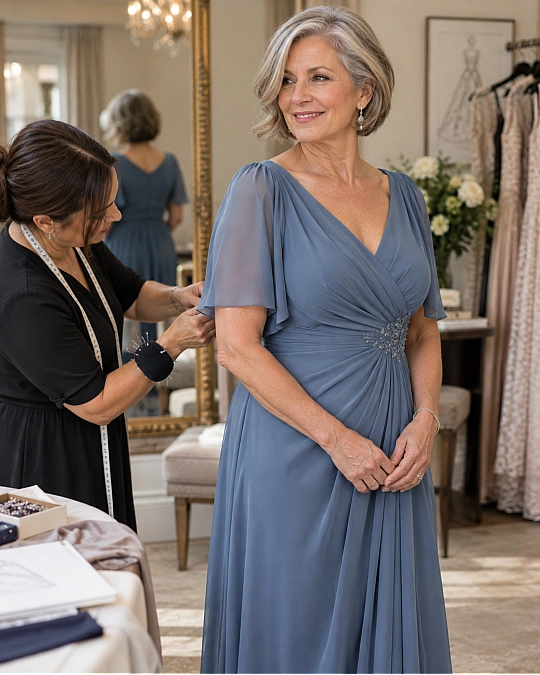
Fit often matters more than the price tag.
A dress can be lovely on the hanger but still feel wrong because the shoulder sits half an inch too wide, the waist hits slightly low, or the hem interrupts the best part of your leg.
Those are tailoring problems, not signs that your body is difficult to dress.
Hem length deserves special attention. With a long gown, bring the shoes you plan to wear when the hem is pinned. With a midi dress, try slightly different lengths before cutting because a few inches can change the whole proportion.
The same goes for sleeve length. A bracelet-length sleeve often looks more intentional than a sleeve that simply stops at an awkward point on the forearm.
If something feels almost right, these swaps often work better than abandoning the whole style:
| Instead of This | Try This |
|---|---|
| Tight waist that needs constant adjusting | A softly shaped waist or gentle draping |
| Very stiff jacket over a formal dress | A softer cropped jacket or elegant wrap |
| Heavy head-to-toe embellishment | One embellished area with the rest kept clean |
| Floor-length gown for an outdoor garden event | A midi or lighter maxi with easier movement |
| Thin high heel you rarely wear | Block heel, slingback, kitten heel, or dressy flat |
Plan the final fitting early enough to make changes calmly. Your full try-on should include your dress, underwear, shapewear if you use it, shoes, jewelry, and jacket or wrap.
That final combination matters more than judging every item on its own.
A Reliable Mother-of-the-Bride Formula When You Feel Overwhelmed
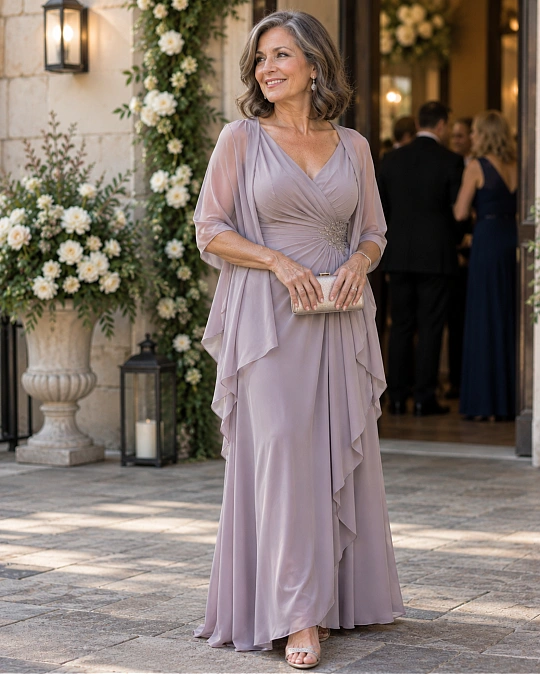
Shopping becomes much easier when you stop looking for “the perfect mother-of-the-bride dress” and start looking for a formula.
Formula: beautifully fitted midi or long dress + one refined accessory + comfortable dress shoe
The dress supplies the shape. The accessory gives the outfit personality. The shoe keeps the whole look realistic for a long day.
For a formal evening wedding, that might mean a navy draped gown, sculptural earrings, and a low metallic heel.
For a garden wedding, it could be a soft floral midi, simple gold earrings, and a block-heel slingback.
A dressy jumpsuit works through the same formula. Choose fluid trousers, a defined upper half, one strong accessory, and a shoe that keeps the trouser hem just clear of the floor.
This is also useful when shopping for elegant outfits for women over 50 beyond the wedding itself. The pieces feel special because of their fit and finish, not because they follow a narrow definition of “mother-of-the-bride fashion.”
Frequently Asked Questions
Does the mother of the bride have to wear a long dress?
No. Dress length should follow the formality of the wedding rather than your role alone.
A floor-length gown usually suits black-tie events, while cocktail, garden, and semi-formal weddings often work well with midi or tea-length dresses.
What color should the mother of the bride wear?
There is no single required color. Choose something that works beside the wedding palette and bridesmaid dresses without needing to match them exactly.
If you are considering white, ivory, champagne, or another bridal-looking shade, check with the couple first.
Can the mother of the bride wear a jumpsuit?
Yes. A dressy jumpsuit can be sophisticated enough for many weddings.
Look for fluid trousers, a defined or well-cut bodice, quality fabric, and enough length to create a long, clean line.
Should the mother of the bride match the mother of the groom?
They do not need matching outfits. It can help to share basic information about formality, length, and color so neither person is surprised on the wedding day.
Coordination is useful; identical dressing is not necessary.
How can I look modern without choosing something too trendy?
Start with a clean silhouette and add one current detail, such as draping, an asymmetric neckline, interesting sleeves, or modern earrings.
That keeps the outfit fresh while avoiding a look that depends on several short-lived trends at once.